
Researchers at Los Alamos National Laboratory (LANL) and Cornell University have published an analytical and numerical framework demonstrating that intermediate many-body states prepared during dynamical quantum simulations can be repurposed to interrogate quantum information metrics. In a preprint titled Dynamical quantum simulations as laboratories for quantum information, the team analyzed local-pulse protocols traditionally executed on quantum hardware to calculate retarded spin Green functions and inelastic neutron scattering dynamical structure factors. By reframing opposite local spin rotations as the encoding of a classical bit or a continuous parameter into evolving many-body states, the study tracks how quantum information propagates, reorganizes across spatial partitions, and responds to physical measurement constraints in 50-spin XX and XXX (isotropic Heisenberg) chains.
LANL and Cornell Researchers Demonstrate Extraction of Quantum Information Structures from Condensed-Matter Dynamical Simulations
Researchers at Los Alamos National Laboratory (LANL) and Cornell University have published an analytical and numerical framework demonstrating that intermediate many-body states prepared during dynamical quantum simulations can be…
Quantum Computing Report
Publisher
Oct 29, 2026 at 1:23 AM UTC · Updated 17 saat önce · 3 dk okuma
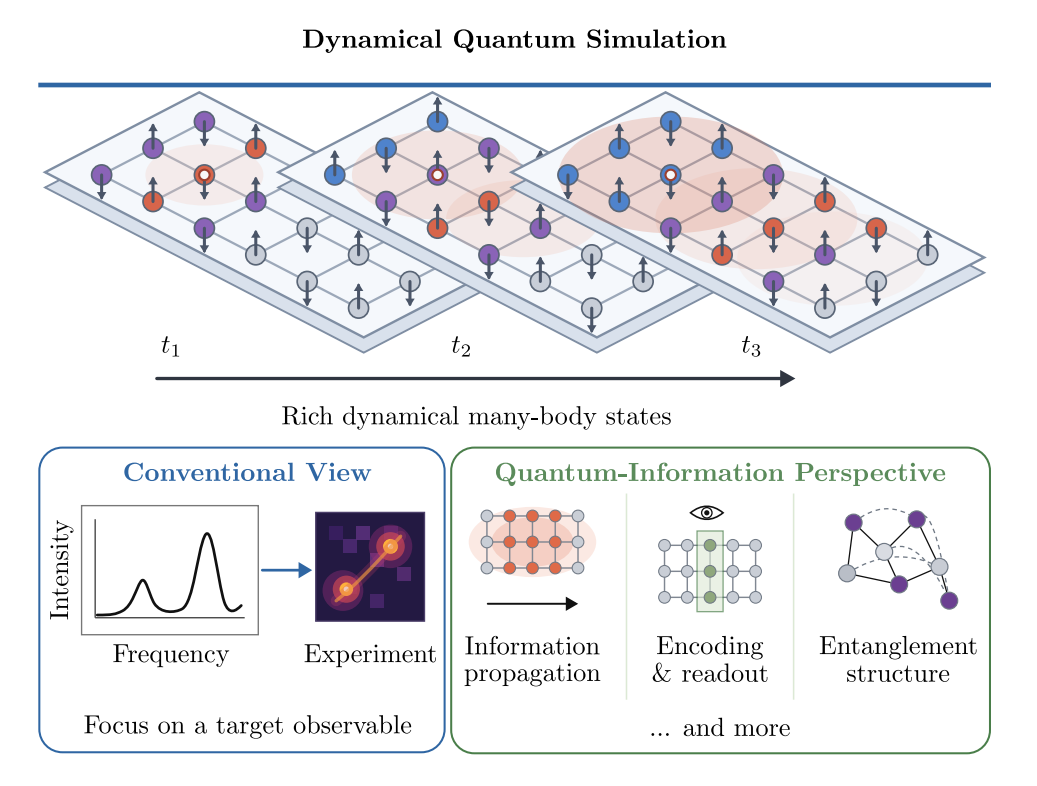
Information Propagation, Representation-Readout Inversion, and Multipartite Entanglement
The investigation establishes that conventional local response functions capture only a restricted projection of the underlying quantum record. As the spatial observation aperture expands from a single site (k = 1) to seven sites (k = 7), the trace distance ΔR and Holevo information χR reveal persistent multi-site correlations that remain present even when local single-spin response functions vanish. A central finding is an inversion between mathematical representation complexity and physical measurement efficiency: while the free-fermionic XX chain admits an exact, compact description via two-point fermionic covariance matrices, simple product-Pauli spin measurements recover a larger fraction of available distinguishability, Holevo information, and quantum Fisher information (QFI) in the strongly interacting XXX chain. Furthermore, the prepared dynamical states allow direct certification of evolving quantum resources, demonstrating that localized perturbations reduce internal entanglement while establishing genuine five-partite entanglement across spatial blocks.
Article Intelligence
Related Coverage
 QuantumAsian Cybersecurity in the Age of AI and Quantum Computing7 saat önce · 1 min read
 QuantumUbiQD secures $200,000 grant to advance novel light source for quantum computing7 saat önce · 1 min read
 QuantumFederal security leaders team up as post-quantum deadlines tightenbir saat önce · 1 min read
Sponsored
Ad
NewsLayer Premium
Unlock deeper intelligence.
Ad-free reading, exclusive research, and real-time onchain insights.
Go Premium