
Insider Brief
New X-ray Technique Helps Scientists Watch Quantum Materials Respond to Laser Pulses
Insider Brief PRESS RELEASE — Creating a quantum device often begins by intentionally damaging a crystal. Scientists fire an ultrafast laser pulse into a material, knocking atoms out of place and leaving behind tiny imperfections called…
Matt Swayne
Publisher The Quantum Insider
Oct 7, 2026 at 10:28 AM UTC · 6 dk okuma
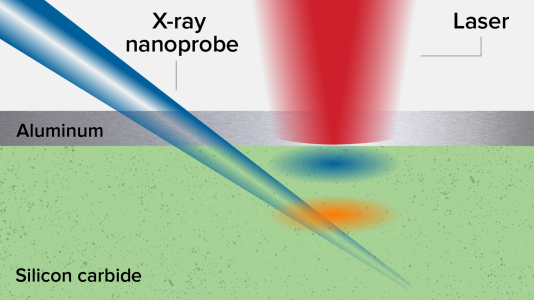
- Argonne researchers developed an X-ray imaging technique to track silicon carbide’s response to ultrafast laser pulses, providing insights that could improve the precision of creating quantum defects.
- The measurements revealed energy moving through the crystal as fast mechanical waves and more slowly dispersing heat, capturing changes across its surface and into its interior.
- The technique could help researchers refine laser conditions to create more reliable defects for use as qubits, though precise placement remains a long-term goal.
- Image: In a new technique developed at Argonne, an X-ray beam is directed at silicon carbide at a controlled time after the material is struck by a pulse of laser light. The X-ray acts like a camera, letting scientists see in real time how the material responds to the laser. (Haidan Wen/Argonne National Laboratory)
PRESS RELEASE — Creating a quantum device often begins by intentionally damaging a crystal.
Scientists fire an ultrafast laser pulse into a material, knocking atoms out of place and leaving behind tiny imperfections called vacancies. Far from being flaws, these vacancies can behave as qubits — the fundamental building blocks of quantum information.
Article Intelligence
Topics
Related Coverage
 QuantumSuperconducting circuit links smaller photon groups into larger entangled states6 saat önce · 1 min read
 QuantumLight reads electron spins inside porous crystals, opening path to quantum chemical sensors3 saat önce · 1 min read
 Quantum5 Big Things To Know About Post-Quantum Security In 20263 saat önce · 7 min read
Sponsored
Ad
NewsLayerLearn more
NewsLayer Premium
Unlock deeper intelligence.
Ad-free reading, exclusive research, and real-time onchain insights.
Go Premium