
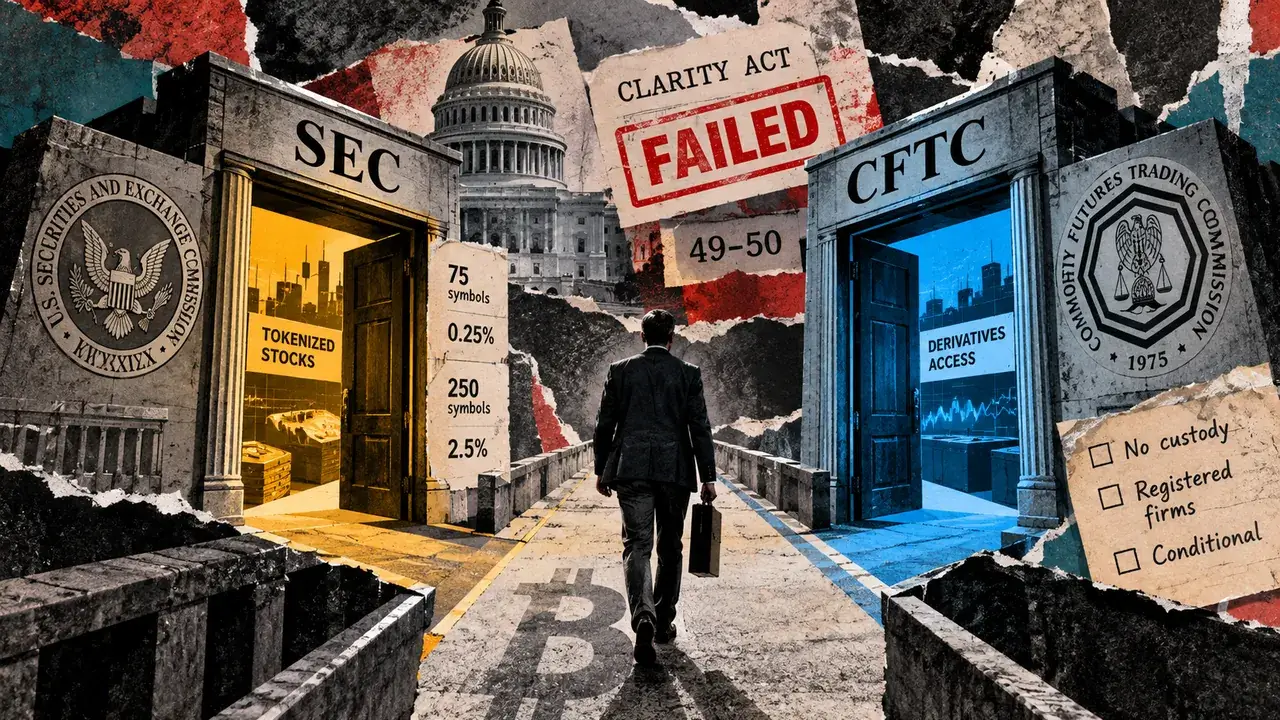
Two days after the US Senate failed to advance the CLARITY Act, federal regulators opened two narrower routes for crypto-linked market access under existing law.
SEC and CFTC bypass Congress to open crypto access after CLARITY fails – with a catch
Two days after the US Senate failed to advance the CLARITY Act, federal regulators opened two narrower routes for crypto-linked market access under existing law.
CryptoSlate
Publisher
Sep 18, 2026 at 12:46 PM UTC · 6 dk okuma
Çevriliyor…
The Securities and Exchange Commission created a five-year path for permissioned venues to trade tokenized US stocks through automated market makers. The Commodity Futures Trading Commission broadened staff no-action relief so qualifying software providers can connect users to regulated derivatives markets without registering as introducing brokers for the covered activity.
The actions can support real products, but they do not recreate market-structure legislation. The SEC route is capped and conditional. The CFTC route still relies on registered derivatives firms for onboarding, trading and custody, and it rests on a staff position that can change.
The SEC turns existing authority into a five-year test
The timing was direct. On Sept. 15, senators voted 49-50 against cloture on the motion to proceed to H.R. 3633, according to the official roll call. That was a procedural failure to advance the CLARITY Act, not a final vote on the bill's merits.
On Sept. 17, SEC Chairman Paul Atkins connected the congressional setback to the Commission's next move. In a statement accompanying the Innovation Exemption, Atkins said the agency was acting within its existing statutory authority. He also characterized the exemption as a bridge that should be followed by durable rulemaking.
Article Intelligence
Regulation Signal
in progressUpdated bir ay önce
SEC Crypto Asset Market Structure RulemakingRelated Coverage
 PolicyCongress stalls, so the CFTC routes its crypto rulebook through the White House3 saat önce · 1 min read
 PolicySEC Moves Forward Despite Clarity Act Stalling, Says Bitfinex40 dakika önce · 1 min read
 CryptoBitcoin Reclaims $80,000 As CFTC Files Crypto Rulesbir saat önce · 1 min read
Sponsored
Ad
NewsLayerLearn more
NewsLayer Premium
Unlock deeper intelligence.
Ad-free reading, exclusive research, and real-time onchain insights.
Go Premium