

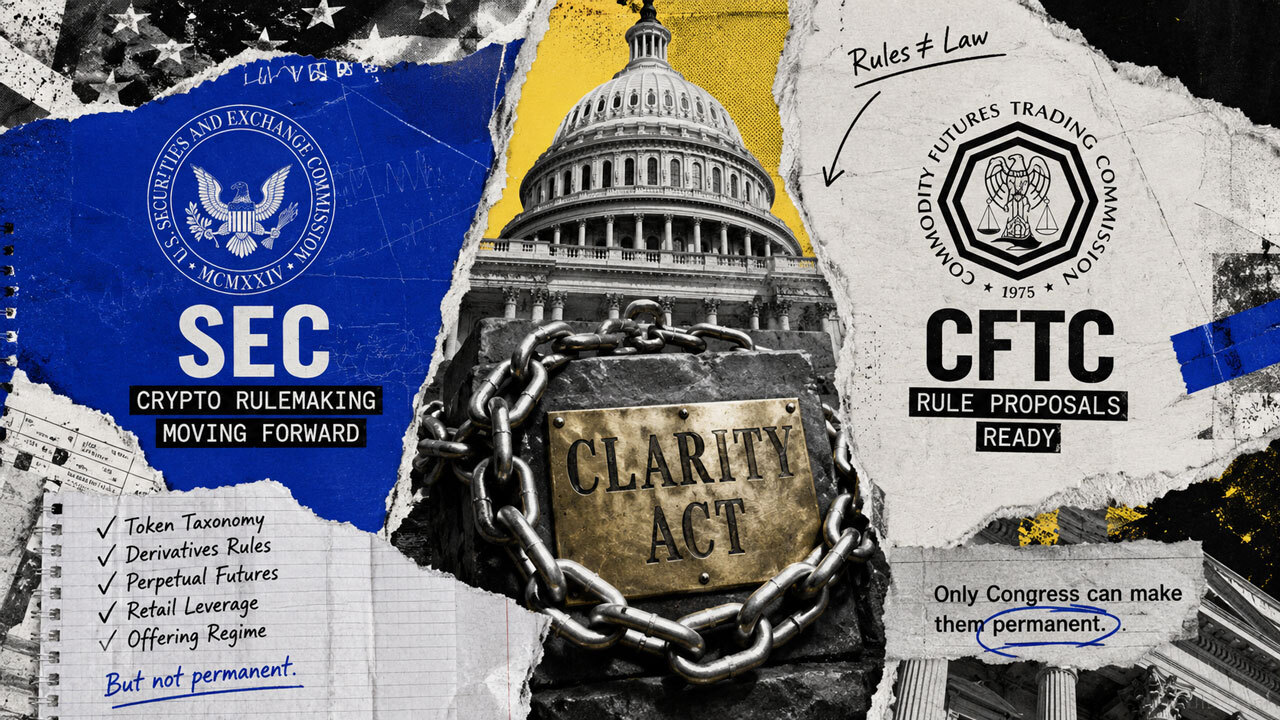
CFTC Chair Michael Selig said on Aug. 4 that the agency has crypto rule proposals ready and plans to finalize them before the current administration ends, regardless of whether Congress passes the CLARITY Act.
SEC and CFTC plans to write crypto rules without Congress - but they can’t make them permanent
CFTC Chair Michael Selig said on Aug. 4 that the agency has crypto rule proposals ready and plans to finalize them before the current administration ends, regardless of whether Congress passes the CLARITY Act.
CryptoSlate
Publisher
Aug 12, 2026 at 12:30 PM UTC · 5 dk okuma
Key Signal
Aug. 4 CFTC rules ready
Last Updated
2 ay önce
Çevriliyor…
SEC Commissioner Hester Peirce has separately said the SEC can keep pursuing meaningful crypto rulemaking even if Congress fails to act.
The Senate left CLARITY untouched before its August recess, and Majority Leader John Thune has filed cloture on a motion to proceed, setting up a procedural vote around Sept. 15 that would require 60 votes to advance the bill.
The House already passed its own version of CLARITY, 294-134, last July.
| Track | What is happening | Timeline | Why it matters |
|---|---|---|---|
| CFTC | Says crypto rule proposals are ready and will move forward even without CLARITY | Aug. 4 onward | Shows regulators are not waiting for Congress |
| SEC | Says it can continue crypto rulemaking if Congress fails to act | Ongoing | Builds a parallel regulatory path |
| Senate | CLARITY left until after recess; cloture vote expected | Around Sept. 15 | First major post-recess test; needs 60 votes |
| House | Passed its version of CLARITY 294-134 | July | Shows bipartisan momentum, but not final law |
| Market | Bitcoin remains legally clearer than most crypto assets | Current | BTC is less exposed than token issuers, exchanges, and DeFi |
What regulators are building without Congress
SEC Chair Paul Atkins unveiled the SEC's Regulation Crypto Assets framework in March and said only Congress can ensure regulation in this area is future-proofed, describing agency rulemaking as merely a head start on legislation.
He made the same point in November 2025, saying there is no stronger tool for future-proofing crypto regulation than statutory language from Congress.
The SEC and CFTC already issued a joint interpretation in March stating that most crypto assets are not themselves securities, along with a token taxonomy covering staking, mining, wrapping, and airdrops.
Market Context
Bitcoin
BTC
$84,765
+0.17% (24H)
Market Cap
$1.70T
Circulating Supply
20.1M BTC
24H Volume
$14.6B
24H High
$85,026
Article Intelligence
Regulation Signal
in progressUpdated 2 ay önce
SEC Crypto Asset Market Structure RulemakingRelated Coverage
 CryptoCOIN and CRCL Stock Outlook as ICBA Sues OCC For Issuing Bank Charters to Crypto Companies2 saat önce · 1 min read
 CryptoAdam Livingston: Bitcoin treasury debates preferred dividends and risk levels4 saat önce · 1 min read
:quality(82)/3ad453c2be014a8bb923ae8c0631e2f3) CryptoCommunity Bankers Sue OCC Over Crypto Firms' National Trust Charters4 saat önce · 1 min read
CryptoCommunity Bankers Sue OCC Over Crypto Firms' National Trust Charters4 saat önce · 1 min readSponsored
Ad
NewsLayerLearn more
NewsLayer Premium
Unlock deeper intelligence.
Ad-free reading, exclusive research, and real-time onchain insights.
Go Premium