logo
  • Consent
  • Details
  • [#IABV2SETTINGS#]
  • About
This website uses cookies
We use cookies to personalise content and ads, to provide social media features and to analyse our traffic. We also share information about your use of our site with our social media, advertising and analytics partners who may combine it with other information that you’ve provided to them or that they’ve collected from your use of their services.
[#GPC_BANNER_ICON#]
[#GPC_TOAST_TEXT#]
Consent Selection
Show details
Details
  • Necessary cookies help make a website usable by enabling basic functions like page navigation and access to secure areas of the website. The website cannot function properly without these cookies.
    • Pexels
      1
      Learn more about this provideropens in a new window
      _cfuvidThis cookie is a part of the services provided by Cloudflare - Including load-balancing, deliverance of website content and serving DNS connection for website operators.
      Maximum Storage Duration: SessionType: HTTP Cookie
    • ambcrypto.com
      benzinga.com
      bitcoinmagazine.com
      coingape.com
      decrypt.co
      image.coinpedia.org
      pexels.com
      7
      __cf_bm [x7]This cookie is used to distinguish between humans and bots. This is beneficial for the website, in order to make valid reports on the use of their website.
      Maximum Storage Duration: 1 dayType: HTTP Cookie
    • newslayer.com
      1
      CookieConsentStores the user's cookie consent state for the current domain
      Maximum Storage Duration: 1 yearType: HTTP Cookie
  • Preference cookies enable a website to remember information that changes the way the website behaves or looks, like your preferred language or the region that you are in.
    • We do not use cookies of this type.

  • Statistic cookies help website owners to understand how visitors interact with websites by collecting and reporting information anonymously.
    • We do not use cookies of this type.

  • Marketing cookies are used to track visitors across websites. The intention is to display ads that are relevant and engaging for the individual user and thereby more valuable for publishers and third party advertisers.
    • We do not use cookies of this type.

  • Unclassified cookies are cookies that we are in the process of classifying, together with the providers of individual cookies.
    • newslayer.com
      3
      __emg_sidPending
      Maximum Storage Duration: 1 dayType: HTTP Cookie
      __emg_vidPending
      Maximum Storage Duration: 1 yearType: HTTP Cookie
      nl-read-countPending
      Maximum Storage Duration: PersistentType: HTML Local Storage
Cross-domain consent[#BULK_CONSENT_DOMAINS_COUNT#]
[#BULK_CONSENT_TITLE#]
List of domains your consent applies to: [#BULK_CONSENT_DOMAINS#]
Cookie declaration last updated on 8/12/26 by Cookiebot
[#IABV2_TITLE#]
[#IABV2_BODY_INTRO#]
[#IABV2_BODY_LEGITIMATE_INTEREST_INTRO#]
[#IABV2_BODY_PREFERENCE_INTRO#]
[#IABV2_BODY_PURPOSES_INTRO#]
[#IABV2_BODY_PURPOSES#]
[#IABV2_BODY_FEATURES_INTRO#]
[#IABV2_BODY_FEATURES#]
[#IABV2_BODY_PARTNERS_INTRO#]
[#IABV2_BODY_PARTNERS#]
About
Cookies are small text files that can be used by websites to make a user's experience more efficient.

The law states that we can store cookies on your device if they are strictly necessary for the operation of this site. For all other types of cookies we need your permission.

This site uses different types of cookies. Some cookies are placed by third party services that appear on our pages.

You can at any time change or withdraw your consent from the Cookie Declaration on our website.

Learn more about who we are, how you can contact us and how we process personal data in our Privacy Policy.

Please state your consent ID and date when you contact us regarding your consent.
NewsLayer

Install NewsLayer

Get the app experience — one tap from your home screen, instant loads and breaking-news alerts.

NewsLayer.com
LatestDaily BriefMarkets
NewsLayer PulseLIVE₿BTC$64,153+0.90%ΞETH$1,896-0.34%◎SOL$76.14+0.79%✕XRP$0.9978-0.19%ÐDOGE$0.0698-0.53%₳ADA$0.1749+0.47%Total Cap$2.29T+0.36%24H Vol$215.2BLayer Index47 Neutral
Quantum
External ReportingYayınlandı bir saat önce

The global race to make a practical quantum computer just took a big leap forward

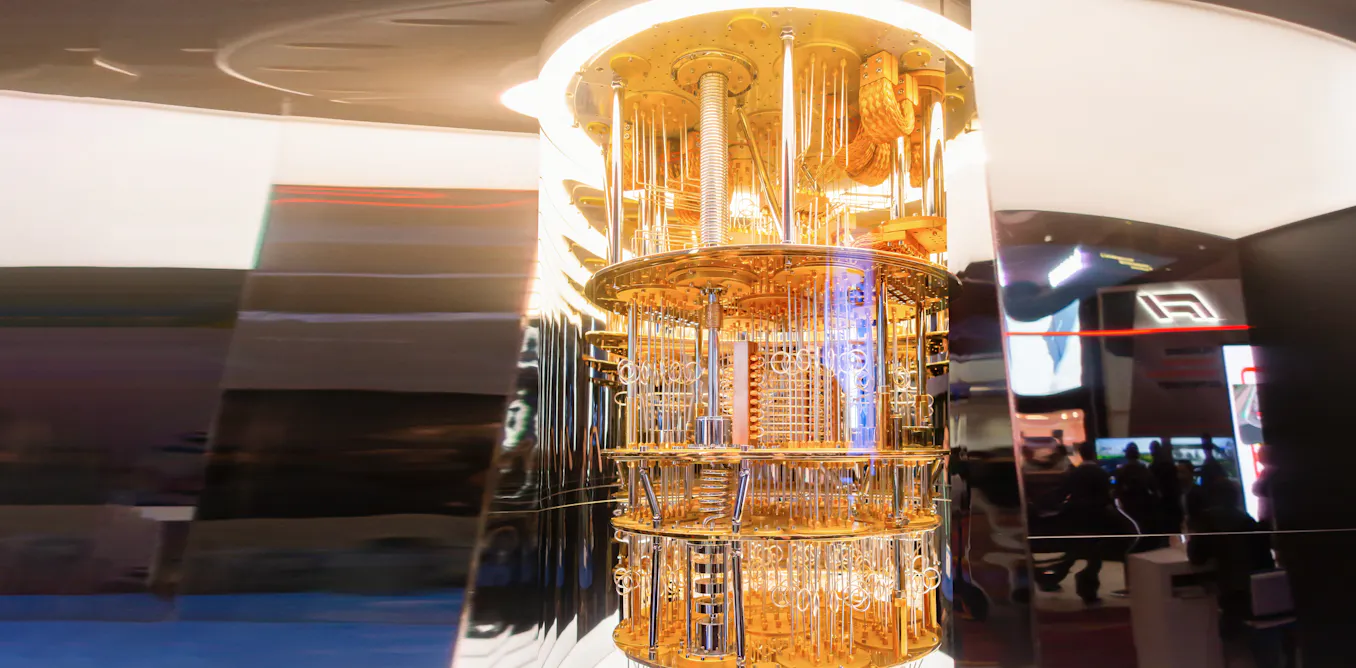
In the global race to build bigger and better quantum computers, researchers have taken a step forward. A new machine called Helios is a radically different system compared to other quantum computers.

The global race to make a practical quantum computer just took a big leap forward
Publisher The Conversation 4 dk okuma
Image via The Conversation
Çevriliyor…

Market Context

Total Market Cap$2.29T+0.36%
24H Volume$215.2B
BTC Dominance56.2%

Updated 7 dakika önce

Layer Index

47

Neutral

Layer Index

↑ 3 pts in 24h

In the global race to build bigger and better quantum computers, researchers have taken a step forward. A new machine called Helios is a radically different system compared to other quantum computers.

Quantum computers harness the power of quantum mechanics, the laws that govern how physics operates at atomic and sub-atomic scales. Among various designs for such machines, Helios is a trapped-ion quantum computer, which means it uses charged atoms suspended in free space using electromagnetic fields.

It operates using 98 qubits – the units of information that a quantum computer uses to process data. This number of qubits makes it the largest trapped-ion quantum computer built so far. Quantinuum, the company behind the device, which is based in Cambridge, UK and Broomfield, Colorado, demonstrated earlier machines operating on 32 qubits in 2023 and 56 qubits in 2025.

Helios and its predecessors use an architecture (or operational structure) with separate regions for storing and processing quantum information. The architecture is called a QCCD (quantum charge-coupled device) and was invented in 2002. This is akin to the architecture of classical computers that have a memory for storage (hard disk drives, solid state drives) and a separate processor (CPU, GPU).

The specific geometry of Helios resembles a rosette, with the ring for storage and two streamers for processing. The crucial element is the four-way X junction where they meet. A QCCD physically transports the charged objects (the ions) from the storage to the processing regions electrically.

The processing is done using laser pulses. This requires a quantum algorithm to be broken up into ion transport and quantum processing. This differs substantially from other quantum computing architectures such as superconducting qubits, where the qubits are fixed in space, and processing is executed by electrical signals switched on and off in time.

Reach crypto's most engaged readers — advertise mid-article on NewsLayer
Sponsored

Reach crypto's most engaged readers — advertise mid-article on NewsLayer

NewsLayer

Ad

Error correction

Classical charge-coupled devices, the template for the types now used in Helios, were the central component in early digital cameras. There are three main advantages to now using these in quantum computation.

Gates are the fundamental building blocks of quantum circuits, which operate on qubits. One advantage of the QCCD approach is that gates operating on certain qubits do not affect their neighbours. This reduces a phenomenon known as “crosstalk”, leading to better quality performance.

The second advantage is the ability to measure and reset qubits during a computation. This enables inevitable errors in the computation to be detected and corrected at the earliest possible time, again improving performance.

Finally, as qubits can be accessed from and returned to very different parts of the memory after processing (within limitations), distant qubits can be connected, leading to more efficient operation.

The Helios device demonstrated all the above advantages. It relies on two major advances – one in hardware and one in software. First, the four-way X junction lets the system handle several tasks at once rather than one at a time, which is much faster. That was impossible in earlier QCCD machines, which could only move data back and forth in a single line or loop.

Secondly, judicious use of the freedom offered by the two dimensions of the X junction relies on a new classical control software called Helios runtime which plans the smartest, fastest route for moving and processing the data.

Together, these represent a substantial advance in the engineering of quantum computers. An important consequence is that Helios can perform computations that cannot be performed even on the largest supercomputers using known methods within reasonable amounts of time and power consumption.

Computational prowess

It shows the ability of this device, and its successors, in surpassing the computational prowess of classical computers – albeit their algorithms and hardware are rapidly advancing too.

Having said that, Helios’ computations have just been random benchmark tests, so the practical importance of this leap forward is still limited. To perform quantum computations of practical importance from areas of science and commerce, even the most optimistic estimates suggest that quantum computers must be enormously bigger and better – of the order of a million qubits.

The UK National Quantum Strategy Mission 1 proposes to have a fault-tolerant quantum computer (FTQC) with a trillion operations. For reference, the longest computation Helios ran had about 4,000 operations operating on 98 qubits.

Building FTQCs out of the Helios device, or any other known architecture or system for that matter, remains a formidable challenge. As the numbers suggest, it would require connecting thousands of QCCD devices, each with thousands of qubits, via quantum links.

Visions exist for QCCD devices with a two-dimensional grid layout resembling city streets that can operate on thousands or more qubits. The inevitable challenge of engineering and operating such a system with an immense number of junctions and concomitant qubit-jams – akin to traffic jams – is yet to be encountered, let alone overcome. The physical transporting of qubits is also a very slow process because it uses very precise voltages, and this will only grow with larger devices and more qubits.

As of now, the Helios device is an exciting advance in the field of quantum computing. Whatever form the FTQCs of the future take, they will involve imaginatively engineered quantum hardware devices assisted by smart software.

Son Dakika

Hiçbir son dakika haberini kaçırmayın

X'te Takip Et Telegram'a Katıl

Advertisement

House — Advertise on NewsLayer
NewsLayerAd
#quantum

Sourced by

Originally reported by The Conversation

NewsLayer coverage based on externally reported material.

The Daily Brief

The onchain economy, before your day starts.

Curated markets, onchain insights, and key headlines — delivered every weekday morning.

Weekdays · Free · ~5 minute read

Market Context

Total Market Cap$2.29T+0.36%
24H Volume$215.2B
BTC Dominance56.2%

Updated 7 dakika önce

Layer Index

47

Neutral

Layer Index

↑ 3 pts in 24h

Son Dakika

Hiçbir son dakika haberini kaçırmayın

X'te Takip Et Telegram'a Katıl

Advertisement

House — Advertise on NewsLayer
NewsLayerAd

İlgili Haberler

Quantum Computer Solves a Problem in 15 Minutes That Classical Methods Can’t Practically ComputeQUANTUM SPEEDRUN

Quantum Computer Solves a Problem in 15 Minutes That Classical Methods Can’t Practically Compute

Quantum Computer Solves a Problem in 15 Minutes That Classical Methods Can’t Practically Compute SciTechDaily

14 saat önce

4 dk okuma
Quanta Computer Will Scale Up Quantinuum’s Quantum SystemsQUANTA GOES QUANTUM

Quanta Computer Will Scale Up Quantinuum’s Quantum Systems

Quanta Computer Will Scale Up Quantinuum’s Quantum Systems Quantum Zeitgeist

18 saat önce

2 dk okuma
Bluefors Dilution Refrigerator Market Expands With Quantum Computer ScalingQUANTUM DEEP FREEZE

Bluefors Dilution Refrigerator Market Expands With Quantum Computer Scaling

The Bluefors dilution refrigerator market is expanding alongside the scaling of quantum computers. The growth reflects rising demand for ultra-low-temperature systems used in quantum computing development.

18 saat önce

2 dk okuma
What is Quantum Teleportation? How Quantum States Transfer Across DistanceQUANTUM LEAP EXPLAINED

What is Quantum Teleportation? How Quantum States Transfer Across Distance

Insider Brief Mention quantum teleportation in conversation and most people picture humans dissolving in one place and appearing somewhere else. Something from Star Trek, maybe with a dramatic sound effect. That is not what it does. What quantum teleportation transfers is the quantum state of a particle, specifically its spin, polarization, or energy level, to […]

4 gün önce

11 dk okuma
NewsLayer.com

The front page of the onchain economy. Crypto, Web3 and regulation intelligence — live prices, original research and policy tracking in one layer.

Follow on XTelegram

News

  • Latest News
  • The Daily Brief
  • Crypto
  • DeFi
  • Web3
  • Blockchain
  • Policy
  • Explainers

Markets & Tools

  • Market News
  • Live Charts
  • Layer Index
  • Regulation Tracker
  • Regulation Radar
  • Research
  • NewsLayer Originals
  • My Feed
  • Search

Company

  • About NewsLayer
  • Go Premium
  • Advertise
  • PR Publication
  • Become an Author
  • Create Account
  • Sign in

© 2026 NewsLayer.com — The front page of the onchain economy·Privacy Policy·Terms of Service

NewsLayer

Get the signal, not the noise.

Markets, regulation and onchain intelligence in a 5-minute morning read — plus breaking alerts and Layer Index flips as they happen.

The Daily Brief

Breaking alerts

Index flips

Free · No spam · Unsubscribe anytime