
Insider Brief
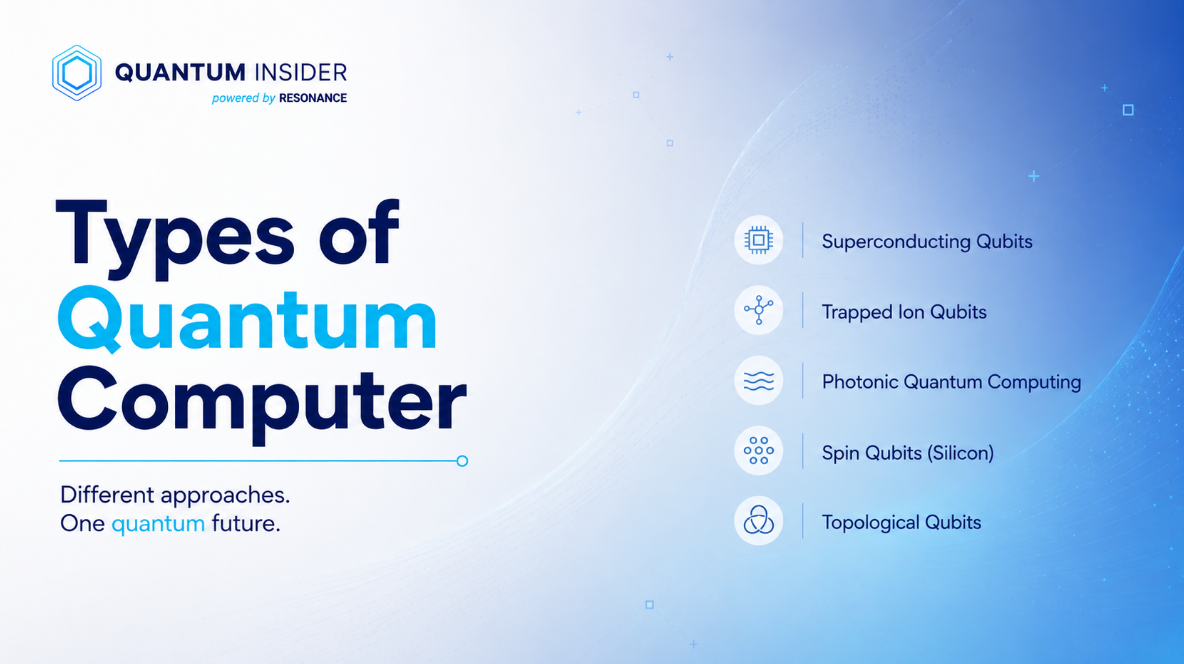
Types of Quantum Computers: 6 Major Quantum Computing Approaches
Insider Brief IBM and IonQ use very different physical systems to build quantum computers. IBM uses superconducting circuits that must be cooled to extremely low temperatures, while IonQ traps charged atoms using electromagnetic fields.…
Mohib Ur Rehman
Publisher The Quantum Insider
Aug 28, 2026 at 10:00 AM UTC · Updated 27 dakika önce · 10 dk okuma
Çevriliyor…
- Quantum computing hardware approaches vary widely, with superconducting, trapped-ion, photonic, neutral-atom, topological and annealing systems making different engineering trade-offs.
- Superconducting and trapped-ion systems are among the most commercially developed approaches, while neutral atoms and photonics are advancing toward larger-scale applications.
- Topological quantum computing remains experimental and contested, while quantum annealers target optimization problems rather than general-purpose quantum algorithms.
IBM and IonQ use very different physical systems to build quantum computers. IBM uses superconducting circuits that must be cooled to extremely low temperatures, while IonQ traps charged atoms using electromagnetic fields. Both approaches can create and control quantum states, but they come with different engineering challenges.
Building a useful qubit is difficult because it needs to maintain its quantum state, be controlled and measured accurately, and interact with other qubits. Different hardware approaches make different trade-offs to achieve these requirements.
That is why qubit count alone does not tell the full story. A system with 1,000 noisy qubits may be less useful for some tasks than a system with 50 more reliable qubits. Factors such as error rates, gate speed, coherence time, connectivity, and how easily the hardware can be manufactured also matter.
Article Intelligence
Topics
Sponsored
Ad
NewsLayerLearn more
NewsLayer Premium
Unlock deeper intelligence.
Ad-free reading, exclusive research, and real-time onchain insights.
Go Premium