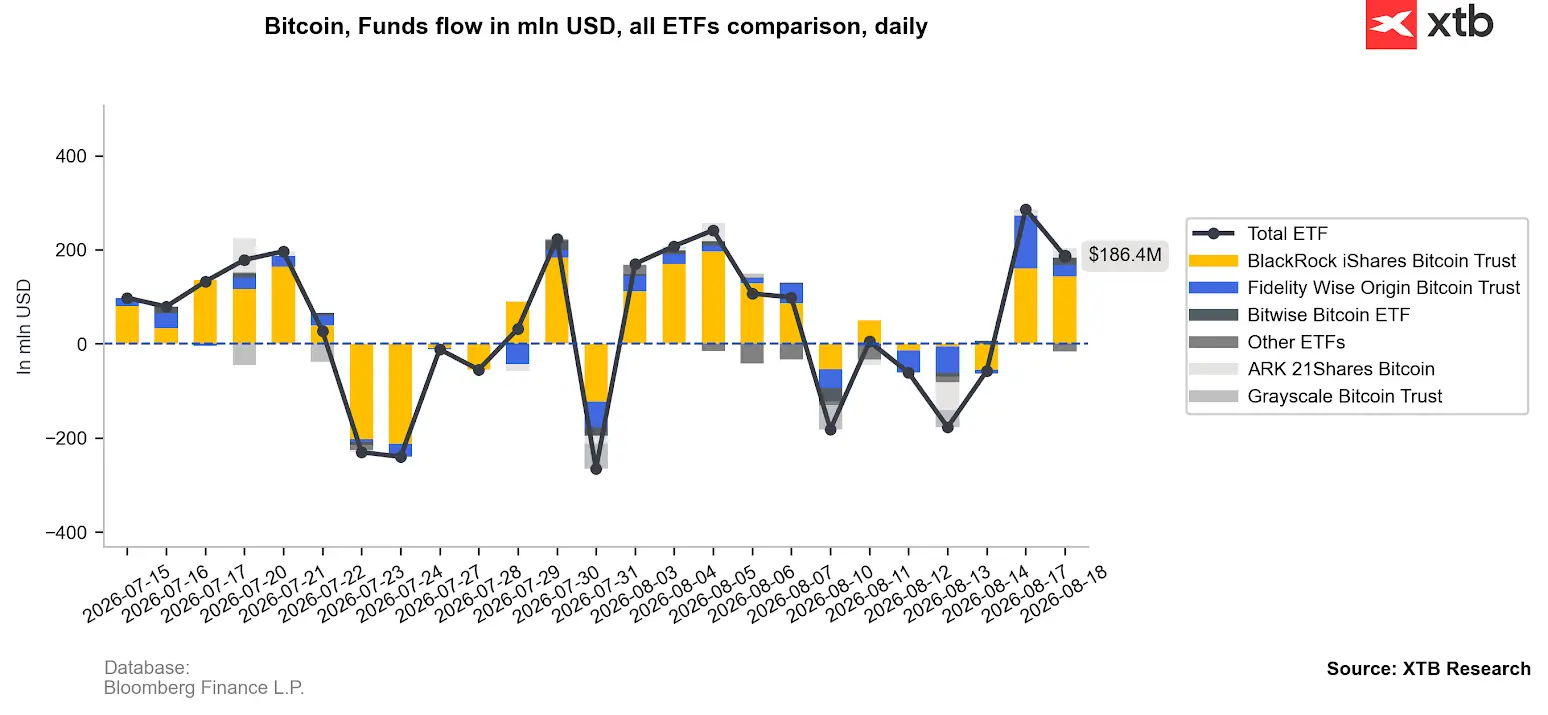
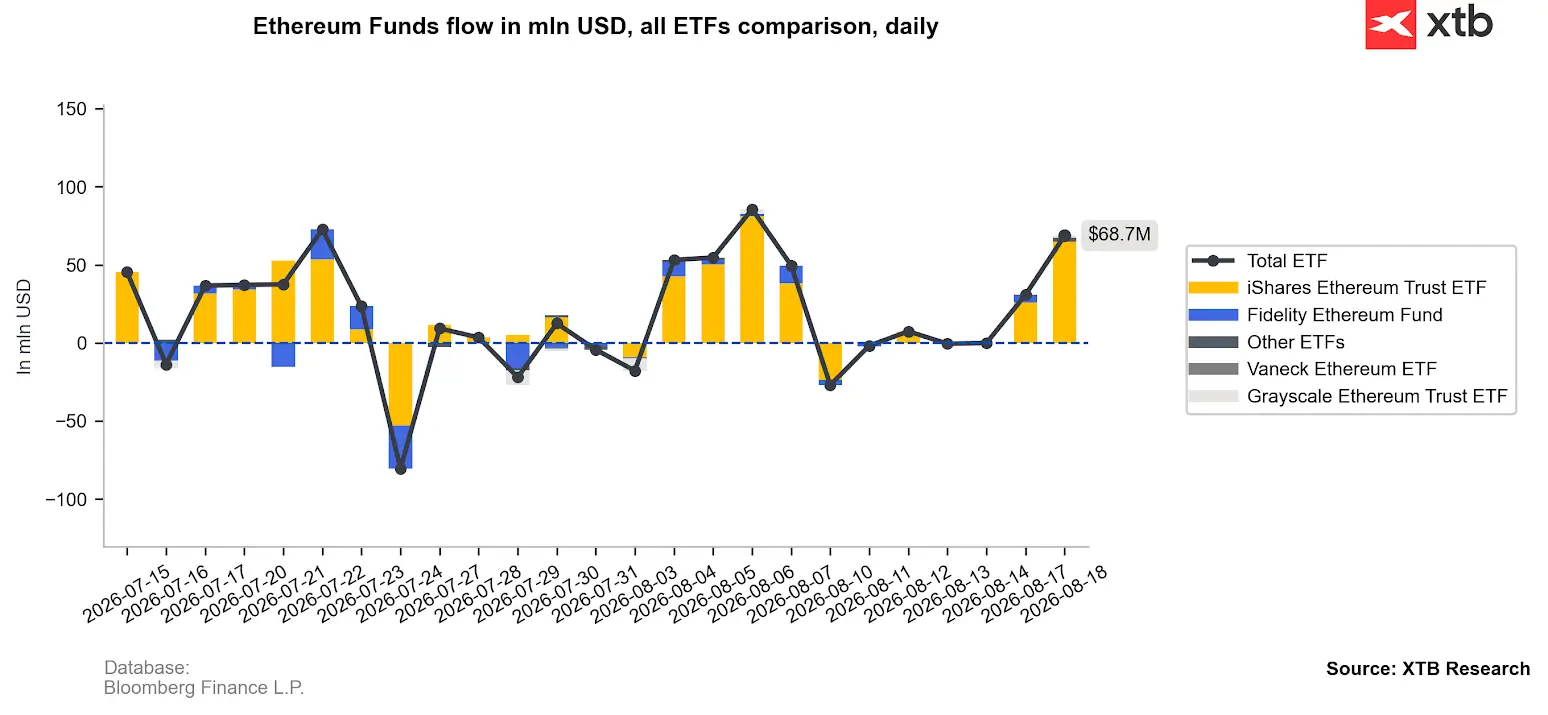
Ethereum ETF flows are significantly smaller than Bitcoin’s, but the latest sessions have also shown improvement. The most recent reading shows around USD 68.7 million in daily inflows, following roughly USD 30 million on Monday and an earlier period of mixed flows and occasional outflows. The iShares Ethereum Trust ETF accounts for the largest share of positive flows, while the remaining funds play a much smaller role. Importantly, over the past few months positive flows have increasingly appeared for several sessions in a row, which may indicate a gradual return of interest in Ethereum after a weaker start to August. The scale remains modest, but the direction of flows is clearly more constructive than it was a few weeks ago.
Source: XTB Research
Bitcoin demand is weakening
CryptoQuant, a firm specializing in on-chain data analysis, points to Bitcoin’s 30-day average Taker Buy Volume, which has fallen to levels seen previously at important points in the cycle. A decline in this indicator means lower activity from aggressive buyers and a stronger relative position for sellers. This does not automatically signal the beginning of a major sell-off. Similar readings have appeared during both capitulation and accumulation phases, but a more credible bottoming signal would require price stabilization alongside a rebound in Taker Buy Volume. For now, it is better interpreted as a sign of exhausted activity rather than confirmation of a trend reversal.
More than 2 million BTC changed hands in the USD 62,000–63,000 area, creating a large concentration of investor cost basis. Bitcoin unsuccessfully tried to stay above USD 65,000. At the same time, trading volume on major exchanges fell by around 10% over the past 24 hours, meaning the rebound is not being supported by particularly strong fresh demand. If the USD 62,000–63,000 zone holds, the market may still enter a stabilization phase. If it breaks under rising selling pressure, the next area in focus is around USD 54,276.
More than USD 200 million in crypto positions were liquidated over the past 24 hours, mostly longs. At the same time, Bitcoin open interest fell by around 0.53%, which, alongside a relatively stable price, may indicate partial short covering. This still does not mean that strong demand has returned. The Crypto Fear & Greed Index remains in fear territory, while crypto-related equities also came under pressure: Strategy fell by more than 5% yesterday, while Bitmine Immersion Technologies lost around 2.3%.
Bitcoin’s problem is only partly macroeconomic
Samsung Electronics and SK Hynix fell by more than 7% in Seoul, the Kospi lost around 6%, MSCI Asia Pacific declined by about 2%, and the Asian semiconductor index dropped by more than 3%. A day earlier, the Philadelphia Semiconductor Index fell by around 5%. Bonds may be even more important. The yield on 30-year U.S. Treasuries rose to its highest level since 2007, while the 10-year yield remained around 4.69%.
Such an environment raises the cost of capital and reduces the attractiveness of risk assets, even if it does not trigger an immediate price reaction. The market is also waiting for the minutes from the Fed’s July meeting and Kevin Warsh’s speech at Jackson Hole. According to a Reuters survey, 94 out of 104 economists expect the Fed to keep rates in the 3.5–3.75% range in September, while markets are pricing in around a 68% probability of no change.
Citi and Zhizao show the other side of the market?
Institutional adoption continues in the background despite the short-term weakness. Citi is preparing to launch a digital-asset custody service under its Custody+ platform, designed to bring traditional assets and cryptocurrencies into a single infrastructure. The bank is also developing tokenized deposits, cooperating with ICE, participating in a SWIFT pilot, and taking part in The Clearing House project.
At the same time, Nasdaq-listed Zhizao Technology completed a USD 154.7 million transaction and launched a Bitcoin treasury strategy covering 2,380 BTC. Bitcoin was valued at a reference price of USD 65,000 in the transaction. According to BitcoinTreasuries.net, the company became the 33rd-largest corporate holder of Bitcoin, although its shares did not respond positively. The stock remains down around 77% year to date.
Short-term demand for BTC is weakening, but the long-term infrastructure around Bitcoin continues to expand. The market failed to hold USD 65,000, on-chain data does not yet confirm a recovery in demand, and the macro backdrop remains unfavorable. That is why the behavior around USD 62,000 may matter more than any single daily rebound. Holding this support alongside an improvement in Taker Buy Volume would support an accumulation scenario, while a break below the zone under rising supply would significantly increase the probability of a deeper correction.
Ethereum and 20-day ETF flows – capital is rebuilding faster than price
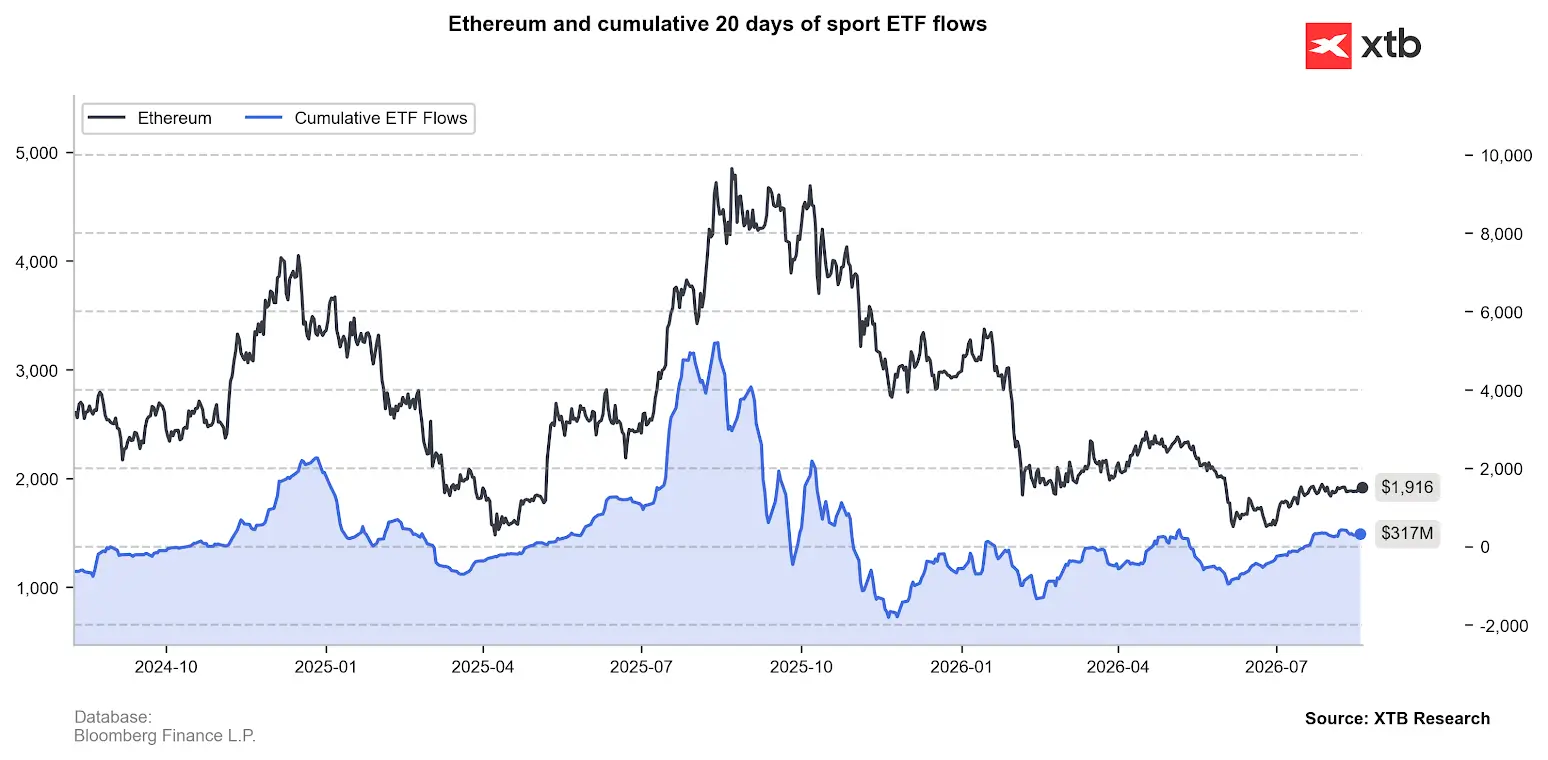
The most interesting signal comes from comparing Ethereum’s price with cumulative 20-day spot ETF flows. ETH remains close to USD 1,900, well below its 2025 highs, while the 20-day flow balance has climbed back to around USD 317 million. This points to an improvement in fund demand even though price itself has not yet confirmed a stronger uptrend. Historically, flows and price have tended to move in the same direction, although not always at the same time, which makes the current divergence worth watching. If positive inflows continue over the coming weeks, they could become an early sign of improving institutional demand, although for now this is not yet a confirmed signal of a lasting trend reversal.
Source: XTB Research