
This website uses cookies
We use cookies to personalise content and ads, to provide social media features and to analyse our traffic. We also share information about your use of our site with our social media, advertising and analytics partners who may combine it with other information that you’ve provided to them or that they’ve collected from your use of their services.
Consent Selection
Details
  • Necessary cookies help make a website usable by enabling basic functions like page navigation and access to secure areas of the website. The website cannot function properly without these cookies.
  • Preference cookies enable a website to remember information that changes the way the website behaves or looks, like your preferred language or the region that you are in.
    • We do not use cookies of this type.

  • Statistic cookies help website owners to understand how visitors interact with websites by collecting and reporting information anonymously.
    • We do not use cookies of this type.

  • Marketing cookies are used to track visitors across websites. The intention is to display ads that are relevant and engaging for the individual user and thereby more valuable for publishers and third party advertisers.
    • We do not use cookies of this type.

  • Unclassified cookies are cookies that we are in the process of classifying, together with the providers of individual cookies.
    • __emg_sidPending
      Maximum Storage Duration: 1 dayType: HTTP Cookie
      __emg_vidPending
      Maximum Storage Duration: 1 yearType: HTTP Cookie
      nl-read-countPending
      Maximum Storage Duration: PersistentType: HTML Local Storage
Cookie declaration last updated on 8/12/26 by Cookiebot
[#IABV2_TITLE#]
[#IABV2_BODY_INTRO#]
[#IABV2_BODY_LEGITIMATE_INTEREST_INTRO#]
[#IABV2_BODY_PREFERENCE_INTRO#]
[#IABV2_BODY_PURPOSES_INTRO#]
[#IABV2_BODY_PURPOSES#]
[#IABV2_BODY_FEATURES_INTRO#]
[#IABV2_BODY_FEATURES#]
[#IABV2_BODY_PARTNERS_INTRO#]
[#IABV2_BODY_PARTNERS#]
About
Cookies are small text files that can be used by websites to make a user's experience more efficient.

The law states that we can store cookies on your device if they are strictly necessary for the operation of this site. For all other types of cookies we need your permission.

This site uses different types of cookies. Some cookies are placed by third party services that appear on our pages.

You can at any time change or withdraw your consent from the Cookie Declaration on our website.

Learn more about who we are, how you can contact us and how we process personal data in our Privacy Policy.

Please state your consent ID and date when you contact us regarding your consent.
NewsLayer

Install NewsLayer

Get the app experience — one tap from your home screen, instant loads and breaking-news alerts.

NewsLayer.com
NewsLayer PulseLIVEBTC$63,380-0.05%ETH$1,886+0.43%SOL$76.2+0.85%XRP$1.01+0.44%DOGE$0.0702+0.86%ADA$0.182-0.20%Total Cap$2.26T-0.22%Layer Index44 Neutral
External ReportingUpdated 18 giờ trước

How Crypto APIs Help Businesses Enter Web3 Faster

Companies stopped asking whether Web3 matters. The question now is how to enter it without turning a product roadmap into a research project. The most straightforward answer, for many businesses, has been crypto APIs. They take the…

How Crypto APIs Help Businesses Enter Web3 Faster
Source Yellow.com 4 phút đọc
Image via Yellow.com

Layer Index

44

↑ 9 pts in 24h

Companies stopped asking whether Web3 matters. The question now is how to enter it without turning a product roadmap into a research project. The most straightforward answer, for many businesses, has been crypto APIs. They take the hardest parts of blockchain work—wallets, swaps, custody, data, compliance, settlement—and package them so a normal engineering team can actually ship something.

The market has moved past pure experimentation. Infrastructure is the focus now, and that shift is quietly changing who gets a competitive edge.

The old approach was blunt. If a company wanted crypto features, it either built everything from scratch or stitched together a handful of vendors and hoped for the best. That was fine in the early stages of Web3, but it doesn't work the same way today. Fintech apps, e-commerce sites, and games need faster onboarding and fewer broken payment paths. Teams that care about speed and asset coverage are increasingly using crypto API support for fast transactions rather than rebuilding liquidity, chain connections, and swap logic themselves.

In a market where user patience is thin and blockchain complexity tends to hide until something goes wrong, owning every technical layer isn’t really an advantage. What matters is owning the customer experience. That’s why a growing number of teams outsource core blockchain functionality instead of trying to do it all in-house.

Core Functions of Modern Crypto APIs

These APIs do more than just move tokens around. They offer a structured set of capabilities that let product teams add blockchain features without redesigning their operations around every chain and every asset. In practice, that means bundling execution, data, wallet management, settlement, fiat connections, and compliance into one integration layer.
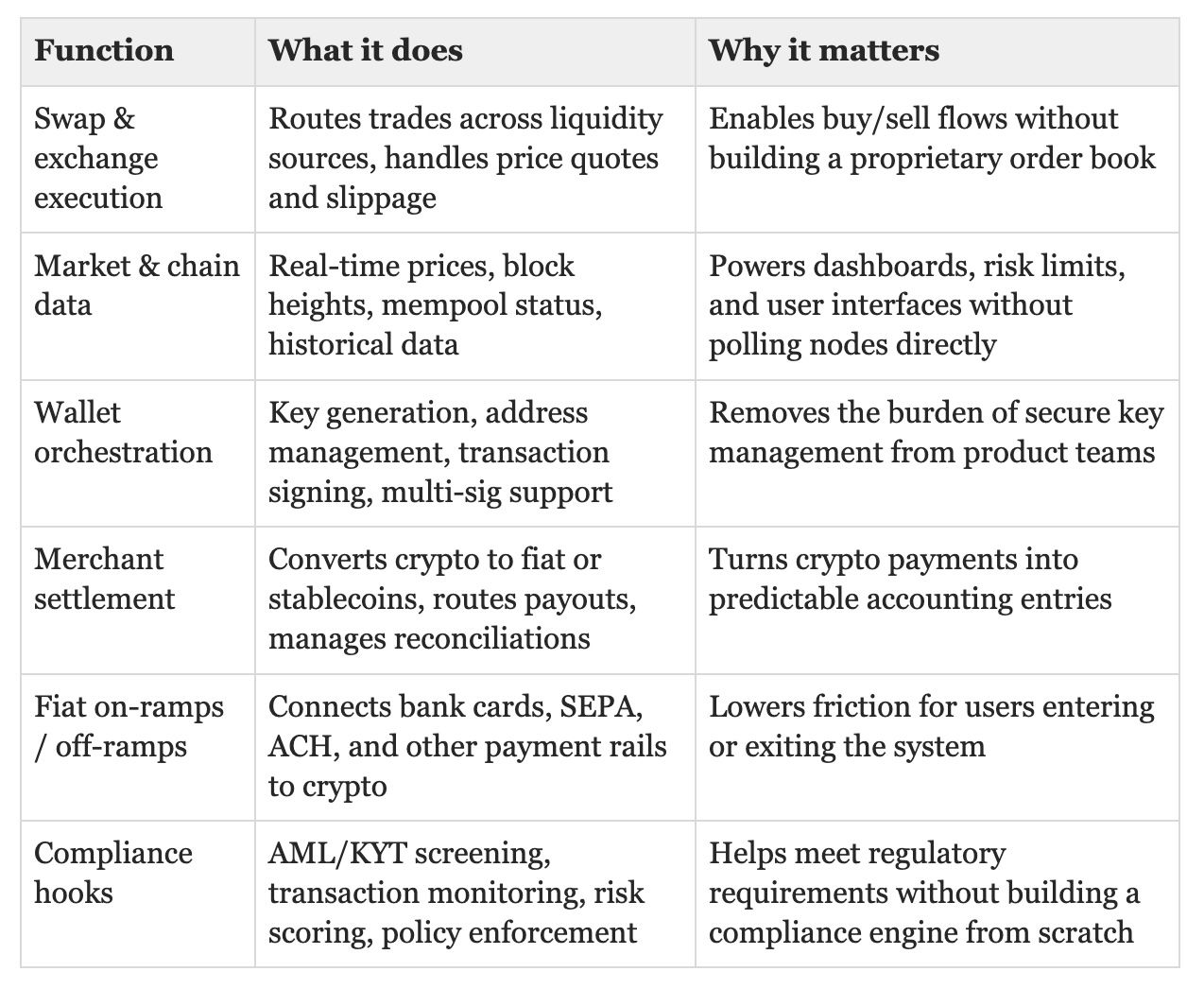
Here’s one way to think about it. Building everything in-house is like constructing your own private road network. You control every detail, but you also pay for every kilometer and manage every traffic jam yourself. An API stack is more like plugging into existing highways. You give up some customization, but you gain speed, redundancy, and immediate access to established liquidity and chain connections.

For most businesses, especially those that aren’t crypto-native to begin with, that trade-off makes sense. The time and money required to build and maintain a multi-chain, compliant, high-availability stack rarely pay off unless crypto is the core product. For everyone else, APIs let teams focus on what actually differentiates their offering rather than rebuilding infrastructure that already exists.

Accelerating Web3 Adoption

Speed is the obvious benefit, but it’s not just about development time. A good API reduces integration complexity, which lowers the cost of trying things out. That makes product teams more willing to launch Web3 features at all. Adoption often stalls not because users aren’t interested, but because of internal bottlenecks: procurement, compliance reviews, and engineering bandwidth. APIs move those obstacles earlier in the process.

There’s also a network effect at play. When APIs aggregate multiple liquidity sources, chains, and asset types, businesses don’t have to wait for each asset to be integrated manually. That means broader coverage and fewer dead ends for users, which helps avoid the “empty app” problem that kills many Web3 products before they get any real traction. Metrics like uptime and response time become part of the business case, not just technical footnotes.

Crypto APIs Reduce Operational Risk

Risk is where Web3 romance usually hits reality. A company that handles custody, swaps, and compliance internally inherits every failure mode at once: key management mistakes, chain-specific bugs, monitoring gaps, inconsistent policy enforcement. Crypto APIs reduce that burden by packaging security, liquidity, and transaction logic into systems that already have operational controls built in.

This is where serious providers separate themselves from the merely convenient ones. Public providers show that crypto API security is important because screening, risk scoring, and real-time monitoring can be embedded directly into transaction workflows.

Multi-Chain Support Has Become Essential

Multi-chain support has become a basic expectation in modern fintech apps. Users move across Ethereum, L2s, Solana, Bitcoin, and other ecosystems without much thought about which chain a company prefers. Businesses that ignore that reality end up with a product that feels narrower than the market they’re trying to serve.

The logic is fairly straightforward. Multi-chain infrastructure widens addressable demand, reduces dependence on a single network’s congestion or fee spikes, and gives product teams room to optimize for cost, speed, or liquidity depending on the use case. It also makes a business more resilient. A single-chain strategy increasingly looks like a single-point-of-failure strategy.

Business Use Cases

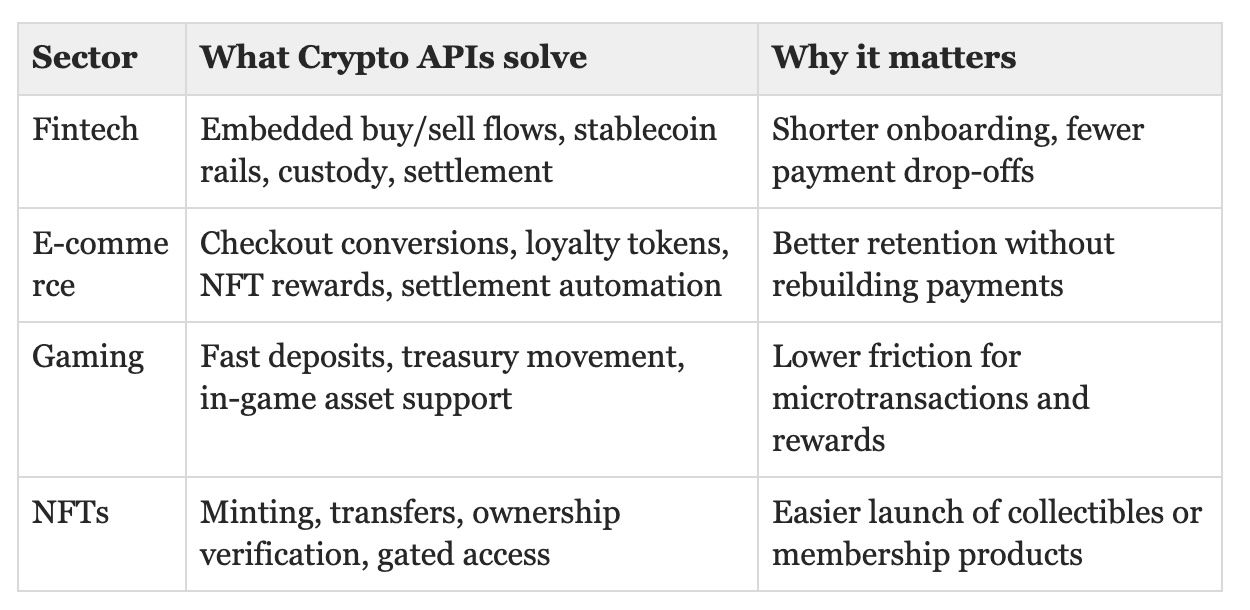
Fintech is probably the clearest example. A neobank or broker can add crypto exposure without becoming a full-fledged crypto exchange—a meaningful distinction in terms of both operational burden and regulatory exposure. E-commerce is more subtle: APIs can turn crypto from a speculative payment option into a loyalty mechanic, an ownership layer, or a cross-border settlement tool. Gaming and NFT platforms, meanwhile, tend to prioritize speed and asset variety above all else. Delays and chain limitations show up immediately in the user experience.

The Bottom Line

Crypto APIs matter because they turn Web3 from an engineering ambition into a business capability. The deeper implication is that the winners in the next phase of adoption may not be the companies with the most blockchain talent. They may be the ones that can integrate reliable infrastructure fastest and shape it around real customer behavior. Web3 adoption is becoming less about ideology and more about execution.

That doesn’t mean APIs remove the hard parts. Regulation is tightening. Chain fragmentation remains expensive. Security failures still punish careless teams. But the market is clearly rewarding companies that treat crypto infrastructure as a plug-in layer rather than a moonshot project. That shift makes Web3 feel less like a separate industry and more like a feature set the broader digital economy is finally ready to absorb.

Attribution

Originally reported by Yellow.com

Get stories like this, daily.

Daily crypto + regulation intelligence, straight to your inbox. Free.

Tin Liên Quan