
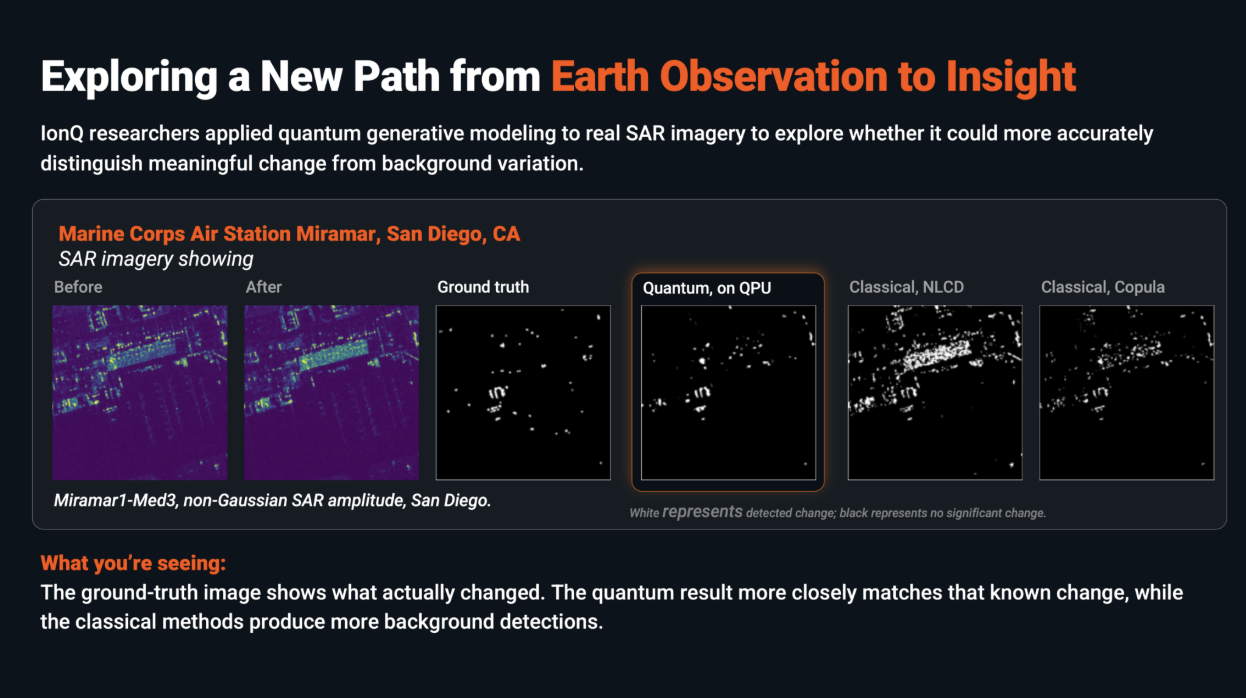
Quantum computing platform developer IonQ, Inc. (NYSE: IONQ) has published breakthrough research demonstrating that quantum generative machine learning models can outperform classical statistical baselines in detecting ground-level changes from satellite-based Synthetic Aperture Radar (SAR) and Interferometric SAR (InSAR) imagery. Published on arXiv (arXiv:2609.05313), the study validates that Quantum Circuit Born Machines (QCBMs) executed on IonQ trapped-ion quantum processing units achieve superior change-detection accuracy under conditions where high-resolution radar data produces sparse or non-Gaussian pixel statistics.
IonQ Demonstrates Quantum Generative Modeling Advantage for High-Resolution Satellite Radar Change Detection
Quantum computing platform developer IonQ, Inc. (NYSE: IONQ) has published breakthrough research demonstrating that quantum generative machine learning models can outperform classical statistical baselines in detecting ground-level…
Quantum Computing Report
Publisher
Sep 25, 2026 at 5:38 AM UTC · Updated 8 ngày trước · 2 phút đọc
Key Signal
20-24 qubits QCBM architecture range
Last Updated
8 ngày trước
Đang dịch…
The research addresses a fundamental bottleneck in satellite Earth Observation (EO). While SAR provides persistent, all-weather, day-and-night imaging by measuring microwave backscatter, sub-meter high-resolution acquisitions generate heavy-tailed, non-Gaussian pixel distributions. Traditional classical background estimators (such as Non-Linear Change Detection, NLCD) rely on joint histogram lookup tables, which degrade when pixel statistics are sparsely populated. By encoding bi-temporal satellite image pairs in Copula space using a 20-qubit to 24-qubit QCBM architecture, IonQ’s quantum model generates synthetic reference samples to construct accurate background expectations without requiring spatial smoothing or sacrificing fine resolution detail.
Article Intelligence
Related Coverage
 QuantumQ&A: How will quantum computers change society?một ngày trước · 1 min read
 QuantumIBM Expands Research Partnerships in India for AI and Quantum Computingmột ngày trước · 1 min read
 QuantumIBM Expands IIT Bombay And IISc Research Partnerships Across AI And Quantum Computingmột ngày trước · 2 min read
Sponsored
Ad
NewsLayerLearn more
NewsLayer Premium
Unlock deeper intelligence.
Ad-free reading, exclusive research, and real-time onchain insights.
Go Premium