
- US OCC and FDIC said they had clarified the definition of "unsafe or unsound practices" to focus supervision on actual legal violations and material financial risks.
- The new rule requires supervisory concerns to be linked to material financial risk or legal and regulatory compliance issues, while prioritizing substantive financial risk over nonfinancial matters.
- The crypto industry said the move could reduce pressure on banks to restrict services to crypto firms and called it an important step toward reversing "Operation Chokepoint 2.0."
OCC, FDIC Tighten Definition of Unsafe Bank Practices, Limiting Leeway to Pressure Crypto Firms
The Office of the Comptroller of the Currency and the Federal Deposit Insurance Corp. clarified the standards they use to define "unsafe or unsound practices" in bank supervision. By tying scrutiny more closely to actual legal…
bloomingbit
Publisher
Aug 27, 2026 at 9:39 PM UTC · Updated một giờ trước · 2 phút đọc
Đang dịch…
Forecast Trend Report by Period
The Office of the Comptroller of the Currency and the Federal Deposit Insurance Corp. clarified the standards they use to define "unsafe or unsound practices" in bank supervision. By tying scrutiny more closely to actual legal violations and material financial risks, the change could also ease regulatory uncertainty for banks serving lawful clients such as crypto firms.
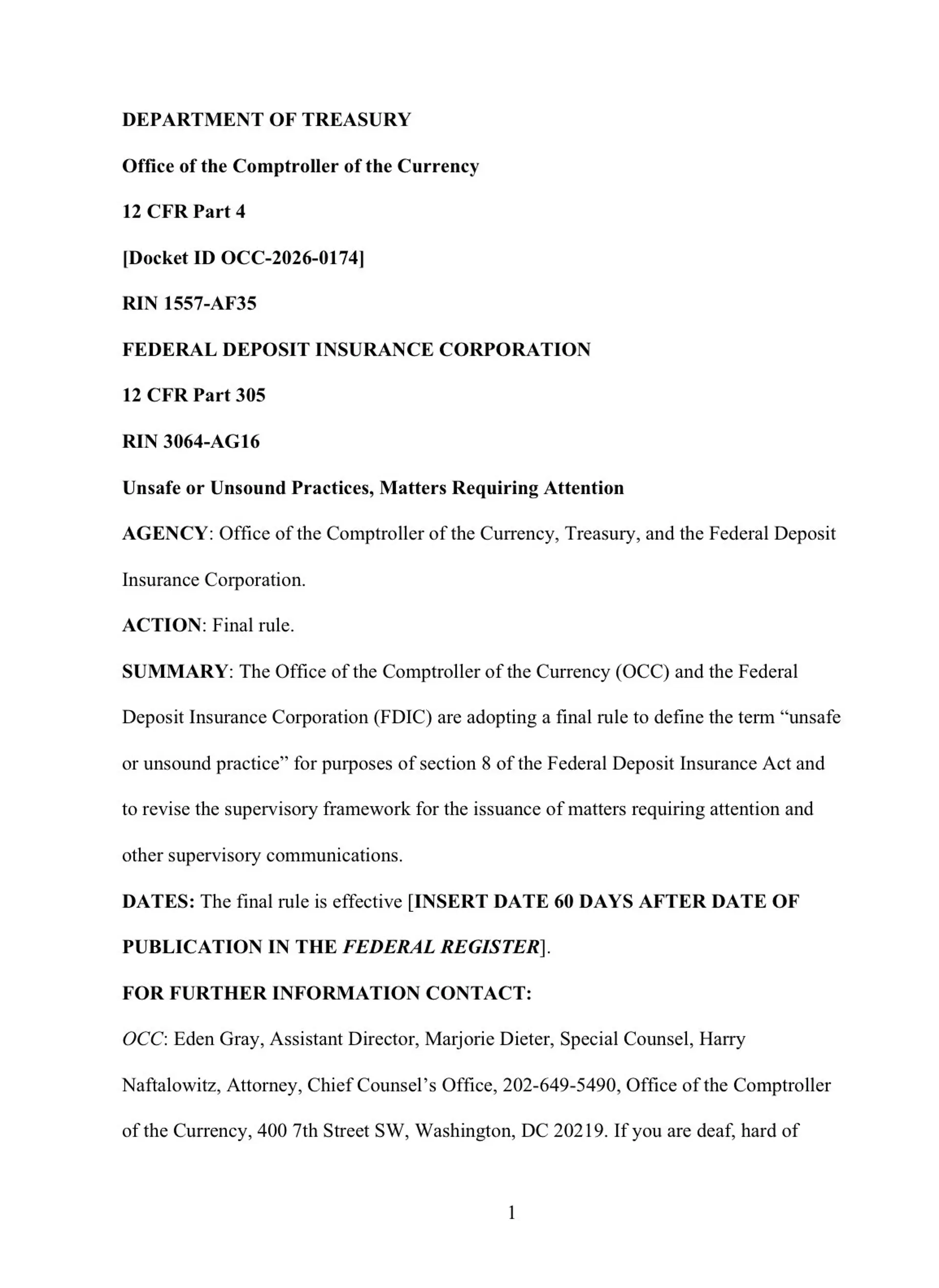
On Aug. 27, the OCC and FDIC issued a final rule establishing a uniform definition of "unsafe or unsound practices" and common supervisory standards for banks. The rule will take effect 60 days after it is published in the Federal Register.
The core of the rule requires supervisory objections to be linked to material financial risk or compliance issues involving banking laws and regulations. It also directs examiners to prioritize substantive financial risks over nonfinancial matters such as policies, procedures and documentation.
Article Intelligence
Related Coverage
 Crypto‘Spy Sheikh’ Holds Major Stake in Trump Family’s New Crypto Bank: Report2 giờ trước · 2 min read
 CryptoTrump Family Crypto Bank Backed by Abu Dhabi Royal2 giờ trước · 1 min read
 CryptoUAE ‘spy sheikh’ backs 49% stake in Trump family’s crypto bank venture, WSJ reports3 giờ trước · 2 min read
Sponsored
Ad
NewsLayerLearn more
NewsLayer Premium
Unlock deeper intelligence.
Ad-free reading, exclusive research, and real-time onchain insights.
Go Premium