
Insider Brief
SAXON Q Reports That Room-Temperature Quantum Computers Can Rival the Performance of Superconducting Processors
Insider Brief PRESS RELEASE — — SAXON Q, a leader in NV-center quantum computing, today released a paper showing that its room-temperature diamond-based system can perform on par with superconducting quantum computers cooled to near…
Matt Swayne
Publisher The Quantum Insider
Oct 14, 2026 at 4:06 PM UTC · Updated 4 ngày trước · 3 phút đọc
Đang dịch…
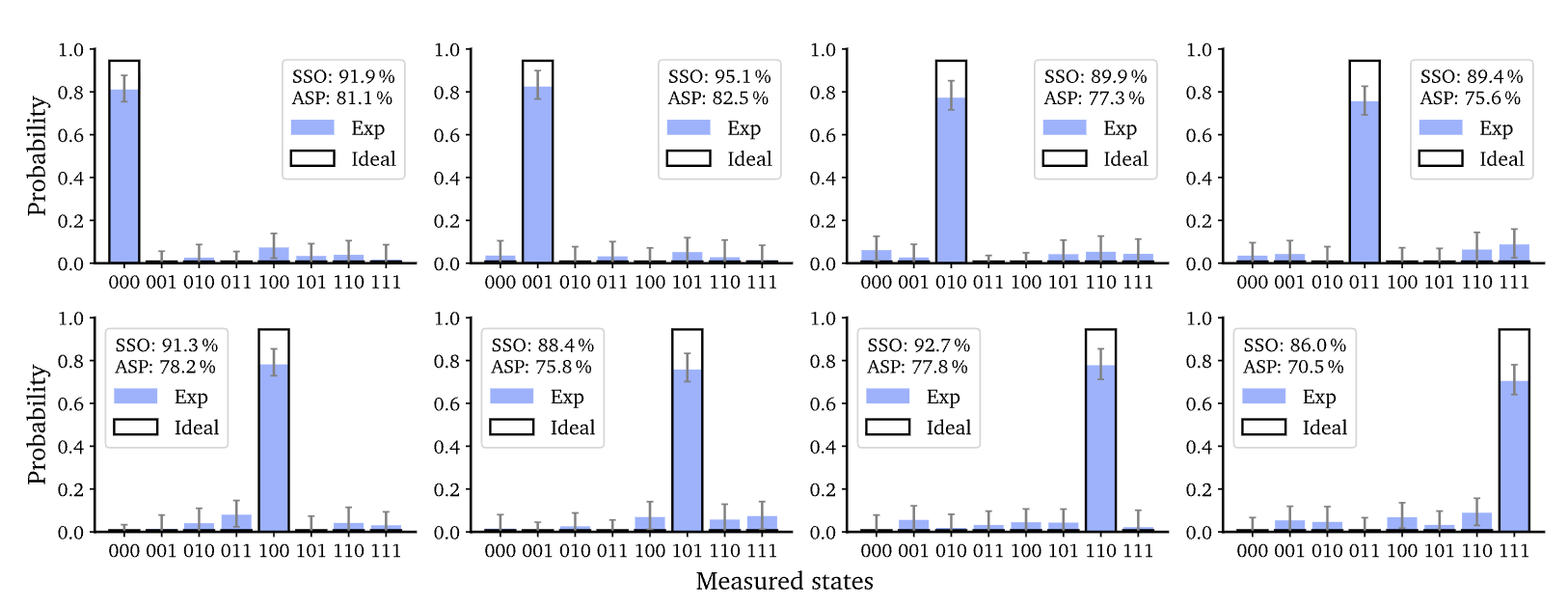
- SAXON Q reported that its room-temperature diamond quantum computer achieved 77.3% success in a three-qubit Grover search, close to the cited superconducting benchmark of 78%.
- The system achieved 87% success when searching for two targets among eight items, with both tests exceeding the classical success limits cited in the paper.
- Researchers conducted the benchmark at Fraunhofer IWU in Dresden using a previous-generation system that consumes roughly 600 watts and requires no cryogenic cooling or vacuum equipment.
PRESS RELEASE — — SAXON Q, a leader in NV-center quantum computing, today released a paper showing that its room-temperature diamond-based system can perform on par with superconducting quantum computers cooled to near absolute zero.
Running Grover’s search algorithm, a standard benchmark test for quantum performance, a SAXON Q system identified a single target state 77.3% of the time using three qubits, rivaling the best published superconducting result of 78%, which required a temperature roughly 15,000 times colder.
“The assumption in quantum computing has been that you trade performance for convenience. These results show that tradeoff isn’t necessary,” said Marius Grundmann, co-founder and CEO of SAXON Q. “Our system ran a complete quantum algorithm in an ordinary room at a customer site, and the results were similar to those of machines that require extensive infrastructure to cool them to near absolute zero.”
Article Intelligence
Related Coverage
 QuantumChalmers Next Labs, ConScience, and NQFF Validate Superconducting Qubit Chip Stability Across International Testbedsmột ngày trước · 1 min readQuantumMIT Bengaluru Inaugurates Q-HUB@MAHE and Deploys QuantrolOx’s Open-Architecture VIDYAQAR Quantum Systemmột ngày trước · 1 min read
 QuantumD-Wave Demonstrates 3D Analog-Digital Quantum Simulation of Higher-Order Topological Insulators Using 728 Qubitsmột ngày trước · 1 min read
Sponsored
Ad
NewsLayerLearn more
NewsLayer Premium
Unlock deeper intelligence.
Ad-free reading, exclusive research, and real-time onchain insights.
Go Premium