
The CLARITY Act is currently functioning as a legislative elevator stuck between floors. A cloture vote is set for September 15 at 2:15pm ET, and the arithmetic is unforgiving: 60 votes required to advance, Republicans holding 53 seats, and only two Democrats – Senators Gallego and Alsobrooks – having crossed the aisle in committee. Polymarket bettors have priced the bill’s 2026 passage at 16%, down from 82% earlier this year. Galaxy Digital puts the odds at 10%.
What Happens When Congress Doesn’t Show Up: The Institutional Crypto Buildout Is Already Underway
The CLARITY Act is currently functioning as a legislative elevator stuck between floors. A cloture vote is set for September 15 at 2:15pm ET, and the arithmetic is unforgiving: 60 votes required to advance, Republicans holding 53 seats,…
forkast.news
Publisher
Sep 6, 2026 at 12:38 PM UTC · 4 phút đọc
Đang dịch…
The gridlock is anchored in three specific disputes: an ethics provision targeting crypto income, DeFi developer liability under Section 604, and the revenue-generating potential of stablecoin yield – specifically the $1.35 billion in annual rewards currently distributed by Coinbase. Seven Democratic senators have issued a joint statement declaring the current draft insufficient on consumer protection and illicit finance. With the House cutting its September sessions and the Senate facing a compressed calendar of roughly 14 working days, the bill is effectively a theoretical exercise.
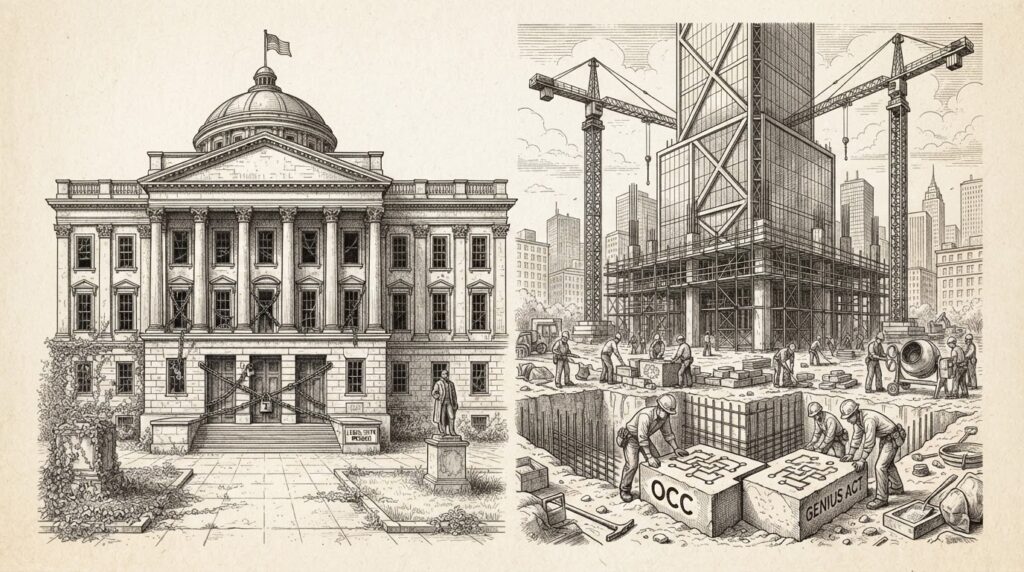
While the legislative machinery grinds to a halt, the actual plumbing of the financial system is being reconfigured with quiet, technical precision. The industry has moved past waiting for Congressional consensus, opting instead to map operations directly onto the regulatory architecture provided by the Office of the Comptroller of the Currency and the GENIUS Act. This is not optimism; it is a cold calculation driven by the compliance cliff of January 18, 2027 – the only deadline that actually matters to institutional balance sheets.
Article Intelligence
Related Coverage
 Web3CLARITY Act Gets a Major Boost, But Another Setback Threatens Its 2026 Passage4 giờ trước · 2 min read
 CryptoThe Capital Wall: How Much Does It Actually Cost to Become a Crypto Bank?2 giờ trước · 4 min read
 CryptoCrypto Regulation in Russia: What Awaits the Cryptocurrency Market2 giờ trước · 6 min read
Sponsored
Ad
NewsLayerLearn more
NewsLayer Premium
Unlock deeper intelligence.
Ad-free reading, exclusive research, and real-time onchain insights.
Go Premium