
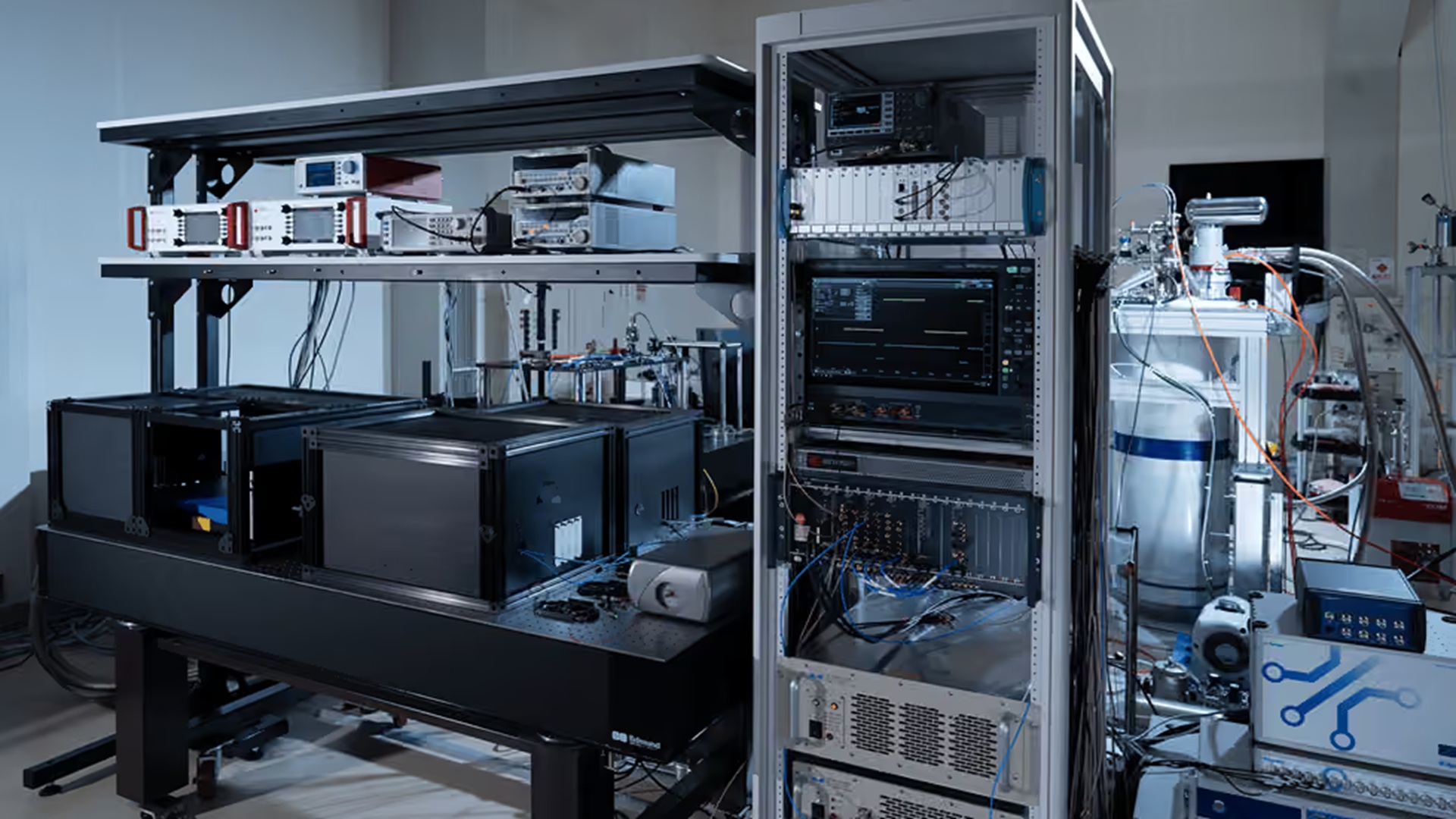
Japanese tech giant Fujitsu has developed the world’s first working diamond-spin quantum computer prototype that incorporates tin-vacancy (SnV) centers into photonic integrated circuits.
World`s first diamond quantum computer could have 1,000 logical qubits
Japanese tech giant Fujitsu has developed the world’s first working diamond-spin quantum computer prototype that incorporates tin-vacancy (SnV) centers into photonic integrated circuits.
Interesting Engineering
Publisher
Sep 8, 2026 at 3:39 PM UTC · 2 phút đọc
Đang dịch…
The new prototype can run at -456.9 degrees Fahrenheit (-271.6 degrees Celsius). This is roughly 2.8 degrees Fahrenheit warmer than the -459.6 degrees Fahrenheit (-273.13 degrees Celsius) required by superconducting quantum computers.
Fujitsu said that the technology could lead to more powerful quantum computers by using light to connect individual computing modules. The firm plans to create a multi-module diamond-spin prototype by 2027. It also aims to make quantum computing practical by 2030.
Under its quantum roadmap, Fujitsu aims to develop a 250-logical-qubit system by fiscal 2030 and a 1,000-logical-qubit system by fiscal 2035. “We are delighted to announce this prototype diamond spin quantum computer as a result of the collaborative research conducted since 2020 between Fujitsu, Delft University of Technology, and QuTech,” Kees Eijkel, PhD, QuTech general director, pointed out.
Turning diamond defects into qubits
The prototype relies on lattice defects in diamond crystals, better known as color centers, to create qubits. Diamond-spin systems have typically relied on nitrogen-vacancy (NV) centers, which are formed when a nitrogen atom replaces a carbon atom next to an empty position in the diamond lattice.
Article Intelligence
Topics
Related Coverage
View all related
Sponsored
Ad
NewsLayerLearn more
NewsLayer Premium
Unlock deeper intelligence.
Ad-free reading, exclusive research, and real-time onchain insights.
Go Premium