
Building an accurate model of how atoms interact is a complicated process. Researchers must choose new calculations, test successive models, and track the mechanisms behind each interaction. But a newly developed AI agent called MLP Copilot has made this process much easier by bridging computational tools and scientific evidence with human supervision.
AI Agents Advance Atomic Modeling and Reveal How Aluminum Nanoparticles Oxidize
Building an accurate model of how atoms interact is a complicated process. Researchers must choose new calculations, test successive models, and track the mechanisms behind each interaction. But a newly developed AI agent called MLP…
Asia Research News |
Publisher
Nov 10, 2026 at 5:23 AM UTC · Updated 11 小时前 · 2 分钟阅读
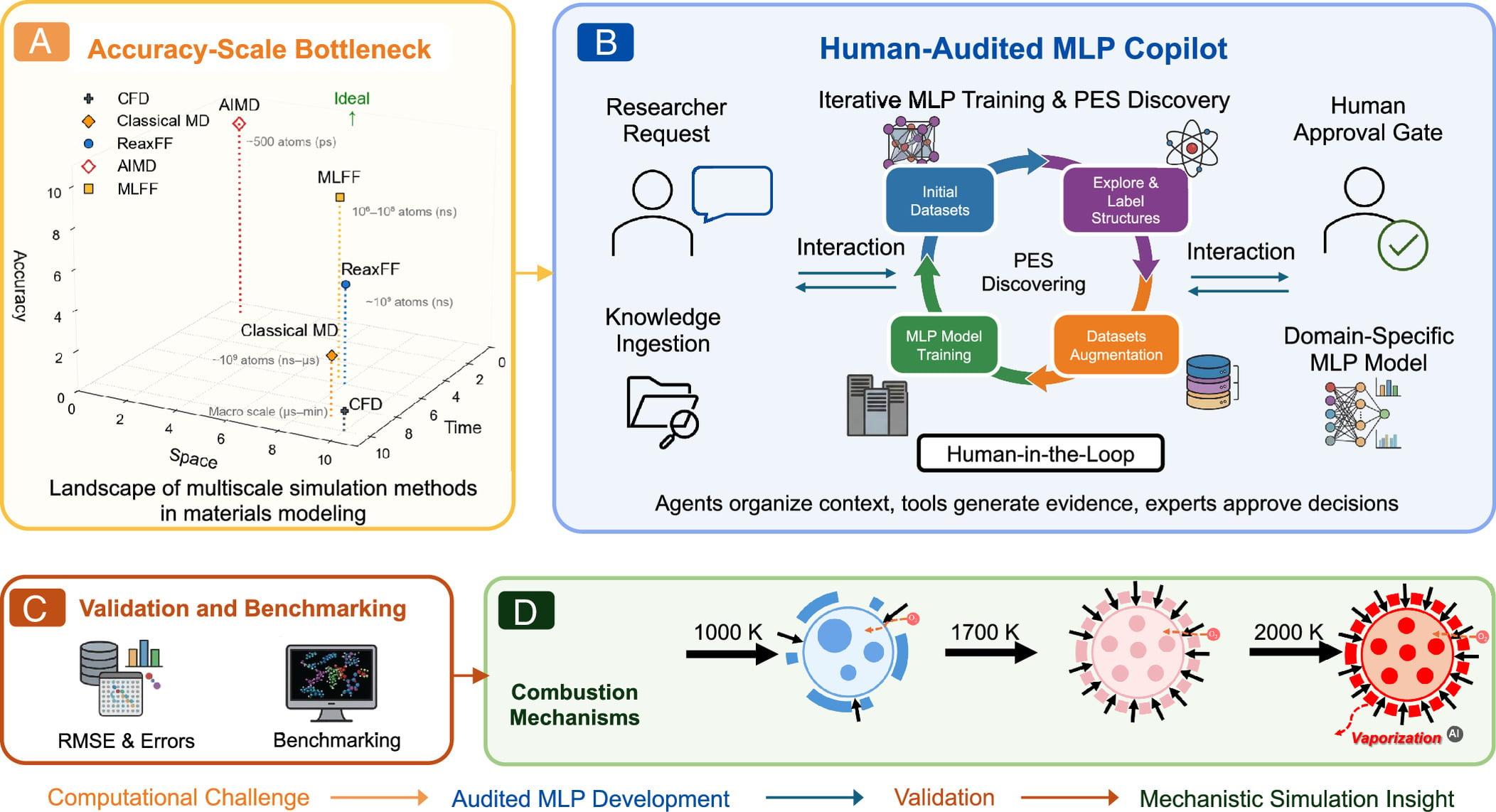
"Just like auto-pilot makes life a lot easier for pilots, our general-purpose framework is designed to make materials science more efficient, without disregarding the need for actual humans to be at the reigns," says Hao Li, Distinguished Professor at the Advanced Institute for Materials Research (WPI-AIMR), Tohoku University.
MLP Copilot learns atomic energies and forces from quantum calculations, the models of which can go on to make larger simulations feasible. The framework's coordination methods can be reused across materials systems, with calculations, training data, and validation tailored to each application.
The study was published as a Direct Submission in the Proceedings of the National Academy of Sciences (PNAS) on October 15, 2026.
To demonstrate the framework, the team investigated aluminum nanoparticle oxidation. These particles store substantial chemical energy, but a surface oxide shell can limit their reaction with oxygen. Understanding how that shell changes could guide future efforts to control oxidation and energy release.
Article Intelligence
Sponsored
Ad
NewsLayerLearn more
NewsLayer Premium
Unlock deeper intelligence.
Ad-free reading, exclusive research, and real-time onchain insights.
Go Premium