

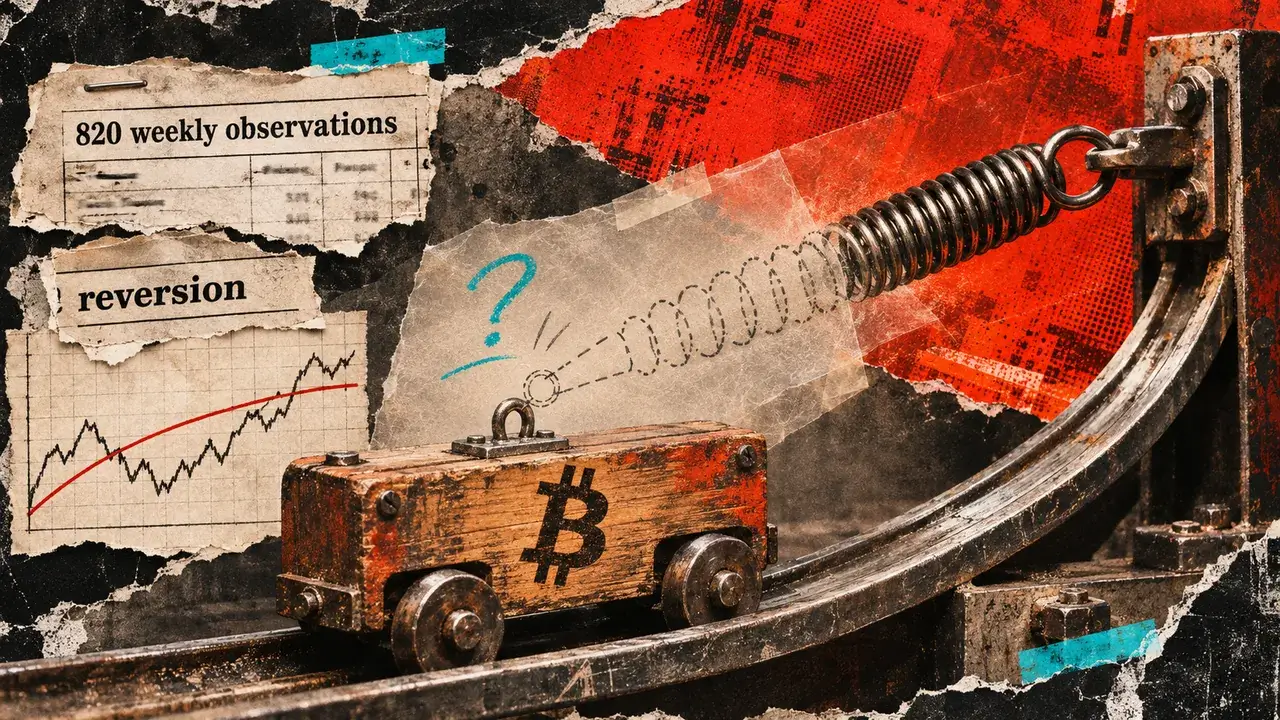
The power-law model links Bitcoin's price to its age, but the recovery forecasts in a Nov. 10 preprint also assume that departures from the long-run curve reverse, a tendency its historical analysis leaves unresolved.
Bitcoin power-law models predict a rebound without real proof
The power-law model links Bitcoin's price to its age, but the recovery forecasts in a Nov. 10 preprint also assume that departures from the long-run curve reverse, a tendency its historical analysis leaves unresolved.
CryptoSlate
Publisher
Nov 18, 2026 at 7:40 AM UTC · 3 分钟阅读
Entities
bitcoin
Last Updated
29 分钟前
翻译中…
Authors Carlos Baquero and Raquel Menezes argued that Bitcoin's long-run growth rate has slowed under the conditions their test allows.
The study's price record ends on Sept. 19, so its results do not explain November's selling.
Model advocate Stephen Perrenod made the attractor argument explicit in a June 5 analysis, arguing that tests of price deviations supported an attractor around which bubbles and bear markets occur.
He also cautioned that those tests did not predict next month's price or prove the relationship must continue indefinitely.
Reports on power-law likewise described an attractor framework while leaving the force sustaining it unsettled.
Baquero and Menezes used 820 weekly observations from January 2011 through September 2026. Within a declared family of possible price deviations, their test found evidence of a slowing long-run growth rate.
It rejected constant drift in expected log price at a nominal 5% significance level, compatible with a power-law trend, but does not identify it uniquely.
Market Context
Bitcoin
BTC
$64,662
+0.61% (24H)
Market Cap
$1.30T
Circulating Supply
20.1M BTC
24H Volume
$32.4B
24H High
$65,379
Article Intelligence
Key Entities
Topics
Related Coverage
 CryptoWho’s buying Bitcoin? Q3 filings reveal billions in bank, sovereign exposure1 小时前 · 1 min read
 CryptoIsraeli banks race to bring Bitcoin trading to customers3 小时前 · 5 min read
 CryptoBitcoin Exchange Binance to Delist Five Spot Trading Pairs on November 202 小时前 · 1 min read
Sponsored
Ad
NewsLayerLearn more
NewsLayer Premium
Unlock deeper intelligence.
Ad-free reading, exclusive research, and real-time onchain insights.
Go Premium