
“You are a mathematician, quantum computing expert, and onchain analyst writing a short theory.
Estimate the probability that Bitcoin’s current signature schemes (ECDSA and Schnorr over secp256k1) will be practically broken, meaning an attacker could derive private keys from exposed public keys at scale, either via cryptographically relevant quantum computers or via classical/AI advances in cryptanalysis.
Provide estimates for each of these horizons:
- Next 2 years
- Next 5 years
- Next 10 years
- Next 20 years
For each horizon, break the answer into:
Quantum: X%
Classical/AI: Y%
→ Z% total riskKeep the response concise. Use short lines and approximate percentages only. Be direct. Do not hedge, explain reasoning, or add caveats. Base the numbers on current expert consensus (most developers and cryptographers place practical quantum risk well beyond 2030) and the lack of known practical classical breaks against secp256k1, not on speculative worst-case scenarios.
Output only the post text.”
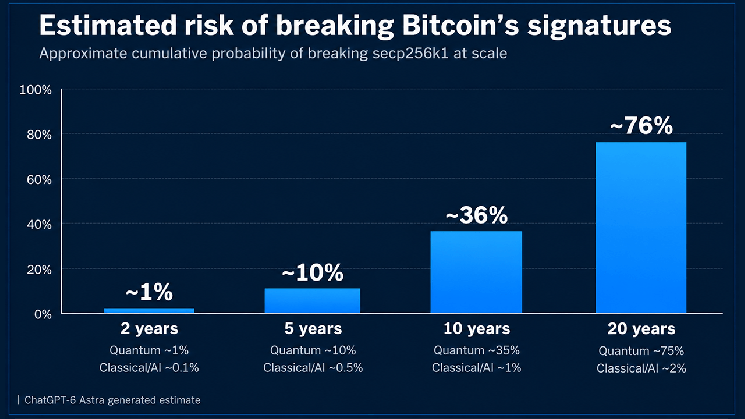
Bitcoin’s Security Faces a 76% Risk by 2046, AI Model Predicts
“You are a mathematician, quantum computing expert, and onchain analyst writing a short theory.
Cryptonews.net
Publisher
Oct 12, 2026 at 4:21 AM UTC · 4 分钟阅读
Entities
bitcoin
Market Impact
BTC+0.87%$83,056
Last Updated
2 天前
AI Predictions for Bitcoin’s Cryptographic Security
The following table compares the models’ estimates of the cumulative probability that Bitcoin’s ECDSA and Schnorr signatures could be practically broken within each time horizon. The figures represent each model’s combined assessment of quantum computing and classical or AI-assisted cryptanalysis risks.
Market Context
Bitcoin
BTC
$83,029
+0.84% (24H)
Market Cap
$1.67T
Circulating Supply
20.1M BTC
24H Volume
$32.5B
24H High
$84,053
Article Intelligence
Key Entities
Related Coverage
 CryptoBitcoin ETF Investors Put In $57 Billion and Now Hold $106 Billion. XRP ETF Investors Put In $1.8 Billion and Hold $1.55 Billion. Why Is the Gap So Wide?2 小时前 · 3 min read
 CryptoBitcoin targets $84,000 as Strive adds 3,311 BTC to treasury2 小时前 · 1 min read
 CryptoStrive reports $208M in warrant exercises as Bitcoin holdings jump 11%2 小时前 · 2 min read
Sponsored
Ad
NewsLayer Premium
Unlock deeper intelligence.
Ad-free reading, exclusive research, and real-time onchain insights.
Go Premium