
This website uses cookies
We use cookies to personalise content and ads, to provide social media features and to analyse our traffic. We also share information about your use of our site with our social media, advertising and analytics partners who may combine it with other information that you’ve provided to them or that they’ve collected from your use of their services.
Consent Selection
Details
  • Necessary cookies help make a website usable by enabling basic functions like page navigation and access to secure areas of the website. The website cannot function properly without these cookies.
  • Preference cookies enable a website to remember information that changes the way the website behaves or looks, like your preferred language or the region that you are in.
    • We do not use cookies of this type.

  • Statistic cookies help website owners to understand how visitors interact with websites by collecting and reporting information anonymously.
    • We do not use cookies of this type.

  • Marketing cookies are used to track visitors across websites. The intention is to display ads that are relevant and engaging for the individual user and thereby more valuable for publishers and third party advertisers.
    • We do not use cookies of this type.

  • Unclassified cookies are cookies that we are in the process of classifying, together with the providers of individual cookies.
    • __emg_sidPending
      Maximum Storage Duration: 1 dayType: HTTP Cookie
      __emg_vidPending
      Maximum Storage Duration: 1 yearType: HTTP Cookie
      nl-read-countPending
      Maximum Storage Duration: PersistentType: HTML Local Storage
Cookie declaration last updated on 8/12/26 by Cookiebot
[#IABV2_TITLE#]
[#IABV2_BODY_INTRO#]
[#IABV2_BODY_LEGITIMATE_INTEREST_INTRO#]
[#IABV2_BODY_PREFERENCE_INTRO#]
[#IABV2_BODY_PURPOSES_INTRO#]
[#IABV2_BODY_PURPOSES#]
[#IABV2_BODY_FEATURES_INTRO#]
[#IABV2_BODY_FEATURES#]
[#IABV2_BODY_PARTNERS_INTRO#]
[#IABV2_BODY_PARTNERS#]
About
Cookies are small text files that can be used by websites to make a user's experience more efficient.

The law states that we can store cookies on your device if they are strictly necessary for the operation of this site. For all other types of cookies we need your permission.

This site uses different types of cookies. Some cookies are placed by third party services that appear on our pages.

You can at any time change or withdraw your consent from the Cookie Declaration on our website.

Learn more about who we are, how you can contact us and how we process personal data in our Privacy Policy.

Please state your consent ID and date when you contact us regarding your consent.
NewsLayer

Install NewsLayer

Get the app experience — one tap from your home screen, instant loads and breaking-news alerts.

NewsLayer.com

Crypto companies urge AI firms to give Bitcoin developers early access

作者 Cointelegraph by Zoltan Vardai发布于 9 小时前 2 分钟阅读
Crypto companies urge AI firms to give Bitcoin developers early access

The Bitcoin Policy Institute and other industry participants urged AI companies to offer early access to their frontier models to aid Bitcoin and open-source developers in their cybersecurity efforts.

A group of cryptocurrency companies has urged frontier artificial intelligence (AI) labs to give Bitcoin developers early access to their most capable models.

The letter, published by the Bitcoin Policy Institute (BPI) on Monday, said many digital asset defenders, including Bitcoin Core developers, lack access to lab cyber programs and can be blocked by guardrails on publicly available frontier systems, leaving them to rely on less capable open-weight models.

The signatories urged frontier AI labs to “establish or expand standing trusted-access programs for qualified defenders of open-source financial infrastructure.” 

The letter said open-source software supports critical digital and financial infrastructure, while Bitcoin (BTC) alone secures more than $1 trillion in value. It added that a vulnerability in open-source infrastructure can place life savings at risk.

The open letter was co-signed by multiple crypto companies and organizations, including the African Bitcoin Institute, Anchorage Digital, BitGo, Bitwise, Blockstream, Bull Bitcoin, MARA, Kraken, Ledger and Trezor, among others.

Related: Strategy-led group pledges $15M to quantum-proof Bitcoin network

Open-source defenders need access to frontier AI

The letter said frontier AI is changing the economics of security research and cyber operations because advanced models can search large codebases, identify potential weaknesses and accelerate complex technical work for both defenders and adversaries.

It said frontier AI could become one of the “most powerful defensive technologies ever developed,” adding:
“Without dedicated access programs, defenders may lack the tools needed to keep pace with evolving threats to the infrastructure they maintain.” 

The BPI said it received multiple independent reports from open-source maintainers describing sophisticated actors, including potential foreign adversaries, using advanced AI capabilities to sustain attacks.

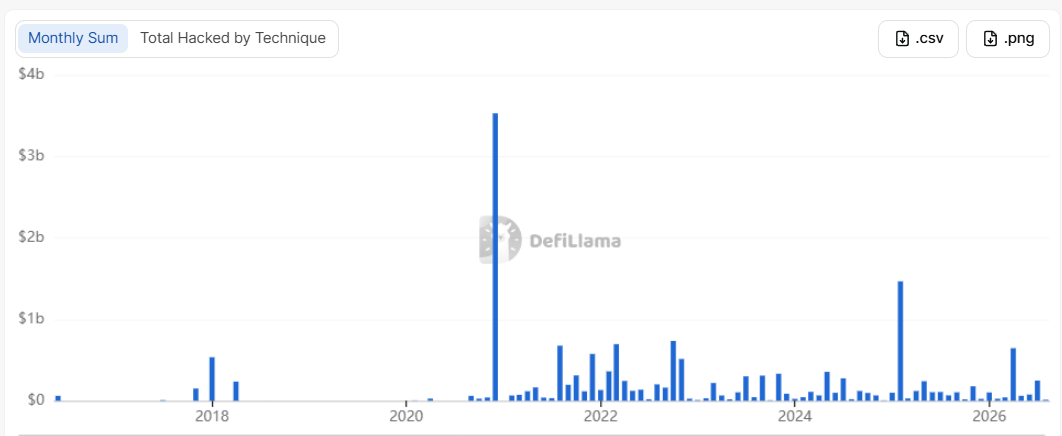
Total crypto hacks by monthly sum, all-time chart. Source: DefiLlama

Hacking activity across the industry surged in April 2026, as malicious actors stole over $634 million from cryptocurrency platforms, the highest monthly total since the Bybit hack, which helped drive losses to roughly $1.4 billion in February 2025, according to DefiLlama data.

Advances in AI-assisted vulnerability discovery have raised concerns across the crypto security industry. New models such as Claude Opus 4.8 and ChatGPT 5.5 have contributed to what Mitchell Amador, CEO of bug bounty platform Immunefi, described as a “vulnerability apocalypse” for the crypto industry.

Magazine: Bitcoin’s quantum upgrade path: What BIP-360 changes and what it does not

Attribution

Originally reported by Cointelegraph

Get stories like this, daily.

Daily crypto + regulation intelligence, straight to your inbox. Free.

相关报道