
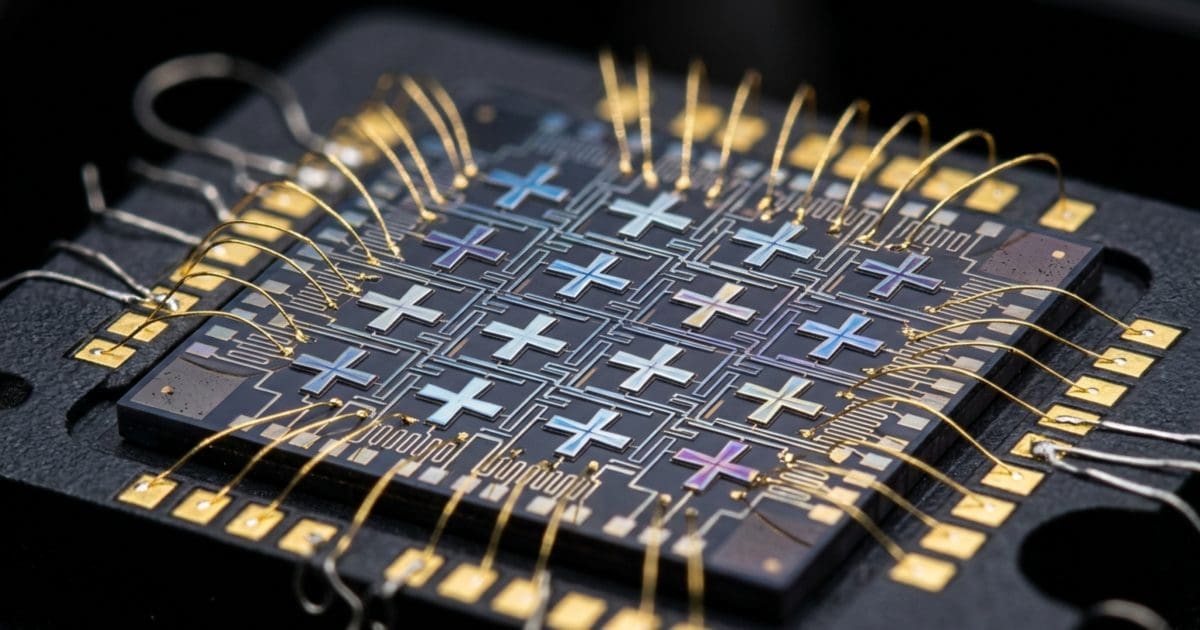
Researchers at the Max-Planck-Institut für Quantenoptik have extended the coherence of nuclear spin qubits to exceed 0.2 seconds, a duration that significantly advances the feasibility of practical quantum memory. The team achieved this milestone by embedding erbium dopants within yttrium orthosilicate and utilizing a cryogenic Fabry-Perot cavity with a linewidth of 65 MHz, smaller than the 0.9 GHz separation of hyperfine levels, to enable frequency-selective enhancement. This combination of nuclear-spin qubits, frequency-selective addressing, and photon emission in the minimal-loss telecommunications C-band positions erbium as a leading candidate for long-range, fiber-based quantum networks.
Freezing Impurities Extends Spin Qubit Coherence To 0.2 Seconds
Researchers at the Max-Planck-Institut für Quantenoptik have extended the coherence of nuclear spin qubits to exceed 0.2 seconds, a duration that significantly advances the feasibility of practical quantum memory. The team achieved this…
Quantum Zeitgeist
Publisher
Aug 30, 2026 at 9:24 AM UTC · Updated 3 小时前 · 6 分钟阅读
翻译中…
Cavity-Enhanced Readout of 167Er Nuclear Spin Qubits
A coherence time exceeding 0.2 seconds has been demonstrated in nuclear spin qubits embedded within yttrium orthosilicate, expanding the potential for practical quantum memory and long-distance quantum communication. Researchers at the Max-Planck-Institut für Quantenoptik achieved this milestone by carefully controlling the environment of erbium-167 dopants, effectively silencing disruptive magnetic noise that typically limits qubit performance.
Article Intelligence
Topics
Regulation Signal
in progressUpdated 23 天前
SEC Crypto Asset Market Structure RulemakingRelated Coverage
 QuantumWeekly: Continued Bitcoin Rally, $96 Billion Nvidia Profit, and First Quantum-Resistant Transaction2 小时前 · 13 min read
 Artificial IntelligenceAfter Their AI Models Hacked Real Companies, AI Labs Call for Stronger Cyber Defenses17 分钟前 · 4 min read
 PolicyWhite House aide turned secret speech text into $107k on prediction markets before CFTC stepped in1 小时前 · 2 min read
Sponsored
Ad
NewsLayerLearn more
NewsLayer Premium
Unlock deeper intelligence.
Ad-free reading, exclusive research, and real-time onchain insights.
Go Premium