
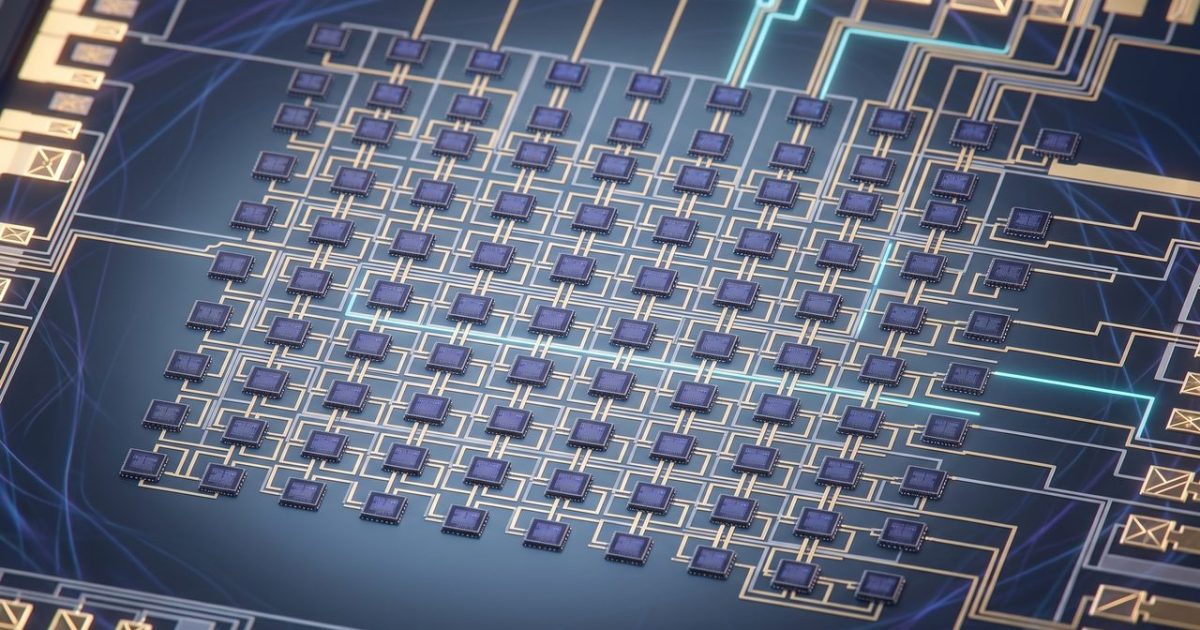
These unintended interactions between qubits, even when idle, can introduce errors that accumulate during computation, impacting the fidelity of results. “In superconducting processors, ZZ crosstalk is one of the most significant sources of systematic errors,” the company reports, as physicists work to characterize and mitigate these effects through techniques like decoupling and pulse sequences. Understanding these interactions is essential for calibrating quantum gates and improving performance as processors grow in complexity.
Horizon Quantum Computing Studies 108-qubit Chip Errors
These unintended interactions between qubits, even when idle, can introduce errors that accumulate during computation, impacting the fidelity of results. “In superconducting processors, ZZ crosstalk is one of the most significant…
Quantum Zeitgeist
Publisher
Nov 10, 2026 at 1:12 PM UTC · 4 分钟阅读
翻译中…
Joint-Ramsey Experiments: Pairwise Characterization Limitations
Conventional methods for characterizing interactions between qubits struggle to keep pace with increasing processor sizes, as the number of required experiments grows quadratically with the number of qubits. Horizon Quantum Computing addressed this limitation by applying multiplexed protocols to joint-Ramsey experiments, a gold standard for ZZ crosstalk measurement, and demonstrated a significant reduction in measurement settings on a 100-qubit processor, the company says.
The company’s approach cut the number of settings from approximately 5,000, typical of pairwise measurements, to just 7, representing a more than 700-fold reduction in complexity. This scaling advantage stems from a logarithmic relationship between measurement settings and qubit count, promising to maintain efficiency even as quantum processors expand to the million-qubit scale and beyond.
Article Intelligence
Topics
Sponsored
Ad
NewsLayerLearn more
NewsLayer Premium
Unlock deeper intelligence.
Ad-free reading, exclusive research, and real-time onchain insights.
Go Premium