
Insider Brief
NeSQom 2026 Workshop Examines Hybrid Quantum-Classical Networks
Insider Brief PRESS RELEASE — Quantum computing, an emerging subfield of engineering and computer science that relies on quantum mechanics to tackle problems that are out of reach for today’s most powerful classical computers – could…
Mohib Ur Rehman
Publisher The Quantum Insider
Sep 29, 2026 at 11:32 AM UTC · Updated 3 小时前 · 3 分钟阅读
翻译中…
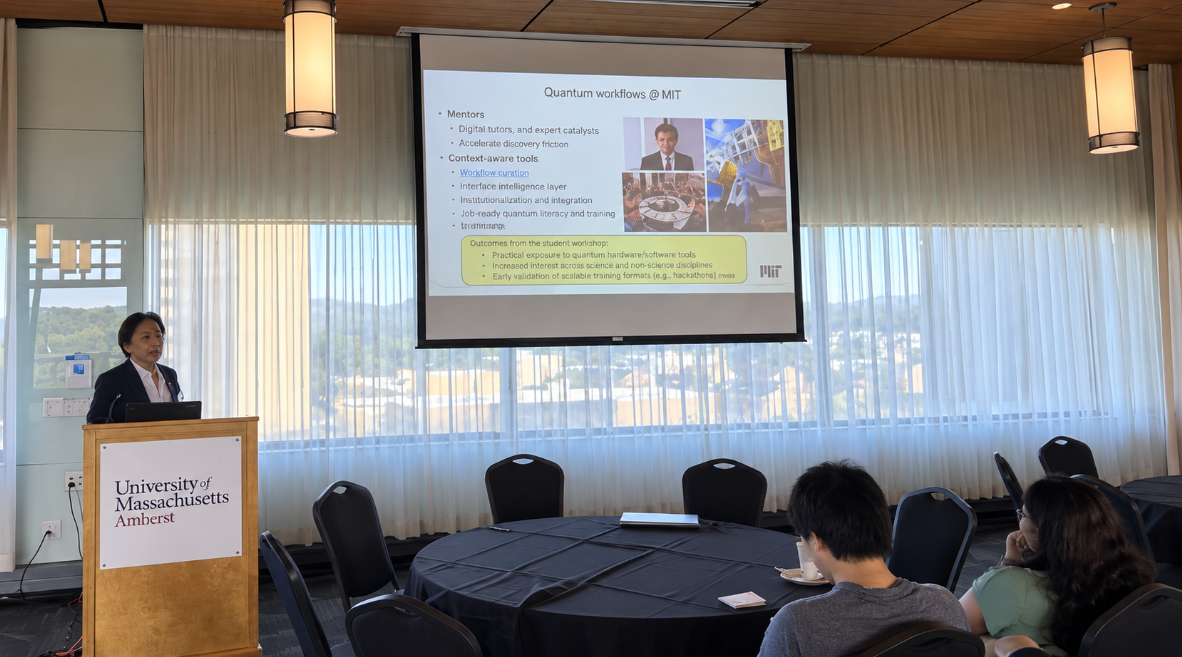
- UMass Amherst hosted NeSQom 2026, a workshop that brought together researchers in quantum networking, quantum information science, quantum security and classical networking.
- About 50 researchers from across the U.S. discussed open problems and systems architecture for hybrid classical-quantum networks to inform the National Science Foundation’s research agenda.
- The workshop produced open-problem statements focused on areas including quantum networking, distributed quantum computing, quantum sensing and quantum key establishment.
PRESS RELEASE — Quantum computing, an emerging subfield of engineering and computer science that relies on quantum mechanics to tackle problems that are out of reach for today’s most powerful classical computers – could change computing forever.
But first, researchers need to overcome some challenges.
“Quantum computing uses quantum mechanics to process information in fundamentally different ways from today’s computers,” said Taqi Raza, assistant professor of electrical and computer engineering in UMass’s Riccio College of Engineering.
Classical computers use binary bits to process complex information; quantum computers use qubits, harnessing the laws of quantum mechanics. Regular bits can exist as either 1 or 0; qubits can be 1, 0 or a combination of the two. These properties could make quantum computers more efficient than classical computers, which in turn could lead to large-scale system advances for medical, environmental, cybersecurity and other applications.
Article Intelligence
Related Coverage
 ResearchUCSB Researchers Join Three NSF Quantum Leap Challenge Institutes4 小时前 · 3 min read
 ResearchUIC Joins Midwest Quantum Collaboratory7 小时前 · 2 min read
 QuantumResearchers Simulate Molecules Using Ten Thousand Qubits4 小时前 · 4 min read
Sponsored
Ad
NewsLayerLearn more
NewsLayer Premium
Unlock deeper intelligence.
Ad-free reading, exclusive research, and real-time onchain insights.
Go Premium