
This website uses cookies
We use cookies to personalise content and ads, to provide social media features and to analyse our traffic. We also share information about your use of our site with our social media, advertising and analytics partners who may combine it with other information that you’ve provided to them or that they’ve collected from your use of their services.
Consent Selection
Details
  • Necessary cookies help make a website usable by enabling basic functions like page navigation and access to secure areas of the website. The website cannot function properly without these cookies.
  • Preference cookies enable a website to remember information that changes the way the website behaves or looks, like your preferred language or the region that you are in.
    • We do not use cookies of this type.

  • Statistic cookies help website owners to understand how visitors interact with websites by collecting and reporting information anonymously.
    • We do not use cookies of this type.

  • Marketing cookies are used to track visitors across websites. The intention is to display ads that are relevant and engaging for the individual user and thereby more valuable for publishers and third party advertisers.
    • We do not use cookies of this type.

  • Unclassified cookies are cookies that we are in the process of classifying, together with the providers of individual cookies.
    • __emg_sidPending
      Maximum Storage Duration: 1 dayType: HTTP Cookie
      __emg_vidPending
      Maximum Storage Duration: 1 yearType: HTTP Cookie
      nl-read-countPending
      Maximum Storage Duration: PersistentType: HTML Local Storage
Cookie declaration last updated on 8/12/26 by Cookiebot
[#IABV2_TITLE#]
[#IABV2_BODY_INTRO#]
[#IABV2_BODY_LEGITIMATE_INTEREST_INTRO#]
[#IABV2_BODY_PREFERENCE_INTRO#]
[#IABV2_BODY_PURPOSES_INTRO#]
[#IABV2_BODY_PURPOSES#]
[#IABV2_BODY_FEATURES_INTRO#]
[#IABV2_BODY_FEATURES#]
[#IABV2_BODY_PARTNERS_INTRO#]
[#IABV2_BODY_PARTNERS#]
About
Cookies are small text files that can be used by websites to make a user's experience more efficient.

The law states that we can store cookies on your device if they are strictly necessary for the operation of this site. For all other types of cookies we need your permission.

This site uses different types of cookies. Some cookies are placed by third party services that appear on our pages.

You can at any time change or withdraw your consent from the Cookie Declaration on our website.

Learn more about who we are, how you can contact us and how we process personal data in our Privacy Policy.

Please state your consent ID and date when you contact us regarding your consent.
NewsLayer.com
NewsLayer PulseLIVEBTC$78,478-0.62%ETH$2,442-1.62%SOL$96.7-2.31%XRP$1.43-3.20%DOGE$0.086-4.56%ADA$0.2091-5.69%Total Cap$2.77T-0.55%Layer Index57 Neutral

UCLA Computer Scientists Jason Cong and Jens Palsberg to Co-Lead 2 NSF Quantum Computing Institutes

Two computer scientists from the UCLA Samueli School of Engineering have been selected as co-principal investigators on separate quantum computing institutes funded by the National Science Foundation’s Quantum Leap Challenge Institutes…

UCLA Samueli School of Engineering

Publisher

Aug 25, 2026 at 11:23 PM UTC · 3 分钟阅读
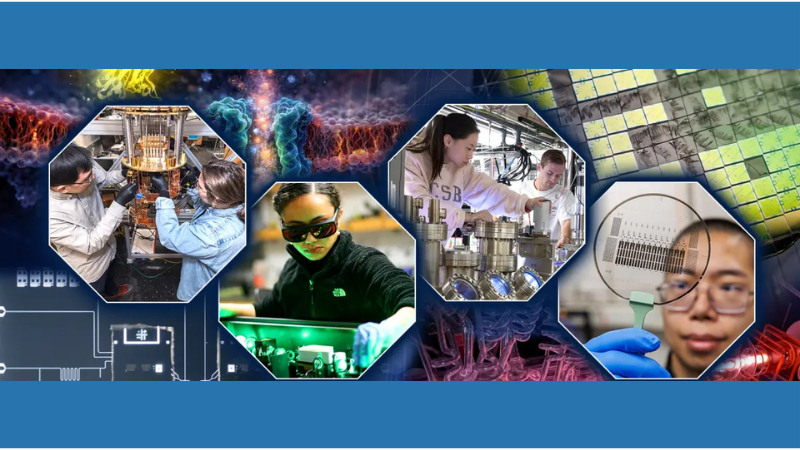
UCLA Computer Scientists Jason Cong and Jens Palsberg to Co-Lead 2 NSF Quantum Computing Institutes
Image via UCLA Samueli School of Engineering
翻译中…

Two computer scientists from the UCLA Samueli School of Engineering have been selected as co-principal investigators on separate quantum computing institutes funded by the National Science Foundation’s Quantum Leap Challenge Institutes (QLCI). 

The five-year grants of $37.5 million each will support two research institutes aimed at overcoming fundamental barriers in quantum information science and accelerating the development of quantum technologies for practical applications.

The two institutes are part of eight QLCI awards totaling more than $290 million announced today by the NSF to propel U.S. quantum science in the global race to create powerful quantum technologies. The investment is an expansion of the QLCI program created in 2020 following the passage of the National Quantum Initiative Act in 2018.

Newly Established NSF Institute for Fault-Tolerant Quantum Systems, Architectures and Applications 

The institute for Fault-Tolerant Quantum Systems, Architectures and Applications (FTQSAA) is one of three newly formed institutes in the program led by Harvard University, with UCLA Samueli and MIT serving as co-leads. The multi-institutional research team will focus on developing quantum systems that can reliably perform useful computations despite the errors and noise that disrupt quantum devices. The researchers will integrate fault-tolerant design across quantum hardware, software, algorithms and applications to maximize quantum systems’ ability to solve previously intractable problems in fields ranging from drug and materials discovery to particle physics and cosmology. 

Article Intelligence

Sponsored

Ad

House — Advertise on NewsLayer
NewsLayerLearn more

NewsLayer Premium

Unlock deeper intelligence.

Ad-free reading, exclusive research, and real-time onchain insights.

Go Premium