

Two wallet incidents this week exposed a growing weakness in crypto self-custody: the systems surrounding hardware devices.
Your crypto hardware wallet can stay secure while everything around it fails
Two wallet incidents this week exposed a growing weakness in crypto self-custody: the systems surrounding hardware devices.
CryptoSlate
Publisher
Sep 18, 2026 at 11:50 AM UTC · 4 分钟阅读
Key Signal
347,149 Trezor contacts exposed
Last Updated
7 天前
翻译中…
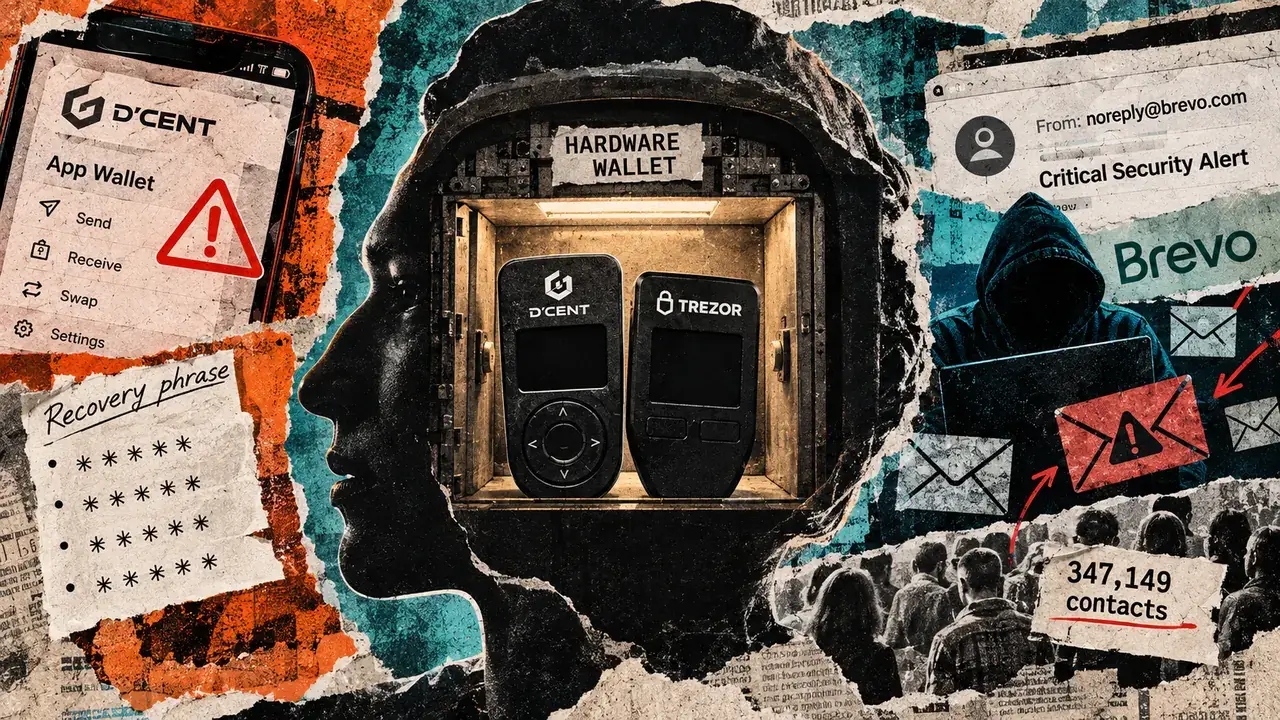
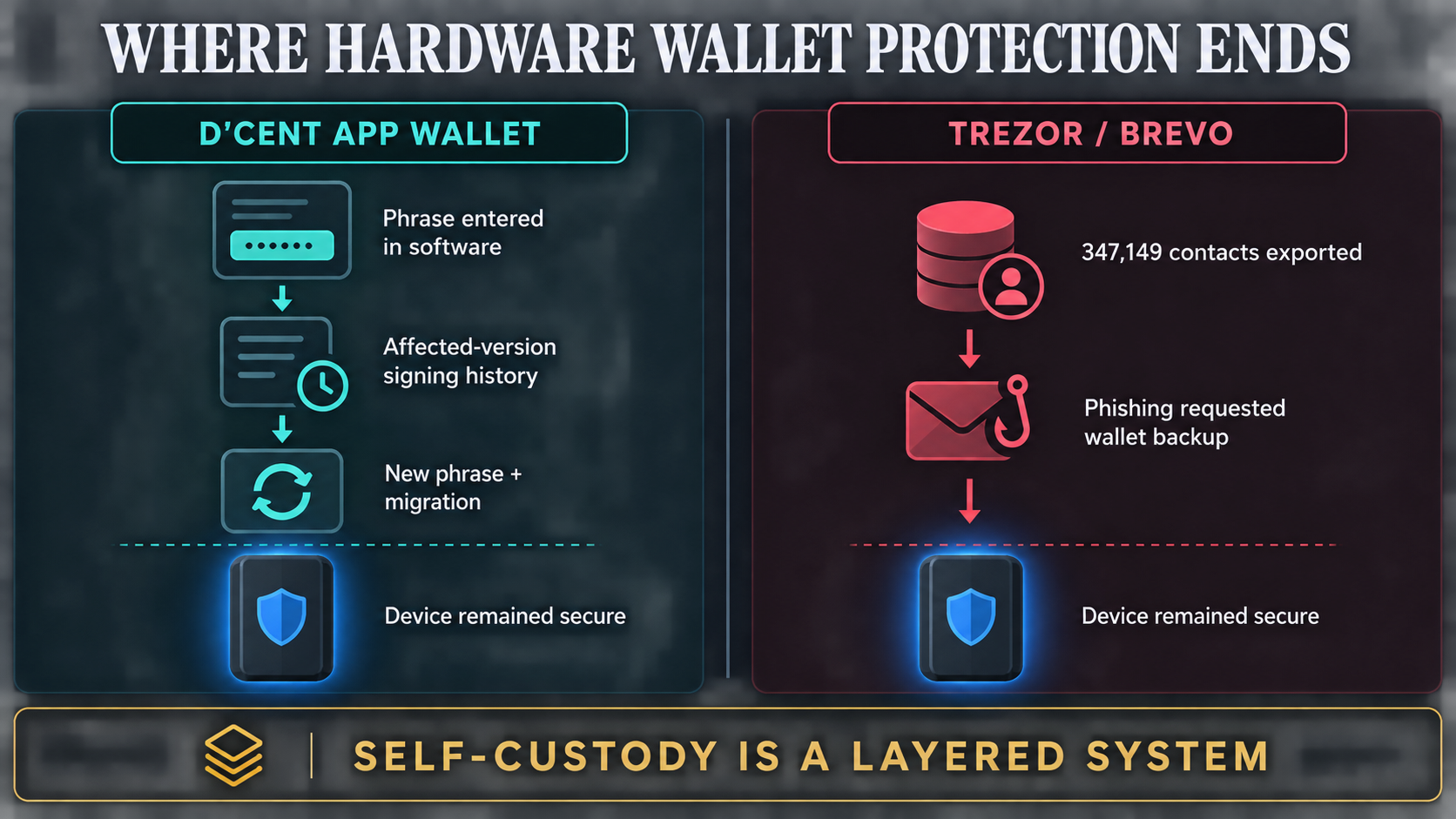
D’CENT, a popular hardware wallet in South Korea, said it is investigating unauthorized transfers from some users of its software-based App Wallet, while Trezor, another crypto hardware firm, disclosed that attackers exported 347,149 customer email contacts after breaching third-party marketing provider Brevo.
Neither company has reported a compromise of its hardware-wallet security.
Yet both incidents created routes to the same prize: the recovery phrase that can reconstruct a wallet and control its assets.
D’CENT phrase reuse pulls hardware assets into software risk
D’CENT’s investigation shows how moving a recovery phrase into software can extend risk beyond the device where the wallet was originally created.
The company first received reports of unauthorized transfers on Sept. 16 and found that most affected users were operating its App Wallet, which stores or imports keys on a phone. D’CENT has not confirmed a compromise affecting its hardware products and continues to investigate the cause and total scope of the transfers.
Its current criteria focus on wallets whose recovery phrases were entered into the App Wallet and that had transaction-signing history on versions earlier than 8.1.0, released Nov. 5, 2025. The potential exposure spans Bitcoin, Ethereum, XRP Ledger, Tron, and other EVM-compatible networks.
Market Context
Bitcoin
BTC
$83,939
-0.61% (24H)
Market Cap
$1.68T
24H Volume
$26.7B
24H High
$85,247
Article Intelligence
Topics
Regulation Signal
in progressUpdated 2 个月前
SEC Crypto Asset Market Structure RulemakingRelated Coverage
 CryptoGaps In FCA's Crypto-Regime Leave Insider Dealing Risk1 小时前 · 1 min read
 CryptoStrategy seeks shareholder approval for daily preferred stock dividends2 小时前 · 2 min read
Sponsored
Ad
NewsLayerLearn more
NewsLayer Premium
Unlock deeper intelligence.
Ad-free reading, exclusive research, and real-time onchain insights.
Go Premium