
Tel Aviv-based photonic hardware developer Quantum Source has published the technical details of its proprietary quantum interconnect, QS-LINK. Designed to address scaling limits in multi-processor quantum networks, the system utilizes a single cavity-trapped rubidium-87 atom as an asynchronous quantum memory buffer to establish remote entanglement between separate quantum processing units (QPUs). The architecture operates at room temperature over standard optical fiber and supports multi-vendor interconnectivity across distinct physical hardware modalities, including trapped-ion, neutral-atom, superconducting, and photonic platforms.
Quantum Source Introduces Memory-Assisted Photonic Interconnect to Unify Multi-Modal Quantum Computing
Tel Aviv-based photonic hardware developer Quantum Source has published the technical details of its proprietary quantum interconnect, QS-LINK. Designed to address scaling limits in multi-processor quantum networks, the system utilizes…
Quantum Computing Report
Publisher
Oct 8, 2026 at 5:37 PM UTC · Updated an hour ago · 2 min read
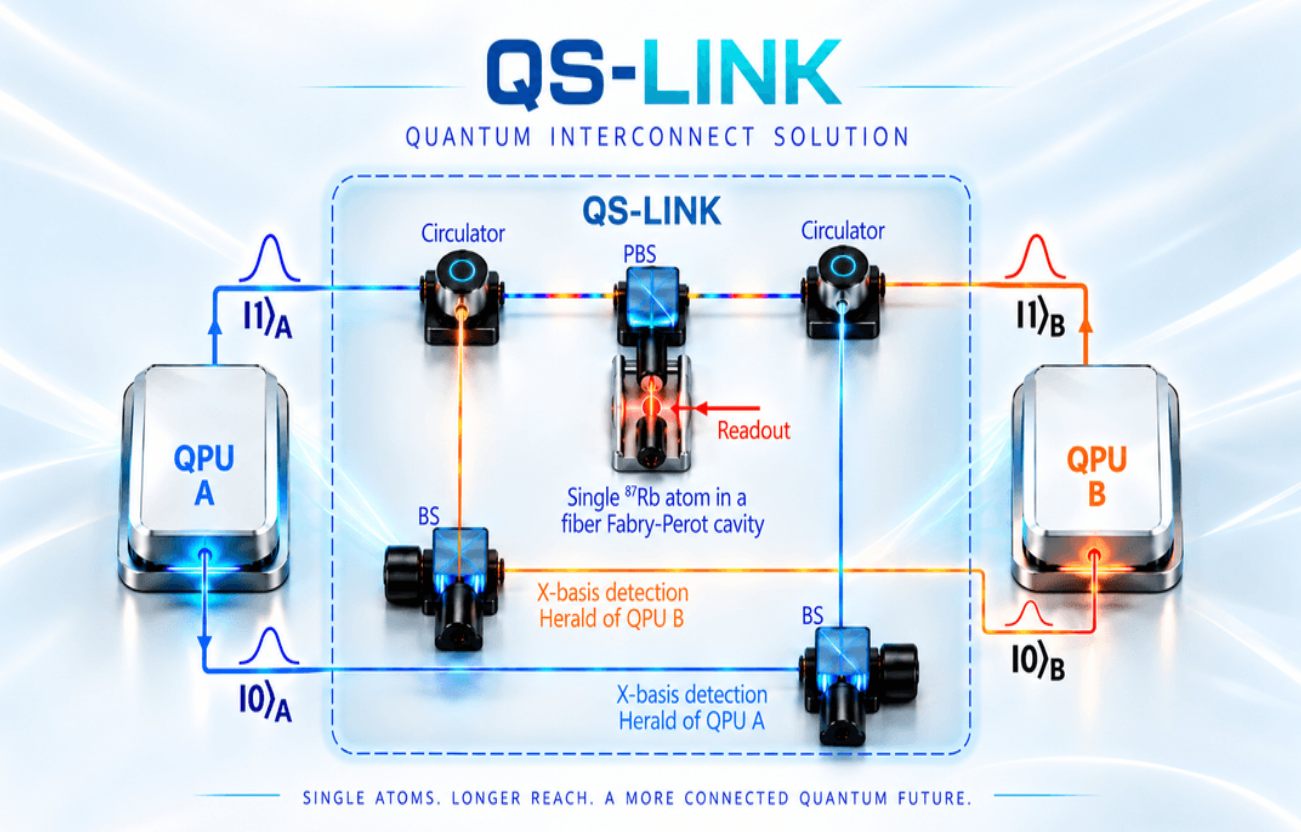
Conventional photonic Bell-state measurements (BSM) rely on linear-optics type-II fusion gates, which require photons from two independent QPUs to arrive simultaneously at a beam splitter in identical quantum states. Because per-attempt photon delivery probabilities (p) across fiber channels typically remain at or below 1%, simultaneous arrival succeeds probabilistically at an order of p2 (roughly once in 10,000 attempts). QS-LINK replaces the two-photon interference requirement with a single-atom cavity quantum electrodynamics (QED) interface. The trapped atom executes a near-deterministic controlled-Z (CZ) gate with an incoming photon from the first QPU, storing the resulting atom-QPU entanglement state while the second QPU continues execution attempts. Once a photon from the second QPU interacts with the atom, a local atomic state measurement projects the two remote QPUs into a shared Bell pair.
Article Intelligence
Related Coverage
 QuantumFujitsu to establish quantum computing research center in New Mexico4 hours ago · 1 min read
 QuantumUniversal Quantum Closes $100 Million Series A to Accelerate Modular Trapped-Ion Architecture Scaling5 hours ago · 2 min read
 ResearchFujitsu deal brings quantum research center to New Mexico2 hours ago · 3 min read
NewsLayer Premium
Unlock deeper intelligence.
Ad-free reading, exclusive research, and real-time onchain insights.
Go Premium