
The Bank of Russia has proposed a 1% crypto capital cap, limiting covered crypto and foreign-digital-instrument risk to a bank’s own funds while leaving some client custody positions outside the new calculation.
Why Russia’s harsh 1% crypto cap actually protects bank customer assets
The Bank of Russia has proposed a 1% crypto capital cap, limiting covered crypto and foreign-digital-instrument risk to a bank’s own funds while leaving some client custody positions outside the new calculation.
CryptoRank
Publisher
Sep 20, 2026 at 1:59 PM UTC · 2 min de lecture
Traduction…
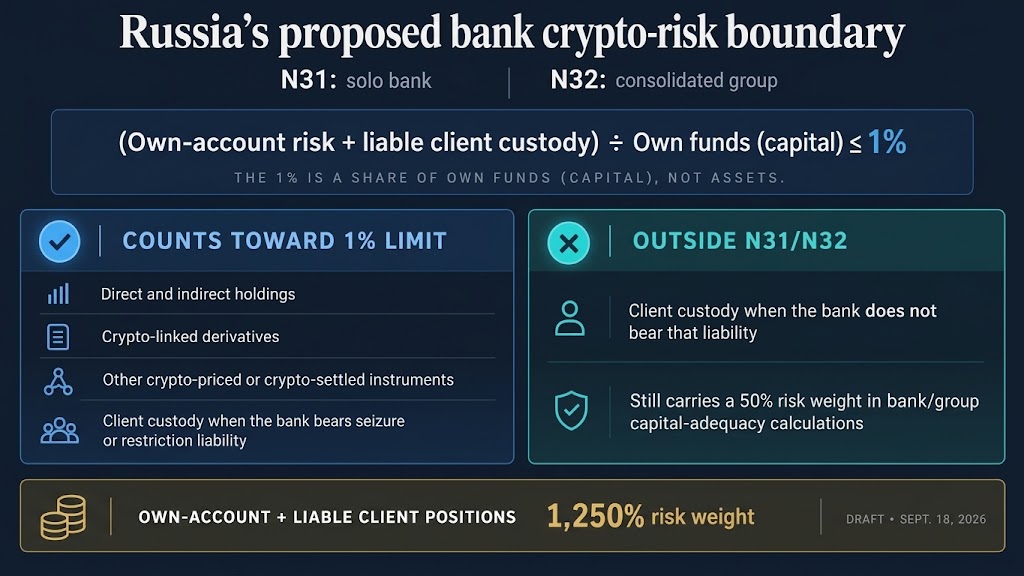
The Sept. 18 proposal would create N31 for individual credit institutions and N32 for banking groups on a consolidated basis. Each ratio compares covered exposure with the relevant institution’s capital, not its total assets. The rules remain in draft form.
The two-level structure subjects both a bank and its wider group to the same proposed percentage ceiling. N31 uses the individual institution’s own funds, while N32 uses consolidated group capital, keeping the measurement tied to the entity that carries the covered risk.
What the 1% crypto capital cap captures
The draft regulation reaches beyond coins held outright. Its numerator includes direct and indirect investments, derivatives tied to crypto prices, and instruments such as loans, bonds, guarantees, repos and credit lines when their settlement or value depends on crypto or foreign digital instruments.
Banks would receive limited recognition for hedges. Long and short positions may be netted only within the draft’s qualifying lower-risk category, which imposes conditions tied to the asset, settlement and maturity as well as freezing and liquidity risk. Direct holdings and other higher-risk exposures are measured more conservatively and cannot be fully neutralized by an offsetting position.
Article Intelligence
Topics
Related Coverage
 CryptoSEC's new tokenized-stock rules could boost Coi...il y a 2 heures · 1 min read
 PolicyGemini’s exchange business is shrinking. Its regulatory licenses may be the real prizeil y a 3 heures · 1 min read
 CryptoCrypto regulation push collapses as industry infighting saps support (BTC-USD:Cryptocurrency)il y a 3 heures · 1 min read
Sponsored
Ad
NewsLayerLearn more
NewsLayer Premium
Unlock deeper intelligence.
Ad-free reading, exclusive research, and real-time onchain insights.
Go Premium