

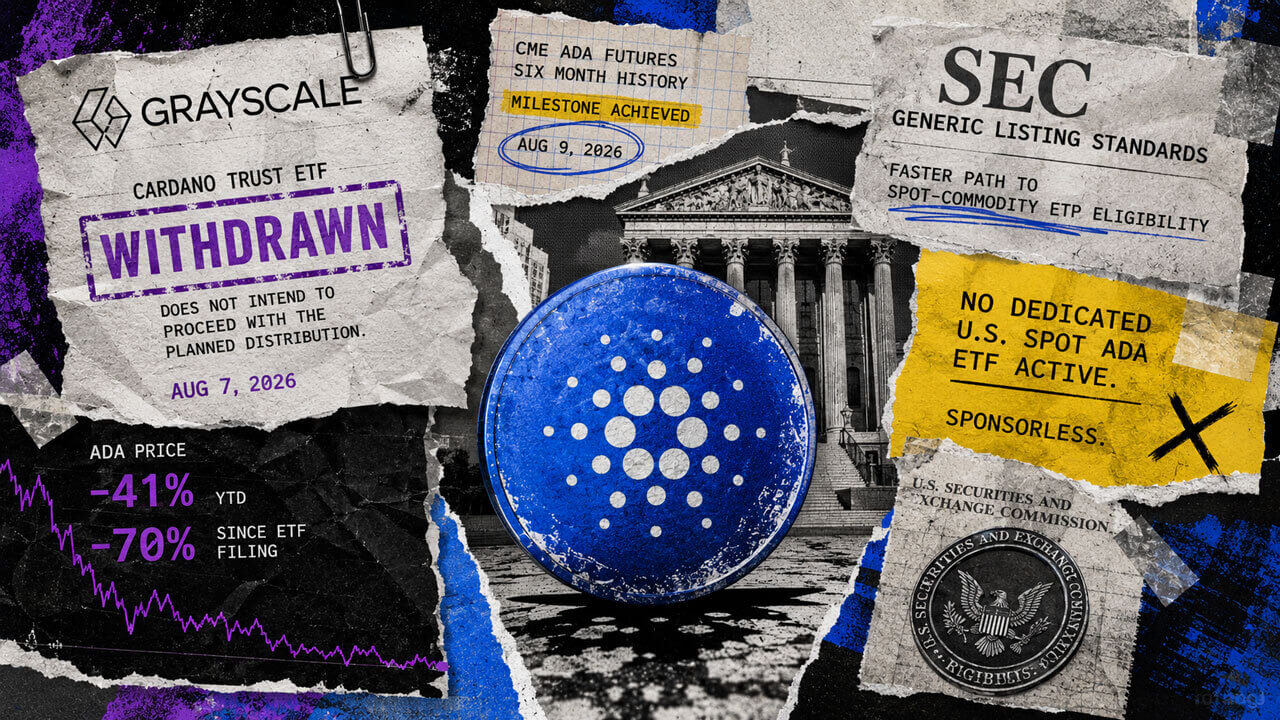
Grayscale withdrew its registration for the Cardano Trust ETF on Aug. 7, telling the SEC only that it “does not intend to proceed with the planned distribution.”
The move was voluntary and came along with parallel registrations for Hedera and Polkadot, within about three minutes of each other that same afternoon.
Two days later, ADA crossed a regulatory threshold that could have made its case for a spot ETF considerably easier. CME's regulated ADA futures had traded for six months as of Aug. 9, the track record the SEC's generic listing framework accepts as one path to spot-commodity ETP eligibility.
Cardano's only dedicated spot applicant walked away right before the rule that could have helped it took effect.
| Date | Event | Why it matters for ADA |
|---|---|---|
| Feb. 9, 2026 | CME ADA futures begin trading | Starts the six-month regulated futures clock |
| Aug. 7, 2026 | Grayscale withdraws Cardano Trust ETF registration | Removes the only dedicated U.S. spot ADA ETF filing |
| Aug. 7, 2026 | Grayscale also withdraws HBAR and DOT filings | Suggests broader product-priority decision, not necessarily an ADA-specific issue |
| Aug. 9, 2026 | ADA reaches six months of CME futures history | ADA crosses a key eligibility route under generic listing standards |
| After Aug. 9 | No other dedicated U.S. spot ADA filing appears active | ADA becomes eligible-looking but sponsorless |
What is fact and what is inference
Other Grayscale altcoin registrations, including Bittensor, Aave, BNB, NEAR, and Zcash, remained active and preliminary the next day. That pattern points to a portfolio-level product decision, though Grayscale has not confirmed why it walked away.
ADA has also fallen more than 41% year-to-date and roughly 70% since Grayscale's original ETF filing. That decline fits a broader story about shrinking appetite for altcoin products, but it does not confirm what Grayscale was weighing when it pulled the filing.
The registration of the Grayscale Cardano Trust ETF never became effective, and the filing states plainly that no securities were issued or sold under it. There was no operating fund holding ADA, so there was nothing to unwind.
The only dedicated US spot ETF application built to hold ADA itself is gone. A vehicle like that would have allowed brokerage and institutional demand to convert directly into ADA purchases every time new shares were created.