This website uses cookies
We use cookies to personalise content and ads, to provide social media features and to analyse our traffic. We also share information about your use of our site with our social media, advertising and analytics partners who may combine it with other information that you’ve provided to them or that they’ve collected from your use of their services.
Consent Selection
Details
  • Necessary cookies help make a website usable by enabling basic functions like page navigation and access to secure areas of the website. The website cannot function properly without these cookies.
  • Preference cookies enable a website to remember information that changes the way the website behaves or looks, like your preferred language or the region that you are in.
    • We do not use cookies of this type.

  • Statistic cookies help website owners to understand how visitors interact with websites by collecting and reporting information anonymously.
    • We do not use cookies of this type.

  • Marketing cookies are used to track visitors across websites. The intention is to display ads that are relevant and engaging for the individual user and thereby more valuable for publishers and third party advertisers.
    • We do not use cookies of this type.

  • Unclassified cookies are cookies that we are in the process of classifying, together with the providers of individual cookies.
    • __emg_sidPending
      Maximum Storage Duration: 1 dayType: HTTP Cookie
      __emg_vidPending
      Maximum Storage Duration: 1 yearType: HTTP Cookie
      nl-read-countPending
      Maximum Storage Duration: PersistentType: HTML Local Storage
Cookie declaration last updated on 8/12/26 by Cookiebot
[#IABV2_TITLE#]
[#IABV2_BODY_INTRO#]
[#IABV2_BODY_LEGITIMATE_INTEREST_INTRO#]
[#IABV2_BODY_PREFERENCE_INTRO#]
[#IABV2_BODY_PURPOSES_INTRO#]
[#IABV2_BODY_PURPOSES#]
[#IABV2_BODY_FEATURES_INTRO#]
[#IABV2_BODY_FEATURES#]
[#IABV2_BODY_PARTNERS_INTRO#]
[#IABV2_BODY_PARTNERS#]
About
Cookies are small text files that can be used by websites to make a user's experience more efficient.

The law states that we can store cookies on your device if they are strictly necessary for the operation of this site. For all other types of cookies we need your permission.

This site uses different types of cookies. Some cookies are placed by third party services that appear on our pages.

You can at any time change or withdraw your consent from the Cookie Declaration on our website.

Learn more about who we are, how you can contact us and how we process personal data in our Privacy Policy.

Please state your consent ID and date when you contact us regarding your consent.
NewsLayer

Install NewsLayer

Get the app experience — one tap from your home screen, instant loads and breaking-news alerts.

NewsLayer.com
NewsLayer PulseLIVEBTC$63,642+0.36%ETH$1,886+0.43%SOL$75.91+0.46%XRP$1.01+0.55%DOGE$0.0704+1.13%ADA$0.1852+1.59%Total Cap$2.28T-0.40%Layer Index42 Neutral
BreakingExternal ReportingPublié il y a 15 heures

After Coldcard Was Hacked, $15 Billion in Bitcoin Moved to Safety

In the days after the worst hardware wallet exploit in Bitcoin’s recent history, Casa CEO Nick Neuman began counting more than just the BTC being drained from vulnerable Coldcard wallets.

After Coldcard Was Hacked, $15 Billion in Bitcoin Moved to Safety
Source Decrypt 3 min de lecture
Image via Decrypt

Market Context

Bitcoin

BTC

$63,642

+0.36% 24h

Layer Index

42

↑ 7 pts in 24h

In brief

  • The Coldcard firmware exploit drained approximately 2,100 BTC, with losses estimated near $130 million across multiple attack waves.
  • Onchain data from Checkonchain shows 233,000 BTC left long-term holder wallets in the days around the breach.
  • Casa CEO Nick Neuman, citing actual customer conversations, says some of that 233,000 BTC came from Ledger and Trezor users—not Coldcard owners—who upgraded to multisig after watching the hack unfold.

In the days after the worst hardware wallet exploit in Bitcoin’s recent history, Casa CEO Nick Neuman began counting more than just the BTC being drained from vulnerable Coldcard wallets.

While attackers were draining Coldcard wallets one address at a time, 233,000 BTC—worth about $15 billion at today’s prices—was quietly moving in search of safety.
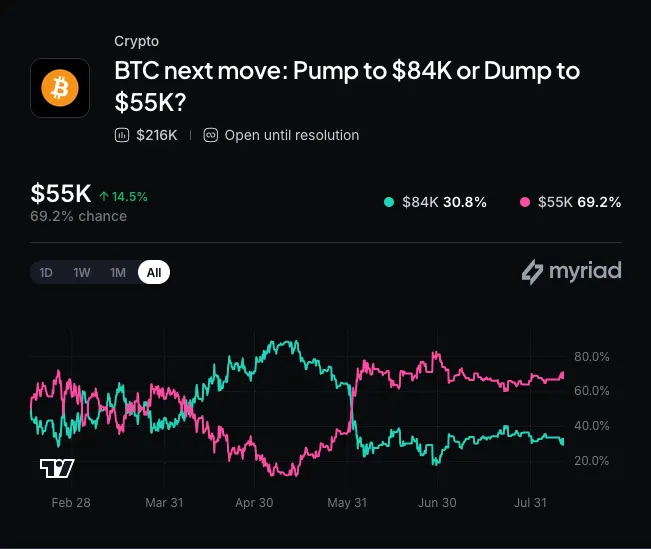
Myriad: Bitcoin's next move? Click to make your prediction.

The massive and ongoing breach that started on July 30 has already led to close to $130 million in stolen Bitcoin from Coldcard hardware wallets—physical gadgets that store private keys entirely offline, never connecting to the internet, and made by Canadian company Coinkite.

A firmware bug introduced in March 2021 had routed key generation through a weak software random number generator instead of the device's dedicated hardware chip. Private keys (the secret codes that prove ownership of Bitcoin and authorize any transaction) became guessable, with security collapsing from 128 bits to roughly 40—the cryptographic equivalent of a bank vault that turns out to have a four-digit PIN.

Galaxy Research tracked the fallout across three confirmed attack waves, with losses reaching approximately 1,596 BTC across more than 5,200 addresses.

Casa’s Neuman, earlier this week, posted the on-chain numbers from analyst James Check of Checkonchain to make an argument for Bitcoin’s resilience. Self-custody, holding your own private keys rather than leaving Bitcoin with an exchange or custodian, didn't buckle under pressure but instead adapted, he argued.

"The onchain metrics around the Coldcard incident reinforce how important self-custody is to the resilience of Bitcoin as an asset class," Neuman wrote on X.

The breakdown Neumann cited in his post, drawing Checkonchain’s onchain data: 2,100 BTC stolen (higher than Galaxy's own accouting), and 22,000 BTC moved to exchanges. And 233,000 BTC moved out of long-term holder wallets—addresses dormant for at least 155 days, a cohort analysts watch as a proxy for serious, patient investors—into safety. That’s more than 100 times what the attackers took.


Some of that came from Coldcard users migrating to multisig wallets (setups requiring multiple independent keys to approve any transaction, so no single compromised device can drain everything). Some came from holders on Ledger and Trezor—entirely different hardware—who used the hack as a wake-up call.

Casa confirmed both patterns from actual customer conversations. "So somewhere between ~10x-100x the amount of bitcoin stolen was moved to safety as people sounded the alarm," Neuman wrote.

When a centralized exchange gets breached, everything goes at once. Here, the attacker had to crack addresses individually, earning a trickle at a time while the rest of the network had time to respond. "This is a giant flashing neon sign showcasing the resilience that self-custody adds to the network," Neuman wrote. "If all that BTC was held at a custodian and the custodian was hacked instead, those numbers would have been flipped."

Data from analytics company Glassnode confirms the scale: long-term holder supply dropped from nearly 15 million BTC to approximately 14.7 million—the largest weekly decline since December 2024. It happened while Bitcoin traded roughly 50% below its all-time high of $126,000, set in October 2025.

Coinkite has urged anyone who generated a seed on firmware versions 4.0.1 through 4.1.9—covering March 2021 to July 2026—to treat those wallets as compromised and migrate to a new seed immediately.

Daily Debrief Newsletter

Start every day with the top news stories right now, plus original features, a podcast, videos and more.

Follow the Story

  1. Aug 12After Coldcard Was Hacked, $15 Billion in Bitcoin Moved to Safety
  2. Aug 13Bitcoin holds $63K support amid $226M whale sho...
  3. Aug 13Ethereum ETFs outpace Bitcoin ETFs in July, sig...
  4. Aug 13Brazil’s largest bitcoin treasury firm plans ETF with 95% allocation to Strategy's STRC

Attribution

Originally reported by Decrypt

Dernière Minute

Ne manquez aucune actualité de dernière minute

Les grandes nouvelles vont vite — recevez-les en premier sur X et Telegram.

Get stories like this, daily.

Daily crypto + regulation intelligence, straight to your inbox. Free.

Articles Liés