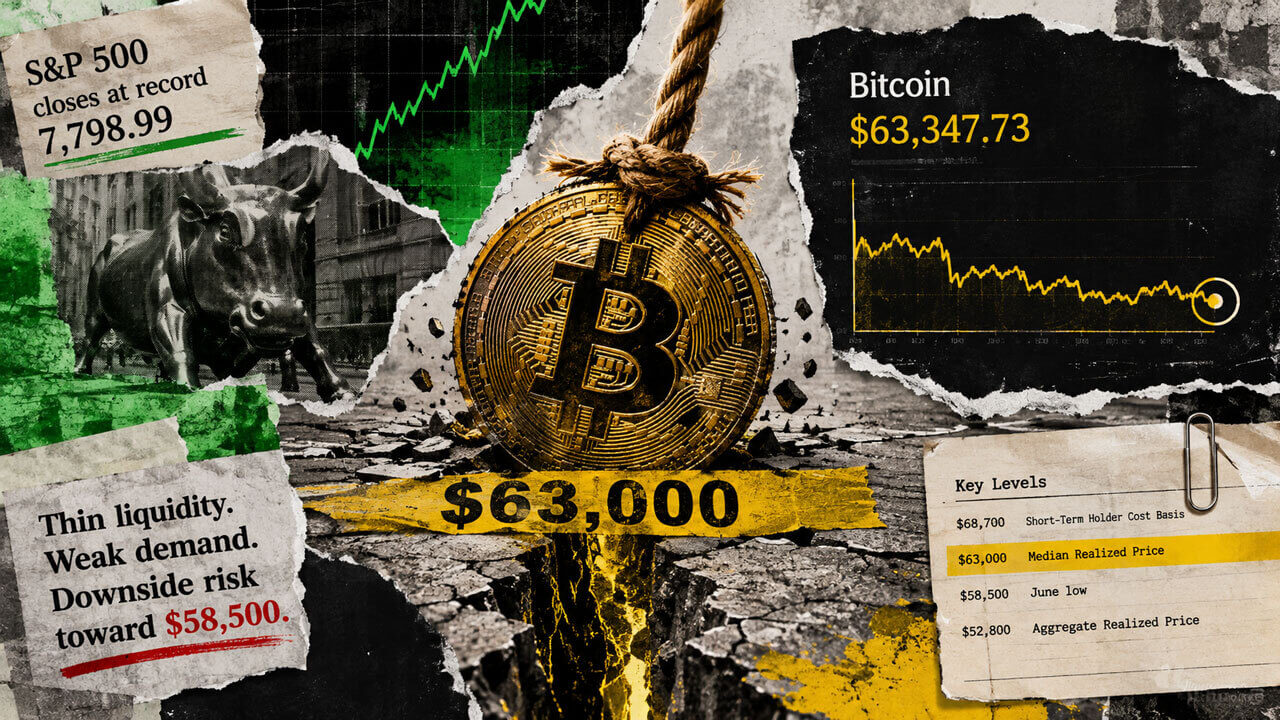
That setup matters for Bitcoin because the asset has historically tracked equities during panics. During the 2020 COVID-19 selloff, BTC fell with stocks rather than holding firm as a safe haven.
XWIN Sees Bitcoin Turning Into a Hybrid Asset
That relationship began to shift in 2025. While the S&P 500 has traded in a tight band, Bitcoin has shown larger swings driven by ETF demand, leverage activity, and crypto-native flows.
The firm concluded that Bitcoin may be turning into a hybrid asset, still tied to macro liquidity yet more capable of moving on its own.
If future conditions bring Fed easing, a weaker dollar, and renewed ETF inflows, XWIN wrote, Bitcoin could become "a secondary liquidity destination rather than simply a correlated tech-like asset." A separate Goldman Sachs report this month reinforced that backdrop, finding hedge funds entered the second quarter with record-high exposure to semiconductors.
On-Chain Activity Cools as Traders Watch $78,000
Network activity has dropped off during the current consolidation. Analyst Ali Martinez flagged that active addresses fell nearly 40% in two weeks, sliding to about 494,000 from roughly 821,000.
He said thinning activity during sideways trading usually means short-term speculators are stepping aside while longer-term holders keep their supply. On-chain data also showed large holders redistributing more than 18,000 BTC during the same stretch.
Martinez added that derivatives traders are leaning toward a breakout, with funding rates recently touching 0.4%, their highest in more than two months. He placed resistance near $78,000 and support around $76,000, with a clean break higher possibly opening a path toward $85,000.
Bitcoin slid below $74,000 over the weekend before recovering past $77,000 on reports of progress toward a US-Iran ceasefire. The asset has since slipped a few hundred dollars back under $77,000, leaving it down almost 30% over the past year.

Steven Zeiler is Chief Evangelist at Yellow, working with builders to create real-time, non-custodial trading infrastructure using the Yellow SDK. A programmer, technologist, and entrepreneur, he previously worked for Ripple, where he helped architect peer-to-peer interbank payment prototypes and contributed to decentralizing the XRP Ledger through consensus tracking software.