This website uses cookies
We use cookies to personalise content and ads, to provide social media features and to analyse our traffic. We also share information about your use of our site with our social media, advertising and analytics partners who may combine it with other information that you’ve provided to them or that they’ve collected from your use of their services.
Consent Selection
Details
  • Necessary cookies help make a website usable by enabling basic functions like page navigation and access to secure areas of the website. The website cannot function properly without these cookies.
  • Preference cookies enable a website to remember information that changes the way the website behaves or looks, like your preferred language or the region that you are in.
    • We do not use cookies of this type.

  • Statistic cookies help website owners to understand how visitors interact with websites by collecting and reporting information anonymously.
    • We do not use cookies of this type.

  • Marketing cookies are used to track visitors across websites. The intention is to display ads that are relevant and engaging for the individual user and thereby more valuable for publishers and third party advertisers.
    • We do not use cookies of this type.

  • Unclassified cookies are cookies that we are in the process of classifying, together with the providers of individual cookies.
    • __emg_sidPending
      Maximum Storage Duration: 1 dayType: HTTP Cookie
      __emg_vidPending
      Maximum Storage Duration: 1 yearType: HTTP Cookie
      nl-read-countPending
      Maximum Storage Duration: PersistentType: HTML Local Storage
Cookie declaration last updated on 8/12/26 by Cookiebot
[#IABV2_TITLE#]
[#IABV2_BODY_INTRO#]
[#IABV2_BODY_LEGITIMATE_INTEREST_INTRO#]
[#IABV2_BODY_PREFERENCE_INTRO#]
[#IABV2_BODY_PURPOSES_INTRO#]
[#IABV2_BODY_PURPOSES#]
[#IABV2_BODY_FEATURES_INTRO#]
[#IABV2_BODY_FEATURES#]
[#IABV2_BODY_PARTNERS_INTRO#]
[#IABV2_BODY_PARTNERS#]
About
Cookies are small text files that can be used by websites to make a user's experience more efficient.

The law states that we can store cookies on your device if they are strictly necessary for the operation of this site. For all other types of cookies we need your permission.

This site uses different types of cookies. Some cookies are placed by third party services that appear on our pages.

You can at any time change or withdraw your consent from the Cookie Declaration on our website.

Learn more about who we are, how you can contact us and how we process personal data in our Privacy Policy.

Please state your consent ID and date when you contact us regarding your consent.
NewsLayer

Install NewsLayer

Get the app experience — one tap from your home screen, instant loads and breaking-news alerts.

NewsLayer.com
NewsLayer PulseLIVEBTC$63,382-0.05%ETH$1,887+0.48%SOL$76.08+0.69%XRP$1.01+0.22%DOGE$0.0702+0.87%ADA$0.1817-0.37%Total Cap$2.28T+0.02%Layer Index45 Neutral
BreakingExternal Reporting公開 2日前

Coldcard hack losses: How investigators trace stolen Bitcoin

The Coldcard hack has no definitive loss figure yet as investigators rely on victim reports and on-chain analysis that produce varying estimates.

Coldcard hack losses: How investigators trace stolen Bitcoin
著者 Cointelegraph by Helen PartzPublisher Cointelegraph 2 分で読める
Image via Cointelegraph

Market Context

Bitcoin

BTC

$63,382

-0.05% 24h

ETH$1,887+0.48%

Layer Index

45

↑ 10 pts in 24h

The Coldcard hack is testing crypto investigators’ ability to measure losses from self-custody wallets, where victim reports are critical to establishing the scale of the theft.

Blockchain analytics platform CryptoQuant currently puts confirmed losses at 1,432 Bitcoin, while other analysts have traced substantially more funds to the attack.

Galaxy Research and blockchain intelligence company TRM Labs both say their analysis points to a higher toll, while distinguishing between losses directly confirmed by victims and funds attributed to the attack through on-chain patterns.

That makes self-custody attacks difficult to quantify: Unlike an exchange hack, there is no complete list of affected accounts, leaving investigators to build estimates rather than pin down a definitive toll.

Galaxy traces losses beyond victim reports

Galaxy’s Alex Thorn told Cointelegraph the platform’s earlier estimate of as much as 1,816 BTC was a potential figure rather than a confirmed loss total.

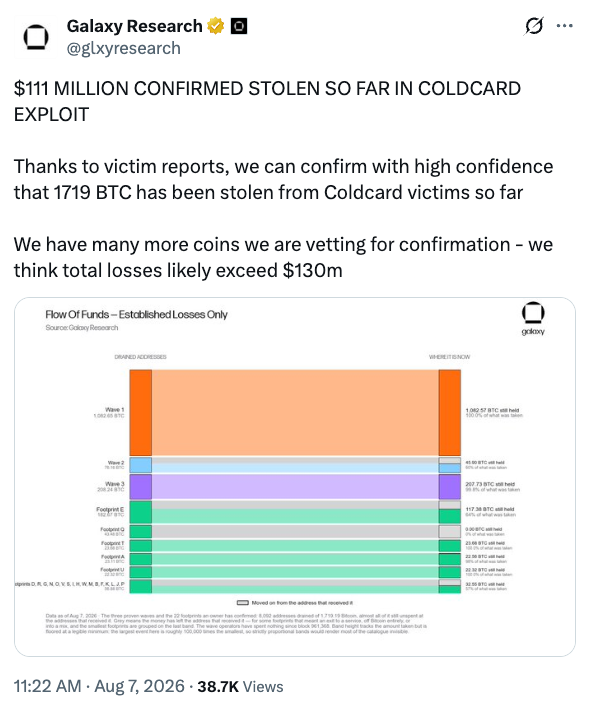
As of Tuesday, Galaxy put its high-confidence minimum at 1,730 Bitcoin, with Thorn saying the figure could still increase as more victim reports corroborate attack patterns.
Source: Galaxy Research

“We have directly confirmed 450+ BTC directly from victim reports, but their reports have helped identify other, as-yet-unknown victims in more than 730 total BTC,” Thorn said. Galaxy uses those reports to corroborate broader attack patterns, while withholding funds it suspects but cannot yet sufficiently verify. “We are still withholding many more BTC we suspect but for which we lack sufficient corroboration,” Thorn said.

Related: Coldcard hackers transfer 64 BTC and 200 ETH to cryptocurrency mixers

TRM Labs said its independent tracing lands in the same range as Galaxy, while its recent analysis estimated that attackers drained about 1,816 BTC from more than 5,200 addresses across four waves. “Investigators should expect the estimate to keep moving upward before it stabilizes,” TRM’s global head of policy Ari Redbord told Cointelegraph.

CryptoQuant takes a stricter approach

CryptoQuant’s head of research, Julio Moreno, told Cointelegraph that the company starts with public reports from victims, including wallet addresses or transaction IDs, and then checks those reports against known on-chain patterns from the attack.

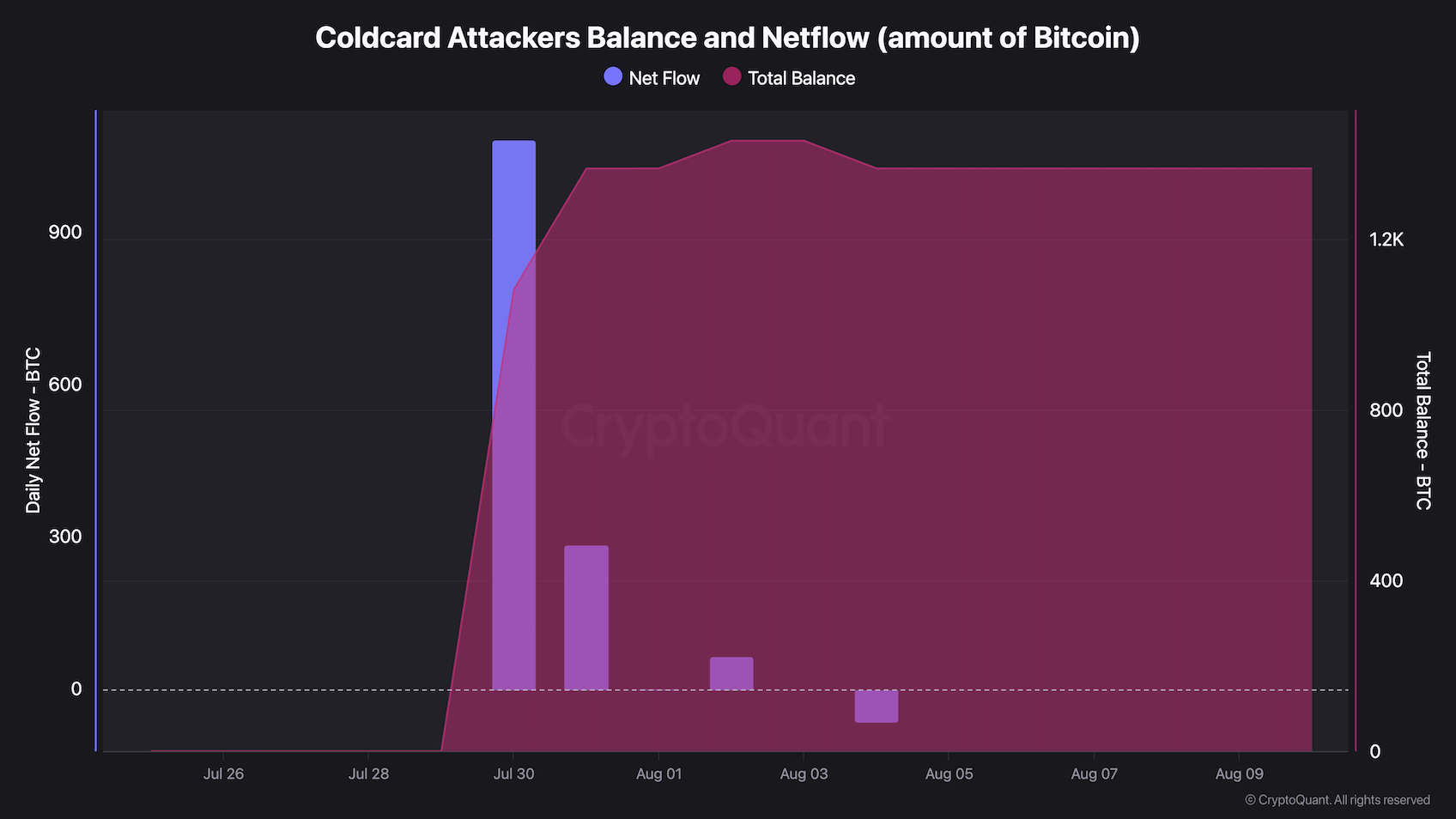
That approach puts CryptoQuant’s confirmed tally at 1,432 BTC, which Moreno described as a floor that could rise if more victims publicly disclose their hacked addresses.

Source: CryptoQuant

Moreno said CryptoQuant is cautious about identifying victims solely from on-chain patterns because doing so could produce false positives and inflate the estimate.

“Because the stolen Bitcoin belonged to individuals and not to a centralized entity, like an exchange, we can only confirm what each victim publicly discloses,” he said.

Hard number to pin down

Moreno emphasized the total will remain an estimate because investigators can only confirm what victims disclose. He said:

“Knowing the total BTC stolen is difficult, and it will always be an estimation.”

Chainalysis told Cointelegraph it has not conducted an independent tally of the losses, while blockchain investigator ZachXBT publicly said he has no plans to monitor or trace the incident.

Magazine: Do the Coldcard attacks mean all hardware wallets are now insecure?

Follow the Story

  1. Aug 11Coldcard hack losses: How investigators trace stolen Bitcoin
  2. Aug 13Silvia Files 5 ETFs Including Bitcoin Treasury mNAV Discount Fund
  3. Aug 13Swiss Banking Giant UBS Doubles Down on Bitcoin ETF Exposure
  4. Aug 13Bitcoin's Bear Cycle Looks Familiar — And That Might Be The Bullish Case

速報

速報を見逃さない

Reader Poll

Will investigators establish a definitive loss figure for the Coldcard hack?

Advertisement

House — Advertise on NewsLayer
NewsLayerAd

Sourced by

Originally reported by Cointelegraph

NewsLayer coverage based on externally reported material.

The Daily Brief

The onchain economy, before your day starts.

Curated markets, onchain insights, and key headlines — delivered every weekday morning.

Weekdays · Free · ~5 minute read

関連記事