This website uses cookies
We use cookies to personalise content and ads, to provide social media features and to analyse our traffic. We also share information about your use of our site with our social media, advertising and analytics partners who may combine it with other information that you’ve provided to them or that they’ve collected from your use of their services.
Consent Selection
Details
  • Necessary cookies help make a website usable by enabling basic functions like page navigation and access to secure areas of the website. The website cannot function properly without these cookies.
  • Preference cookies enable a website to remember information that changes the way the website behaves or looks, like your preferred language or the region that you are in.
    • We do not use cookies of this type.

  • Statistic cookies help website owners to understand how visitors interact with websites by collecting and reporting information anonymously.
    • We do not use cookies of this type.

  • Marketing cookies are used to track visitors across websites. The intention is to display ads that are relevant and engaging for the individual user and thereby more valuable for publishers and third party advertisers.
    • We do not use cookies of this type.

  • Unclassified cookies are cookies that we are in the process of classifying, together with the providers of individual cookies.
    • __emg_sidPending
      Maximum Storage Duration: 1 dayType: HTTP Cookie
      __emg_vidPending
      Maximum Storage Duration: 1 yearType: HTTP Cookie
      nl-read-countPending
      Maximum Storage Duration: PersistentType: HTML Local Storage
Cookie declaration last updated on 8/12/26 by Cookiebot
[#IABV2_TITLE#]
[#IABV2_BODY_INTRO#]
[#IABV2_BODY_LEGITIMATE_INTEREST_INTRO#]
[#IABV2_BODY_PREFERENCE_INTRO#]
[#IABV2_BODY_PURPOSES_INTRO#]
[#IABV2_BODY_PURPOSES#]
[#IABV2_BODY_FEATURES_INTRO#]
[#IABV2_BODY_FEATURES#]
[#IABV2_BODY_PARTNERS_INTRO#]
[#IABV2_BODY_PARTNERS#]
About
Cookies are small text files that can be used by websites to make a user's experience more efficient.

The law states that we can store cookies on your device if they are strictly necessary for the operation of this site. For all other types of cookies we need your permission.

This site uses different types of cookies. Some cookies are placed by third party services that appear on our pages.

You can at any time change or withdraw your consent from the Cookie Declaration on our website.

Learn more about who we are, how you can contact us and how we process personal data in our Privacy Policy.

Please state your consent ID and date when you contact us regarding your consent.
NewsLayer

Install NewsLayer

Get the app experience — one tap from your home screen, instant loads and breaking-news alerts.

NewsLayer.com
NewsLayer PulseLIVEBTC$63,166-0.41%ETH$1,885+0.02%SOL$75.55-0.87%XRP$1-0.56%DOGE$0.0699-0.23%ADA$0.1805-0.94%Total Cap$2.27T-0.06%Layer Index38 Fear
External Reporting公開 2時間前

SEC cancels crypto fundraising meeting, leaving token issuers with no new path to fund development

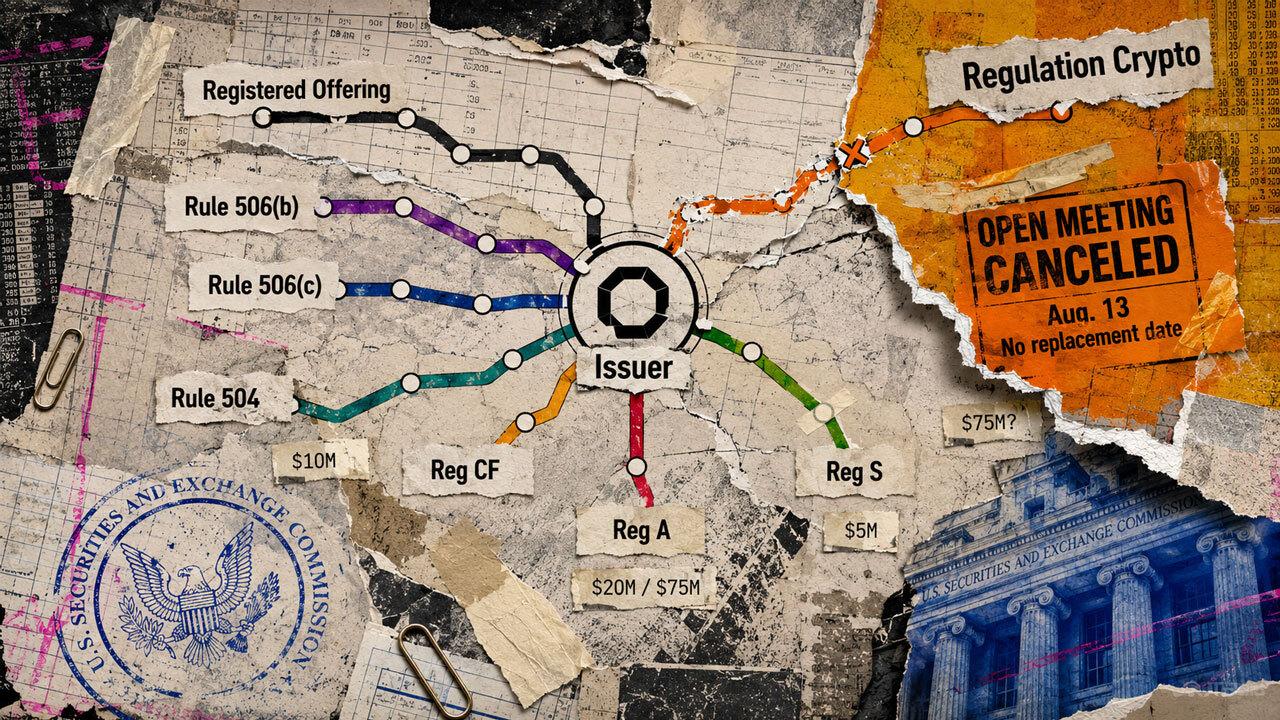
The US Securities and Exchange Commission canceled the open meeting scheduled for Friday morning, delaying the first public look at a possible crypto fundraising regime.

SEC cancels crypto fundraising meeting, leaving token issuers with no new path to fund development
Publisher CryptoSlate 5 分で読める
Image via CryptoSlate

Regulation Context

SEC Crypto Asset Market Structure Rulemaking
JurisdictionUnited States
RegulatorSEC
Statusin progress
Updated7日前

Layer Index

↓ 6 pts in 24h

The US Securities and Exchange Commission canceled the open meeting scheduled for Friday morning, delaying the first public look at a possible crypto fundraising regime.

The agency's Aug. 13 cancellation notice gave no reason or replacement date. The agenda called for commissioners to consider issuing a proposal for a tailored offering regime covering certain investment contracts involving crypto assets.

An affirmative vote would only have opened a rulemaking process. Adoption, an effective date and an issuer's ability to rely on any final exemption would have required later steps. Current law remains unchanged; the cancellation instead delays proposal text that could have revealed eligibility standards, disclosure duties and resale conditions.

That leaves issuers with greater clarity about when a token is separate from an investment contract, but no new crypto fundraising route for development. The available launch paths remain the existing registration and exemption framework.

What the March interpretation changes for crypto fundraising

The SEC's March interpretation separates a crypto asset from the transaction in which it is sold. A crypto asset that is not itself a security can still be offered as part of an investment contract when buyers invest in a common enterprise with a reasonable expectation of profits from an issuer's essential managerial efforts. The SEC's press release highlighted that asset-and-transaction distinction.

The relationship can change as a project develops. Once an issuer completes the essential work it promised, or buyers can no longer reasonably expect those efforts, the token can separate from the associated investment contract. The interpretation says obligations arising from the original investment-contract transaction survive that later separation: the original offer and sale still had to be registered or conducted under an available exemption.

The interpretation therefore resolves a classification question while leaving capital formation under the existing Securities Act framework. It encourages clear public disclosure of issuer promises and milestones that matter to the investment-contract analysis, yet it creates neither a fundraising exemption nor a standardized disclosure document for token launches.

A separate policy lane came from SEC Chair Paul Atkins. In March, he outlined personal ideas for startup, fundraising and investment-contract safe harbors, including a fundraising limit of “say $75 million” in 12 months. His remarks expressly presented the framework as his own thinking. The figure remains an illustration rather than an approved Commission ceiling, and the SEC's rulemaking index showed no published Regulation Crypto proposal as of Aug. 14.

For a development-stage issuer, that distinction reaches the timing of the raise. Buyers funding promised software, network growth or management activity can be purchasing an investment contract even when the transferable unit is a non-security crypto asset. Compliance attaches to the launch transaction when capital is raised. The possibility that the token will later trade separately cannot replace registration or an exemption for that original transaction.

The launch routes available now

Issuers whose token sales create investment contracts can still raise capital. The route determines who may buy, whether the offering can be marketed publicly, how much can be raised and which disclosures or intermediaries are required.

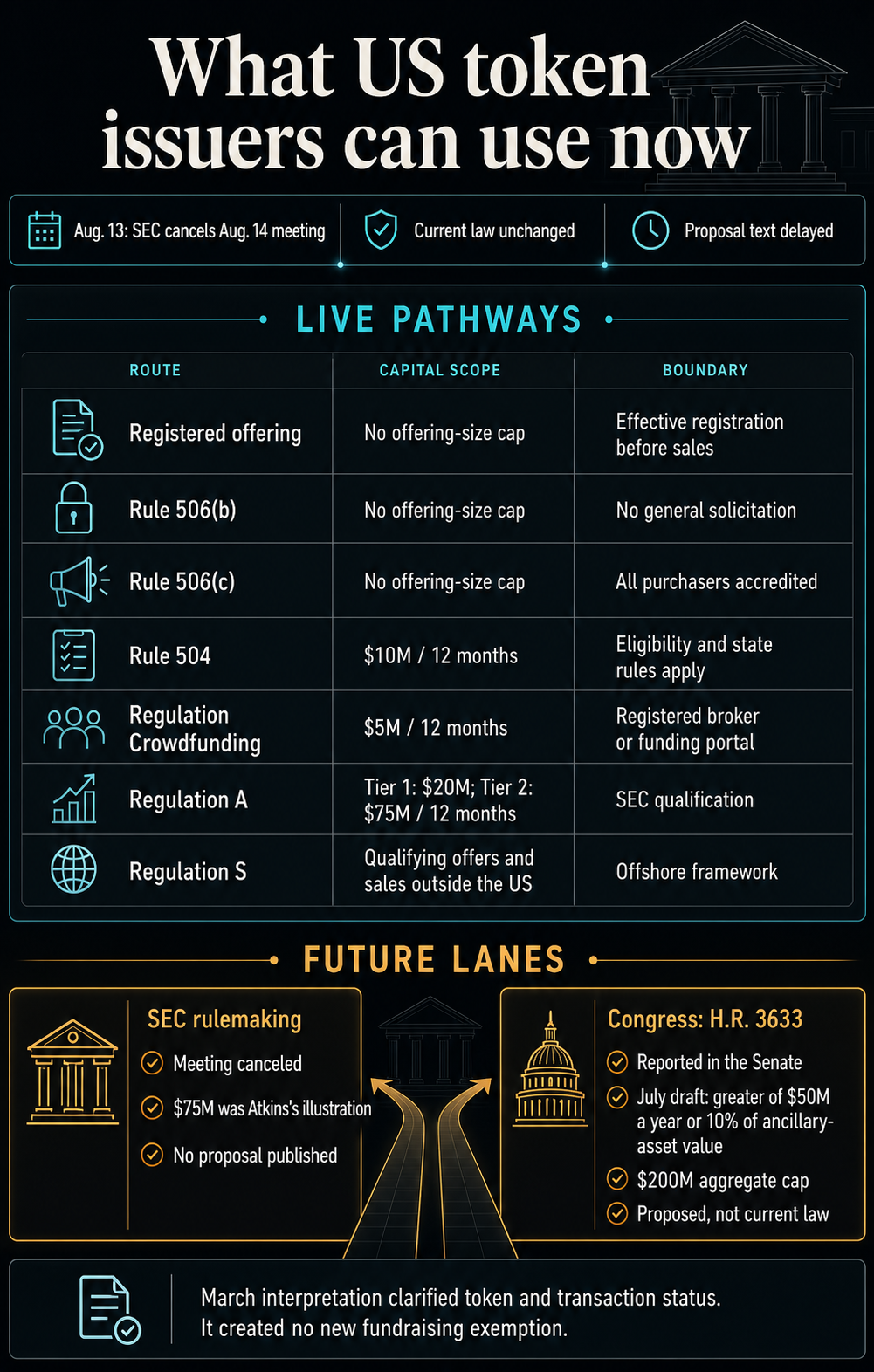
PathwayCapital availableMain boundary
Registered offeringNo offering-size capThe registration statement must become effective before sales, followed by applicable public-company obligations.
Rule 506(b)No offering-size capGeneral solicitation is prohibited; purchaser and disclosure conditions apply when non-accredited investors participate.
Rule 506(c)No offering-size capGeneral solicitation is permitted, but every purchaser must be accredited and the issuer must take reasonable verification steps.
Rule 504$10 million in 12 monthsIssuer eligibility, state-law requirements and offering conditions apply.
Regulation Crowdfunding$5 million in 12 monthsThe offering must use a registered broker-dealer or funding portal.
Regulation A$20 million for Tier 1 or $75 million for Tier 2 in 12 monthsThe SEC must qualify the offering, with applicable disclosure and reporting requirements.
Regulation SQualifying offers and sales outside the United StatesDomestic retail sales require another legal basis.

The SEC's offering-pathways guidance and exempt-offerings overview show the practical split. Rules 506(b) and 506(c) support private or accredited-investor capital without an offering cap, while Regulation Crowdfunding and Regulation A provide forms of broader access with dollar ceilings and added process. Rule 504 serves smaller raises. Regulation S separately covers qualifying offers and sales outside the United States.

CryptoSlate Daily Brief

Daily signals, zero noise.

Market-moving headlines and context delivered every morning in one tight read.

5-minute digest 100k+ readers

Free. No spam. Unsubscribe any time.

Whoops, looks like there was a problem. Please try again.

You’re subscribed. Welcome aboard.
Token projects can also face crypto-specific disclosure work within those general routes. A nonbinding Division of Corporation Finance staff statement says the relevant topics depend on the facts and materiality. They can include development milestones and funding needs, holder rights and transfer restrictions, token supply, technical and cybersecurity risks, financial statements, and code exhibits when code memorializes holder rights.

The practical dividing line is the fundraising transaction. A sale that falls outside an investment contract may avoid Securities Act registration for that transaction. A team financing unfinished work through promises of essential managerial effort must use a registered or exempt offering at launch, even if the token later separates from the investment contract.

Congress's proposed alternative

Congress has placed a tailored crypto fundraising route into legislative text, though issuers cannot use it today. The Senate Banking Committee released H.R. 3633 text ahead of markup and advanced the measure 15-9 in May. The official GovInfo record identifies it as reported in the Senate rather than enacted.

Senator Cynthia Lummis released updated text in July that would direct the SEC to create Regulation Crypto. For qualifying investment-contract transactions involving ancillary assets, the draft proposes an exemption for the greater of $50 million per calendar year for up to four years or 10% of outstanding ancillary-asset value, subject to a $200 million aggregate cap. It also proposes initial disclosures and a notice of reliance at least 30 days before the first covered offer.

Those mechanics belong to proposed legislation, separate from Atkins's illustrative $75 million concept and from any future SEC proposal. They would become relevant only after enactment and the rulemaking required by the bill.

For now, March guidance helps determine when a token is separate from an investment contract. Crypto fundraising for promised development work still runs through existing offering rules. The next agency signal would be a new meeting date or a published proposal on the SEC's meeting page or rulemaking index. Until then, investor eligibility, intermediary requirements, disclosure costs and resale conditions continue to shape which token launches can proceed.

速報

速報を見逃さない

Advertisement

House — Advertise on NewsLayer
NewsLayerAd

Sourced by

Originally reported by CryptoSlate

NewsLayer coverage based on externally reported material.

The Daily Brief

The onchain economy, before your day starts.

Curated markets, onchain insights, and key headlines — delivered every weekday morning.

Weekdays · Free · ~5 minute read

関連記事