
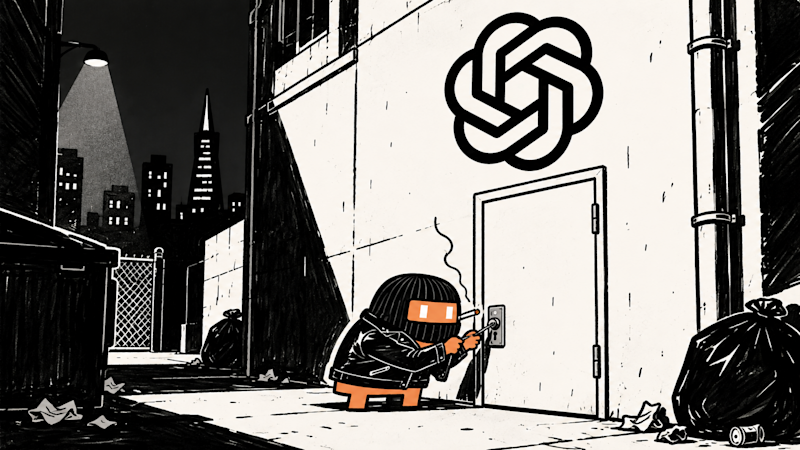
Security researchers say they used Anthropic’s newly released Claude Opus 5 to help turn an image-processing vulnerability into an exploit chain that compromised an OpenAI employee’s ChatGPT account and reached the company’s internal GitHub environment — an incident that illustrates how AI coding agents are changing the economics of sophisticated vulnerability exploitation.
breaking
OpenAI hacked by small team of white hat security researchers using Anthropic's Claude Opus 5
Security researchers say they used Anthropic’s newly released Claude Opus 5 to help turn an image-processing vulnerability into an exploit chain that compromised an OpenAI employee’s ChatGPT account and reached the company’s internal…
VentureBeat
Publisher
Sep 18, 2026 at 4:31 AM UTC · Updated há 44 minutos · 5 min de leitura
Traduzindo…
The researchers, part of security startup Hacktron AI, disclosed the operation this week after reporting it to OpenAI and Discourse in July. The Wall Street Journal independently reported that the team gained access to an OpenAI employee’s ChatGPT account and had a path to read and propose changes to private OpenAI software.
Hacktron says the researchers stopped short of examining sensitive source code. Instead, they used the compromised employee account’s access to Codex to create a harmless pull request in OpenAI’s internal monorepo, demonstrating that the account compromise could extend beyond ChatGPT itself into connected developer infrastructure. The company promoted a video released tonight by YouTuber @LiveOverflow discussing their approach:
The incident matters for enterprises because it combines three increasingly important security boundaries: vulnerable third-party infrastructure, federated identity and AI agents connected to business systems.
Article Intelligence
Topics
Related Coverage
 Artificial IntelligenceSecurity Researchers Hacked Into OpenAI Using Anthropic’s Claudehá 4 horas · 1 min read
 Artificial IntelligenceOpenAI breached by researchers using Anthropic modelshá 6 horas · 1 min read
 Artificial IntelligenceExclusive | Hackers Used Anthropic’s Claude to Break Into OpenAIhá 8 horas · 1 min read
Sponsored
Ad
NewsLayerLearn more
NewsLayer Premium
Unlock deeper intelligence.
Ad-free reading, exclusive research, and real-time onchain insights.
Go Premium