

Market expectations and market rallies often move hand in hand.
breaking
Soft U.S. CPI meets weak BTC: Is the ‘Bitcoin bottom’ thesis breaking?
Market expectations and market rallies often move hand in hand.
AMBCrypto
Publisher
Aug 13, 2026 at 7:00 AM UTC · 3 min de leitura

Key Signal
0.5% Bitcoin post-CPI gain
Entities
bitcoin
Market Impact
BTC-0.86%$83,119
Last Updated
há 2 meses
Traduzindo…
Keeping this in mind, the latest U.S. CPI data should have ideally triggered a stronger rally, especially with crypto consolidating in a tight range for over 6-7 weeks now.
Yet, the reaction was pretty muted, with Bitcoin [BTC] up just 0.5% and still capped below the $65k resistance. This came after U.S. CPI printed a 3.4% for July, exactly in line with expectations.
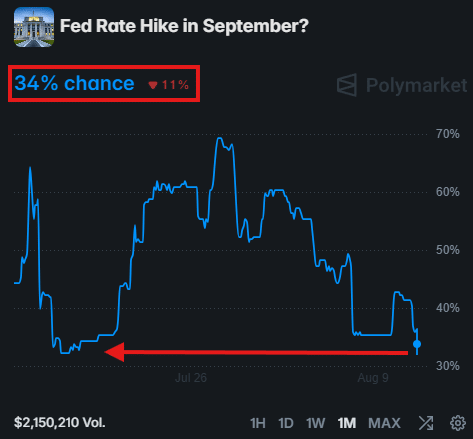
Further adding to the dovish expectations, market odds of a September rate hike fell to 34% after the U.S. CPI data was released.
This is the lowest probability of a September rate hike since the 17th of July, with odds now half of what they were on the 27th. In essence, rate hike expectations have cooled significantly.
Maksym Sakharov, co-founder and CEO of the debanking infrastructure provider WeFi, told AMBCrypto,
The softer print is welcome since the Fed will have more breathing room for deciding on a rate hike, but one release will not settle the argument over the inflation path due to pre-built volatility.
However, these macro tailwinds might just be the tip of the iceberg.
Across social media, the narrative around a “Bitcoin bottom” and a potential “short squeeze” is heating up. From BTC’s technical setup, these narratives aren’t completely far-fetched either.
Market Context
Bitcoin
BTC
$83,104
-0.88% (24H)
Market Cap
$1.67T
24H Volume
$28.0B
24H High
$84,355
Article Intelligence
Key Entities
Topics
Related Coverage
 CryptoBitcoin News Today: Metaplanet Adds 1,000 BTC as Remittix Counts Down to Its Token Debuthá 24 minutos · 1 min read
 CryptoBitcoin Cash News: Scrapped $10K Wallet Rule Revives Self-Custody as Remittix Strengthens Its Wallethá 25 minutos · 1 min read
 CryptoBitcoin falls below $83,000 amid $670M in U.S. government-linked transfershá 26 minutos · 1 min read
Sponsored
Ad
NewsLayerLearn more
NewsLayer Premium
Unlock deeper intelligence.
Ad-free reading, exclusive research, and real-time onchain insights.
Go Premium