

This website uses cookies
We use cookies to personalise content and ads, to provide social media features and to analyse our traffic. We also share information about your use of our site with our social media, advertising and analytics partners who may combine it with other information that you’ve provided to them or that they’ve collected from your use of their services.
Consent Selection
Details
  • Necessary cookies help make a website usable by enabling basic functions like page navigation and access to secure areas of the website. The website cannot function properly without these cookies.
  • Preference cookies enable a website to remember information that changes the way the website behaves or looks, like your preferred language or the region that you are in.
    • We do not use cookies of this type.

  • Statistic cookies help website owners to understand how visitors interact with websites by collecting and reporting information anonymously.
    • We do not use cookies of this type.

  • Marketing cookies are used to track visitors across websites. The intention is to display ads that are relevant and engaging for the individual user and thereby more valuable for publishers and third party advertisers.
    • We do not use cookies of this type.

  • Unclassified cookies are cookies that we are in the process of classifying, together with the providers of individual cookies.
    • __emg_sidPending
      Maximum Storage Duration: 1 dayType: HTTP Cookie
      __emg_vidPending
      Maximum Storage Duration: 1 yearType: HTTP Cookie
      nl-read-countPending
      Maximum Storage Duration: PersistentType: HTML Local Storage
Cookie declaration last updated on 8/12/26 by Cookiebot
[#IABV2_TITLE#]
[#IABV2_BODY_INTRO#]
[#IABV2_BODY_LEGITIMATE_INTEREST_INTRO#]
[#IABV2_BODY_PREFERENCE_INTRO#]
[#IABV2_BODY_PURPOSES_INTRO#]
[#IABV2_BODY_PURPOSES#]
[#IABV2_BODY_FEATURES_INTRO#]
[#IABV2_BODY_FEATURES#]
[#IABV2_BODY_PARTNERS_INTRO#]
[#IABV2_BODY_PARTNERS#]
About
Cookies are small text files that can be used by websites to make a user's experience more efficient.

The law states that we can store cookies on your device if they are strictly necessary for the operation of this site. For all other types of cookies we need your permission.

This site uses different types of cookies. Some cookies are placed by third party services that appear on our pages.

You can at any time change or withdraw your consent from the Cookie Declaration on our website.

Learn more about who we are, how you can contact us and how we process personal data in our Privacy Policy.

Please state your consent ID and date when you contact us regarding your consent.
NewsLayer.com

Bitcoin miners earn under 0.7% of revenue from fees in new 10-year low

Yazan Cointelegraph by William SubergYayınlandı 7 saat önce 2 dk okuma
Bitcoin miners earn under 0.7% of revenue from fees in new 10-year low

Bitcoin miners showed a “concerning” trend of pivoting to AI amid a profit squeeze as transaction-fee income barely bounced from 10-year lows of 0.52% of revenue.

Bitcoin (BTC) transaction fees now account for just 0.69% of miner revenue as major players pivot to AI.

Key points:

  • Bitcoin miners now rely on block subsidies more than at any time in the past decade, data shows.
  • Bitcoin hash rate has declined by 33% since October 2025.
  • Analysts warn that miners switching to AI could affect the network.

Bitcoin miner fee revenue share returns to 2016 levels

Data from onchain analytics platform Glassnode shows that fees as a proportion of miner revenue remain near decade lows after falling to just 0.52% in April.

Miners face ongoing pressure as declining Bitcoin prices and rising electricity costs squeeze profits and force smaller players out of the market. Glassnode co-founder Rafael Schultze-Kraft noted that fees had made up less than 1% of miner revenue for almost a year.

“Bitcoin was below $400 the last time fee share was this low,” he said on X. 
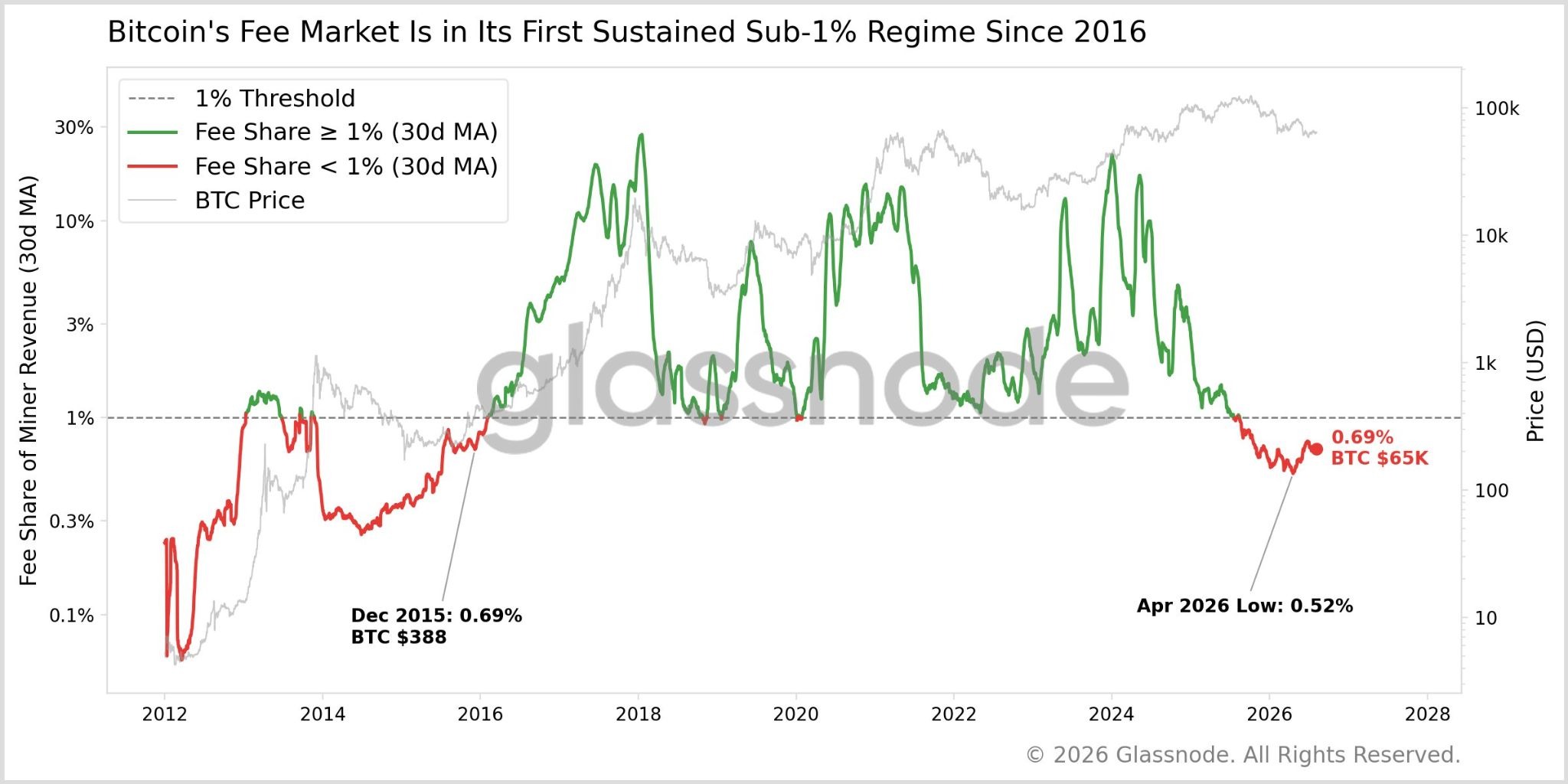
Bitcoin fees as a portion of miner revenue. Source: Rafael Schultze-Kraft on X.com

When transaction fee revenue drops, miners increasingly depend on the fixed block subsidy for income — the amount of newly minted BTC awarded for each mined block, currently 3.125 BTC. Bitcoin’s value has fallen nearly 50% since its October 2025 all-time high, dragging down the US dollar value of the block subsidy and further squeezing miners’ profit margins.

The latest data from onchain analytics resource Checkonchain puts the estimated average cost of producing one Bitcoin at $78,254 as of Tuesday — almost 23% above the current spot price.
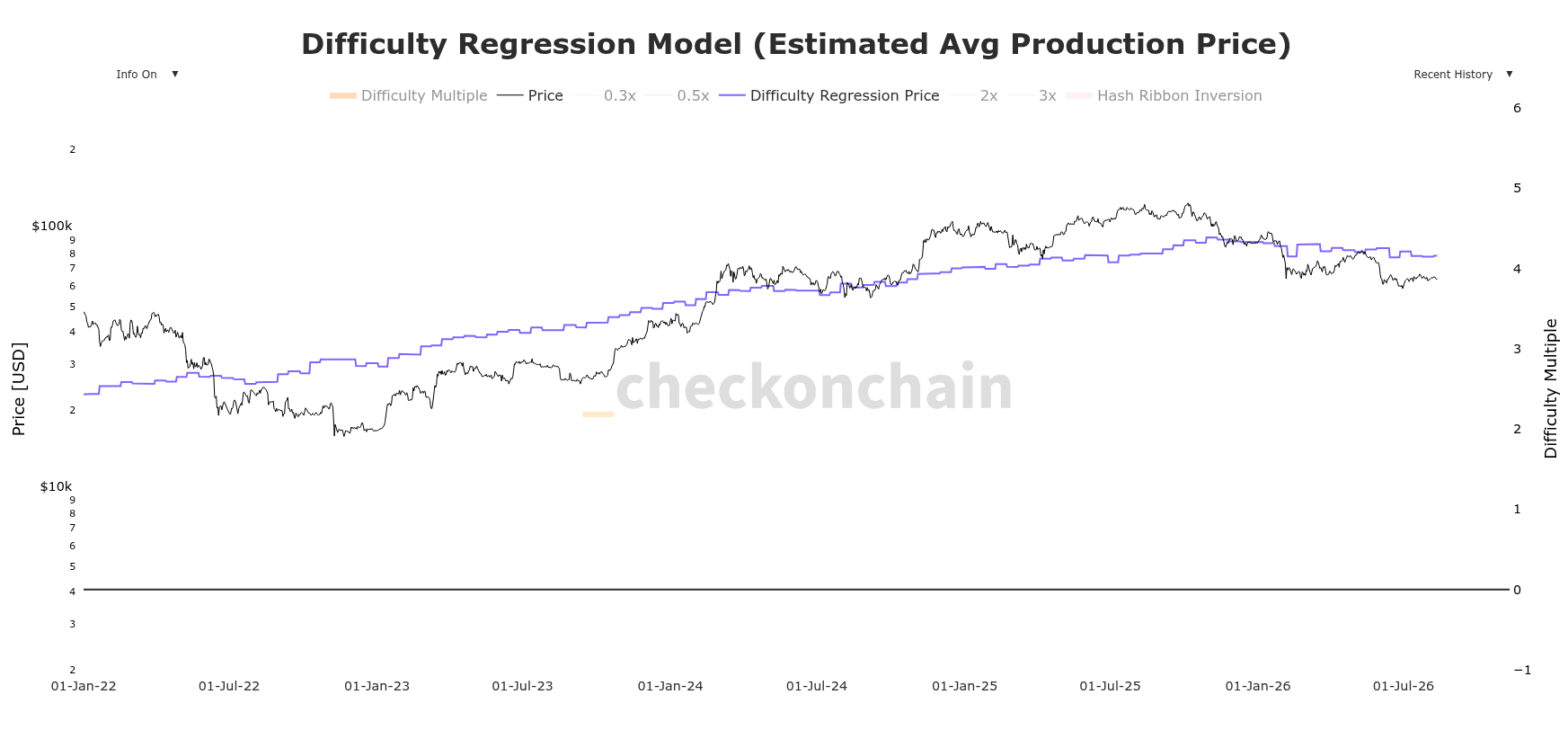
Bitcoin estimated average production cost. Source: Checkonchain
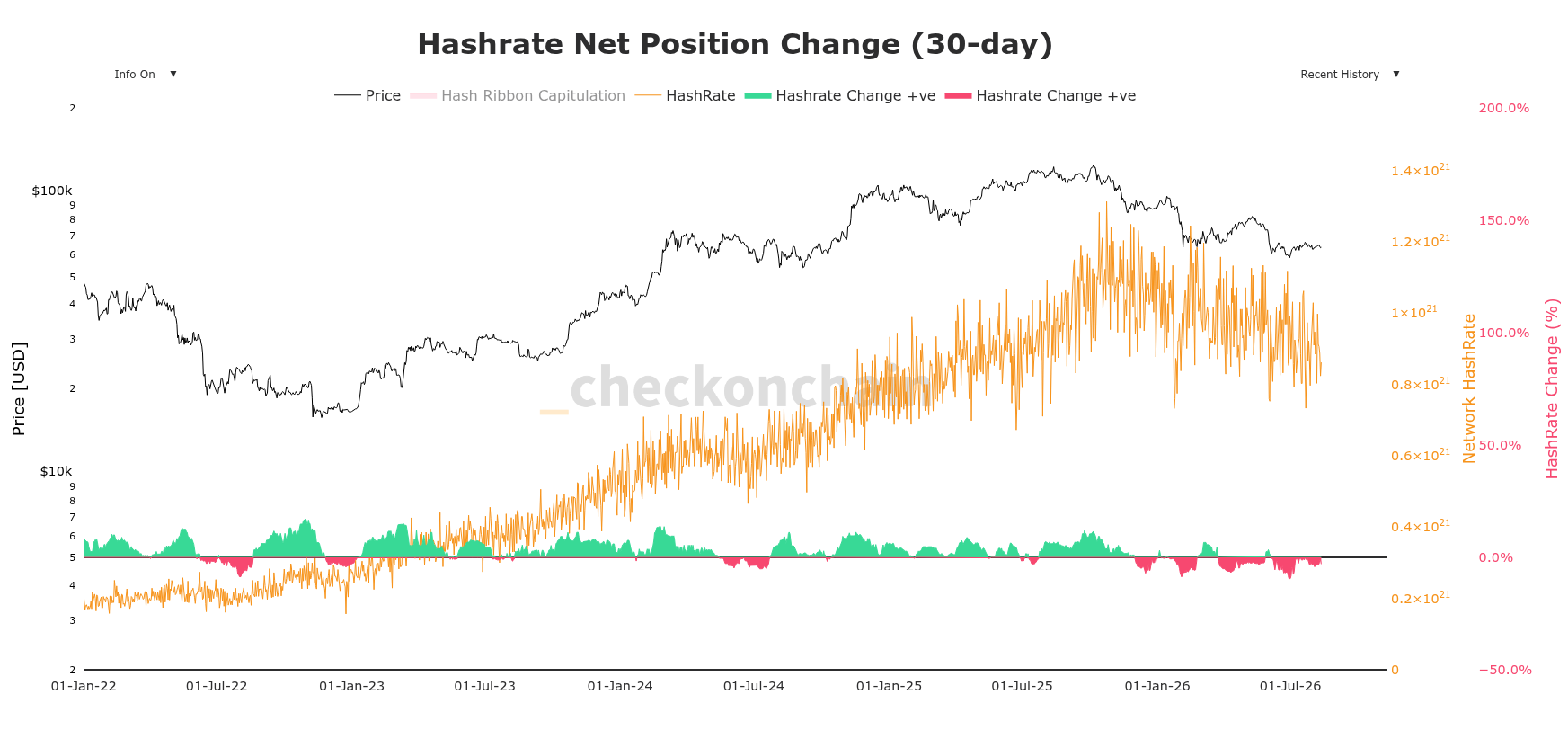

Bitcoin’s network hash rate, an estimated measure of the computing power securing the network, reflects a mining sector in flux. Hash rate has declined from its October 2025 peak of 1.3 zettahashes per second (ZH/s) to 861 exahashes per second (EH/s), Checkonchain shows — a drop of 33%. 

Bitcoin hash rate net position change. Source: Checkonchain


Analyst: AI pivot is “concerning development”

In analysis published at the weekend, independent analyst William Clemente acknowledged the downturn, while noting that miners would have been incentivized to boost activity through automated difficulty readjustments. With difficulty itself now rising again, miners’ shift toward more lucrative AI computing has become conspicuous.

Related: Bitcoin sell pressure ‘closer to exhaustion’ after $4B USDT market-cap drop: CryptoQuant

“There is no other way to slice it, hash rate has been in a decline. This has taken place as miner margins got squeezed post 2022 from more competition are higher energy prices, but more importantly the pivot of many into AI/HPC, which so far have shown to be prudent business decisions for the public names that have done it,” he wrote.

As Cointelegraph reported, Bitcoin miner CleanSpark recently refocused on AI, switching to operating data centers after missing profit targets. Another miner, Keel Infrastructure, shut down all its US mining operations after revenue fell 50% in the second quarter.

“This dynamic has been reinforced as Bitcoin has underperformed AI related assets & the rate of change in demand for compute,” Clemente added.

Charles Edwards, founder of hedge fund and AI platform Capriole Investments, directly linked the drop in hash rate to public miners’ AI pivot.

“This is the least talked about, concerning Bitcoin development in 2026,” he argued on X, noting that the trend had accelerated since April.

Attribution

Originally reported by Cointelegraph

Get stories like this, daily.

Daily crypto + regulation intelligence, straight to your inbox. Free.

İlgili Haberler