

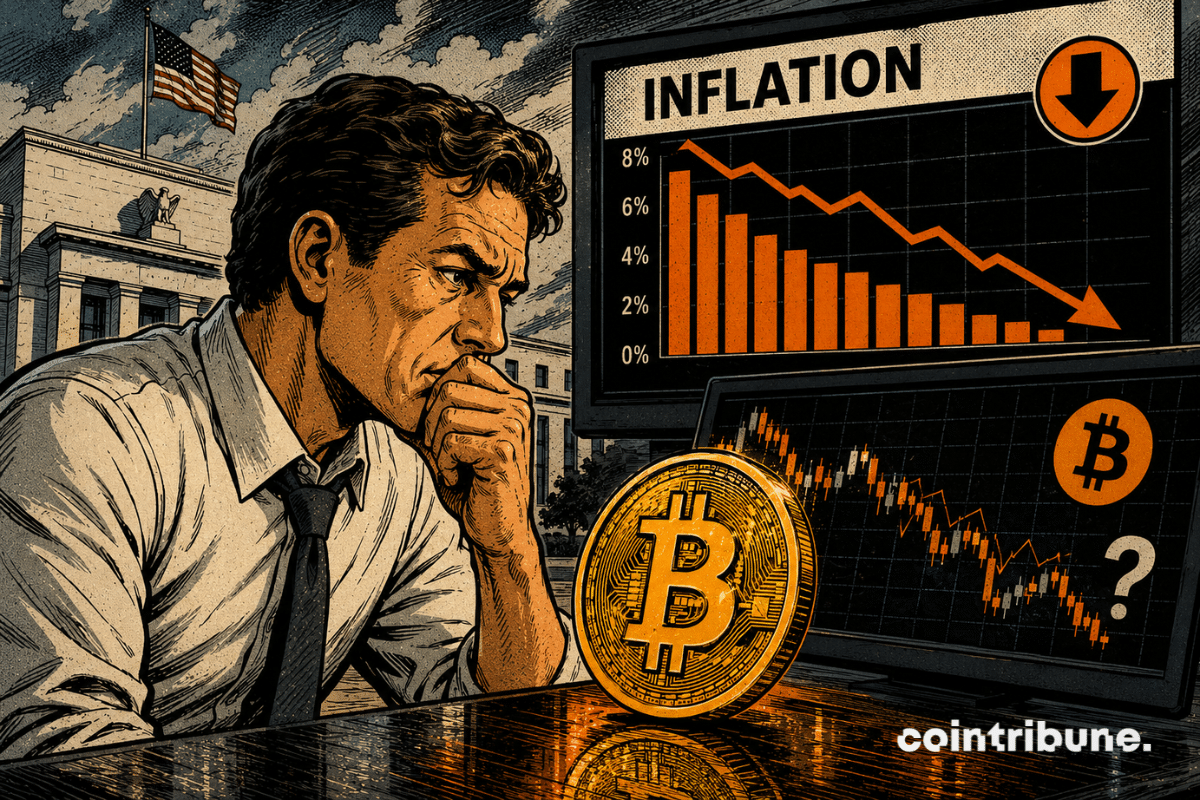
The release of US inflation data on August 12 did not provide markets with the much-expected positive signal. Indeed, there is a slowdown in price increases, not forgetting the Fed’s reservations on the economic trajectory. Bitcoin investors hesitate to adopt an aggressive accumulation policy. The crypto market thus remains dependent on upcoming economic data and, above all, on how the Federal Reserve chooses to interpret them.
In brief
- American inflation slows to 3.4% year-on-year, driven by Core CPI at 2.5% and a temporary drop in energy prices (-1.5%).
- Housing costs (+0.1%) alone generate nearly two-thirds of the monthly increase in the overall index.
- Despite the monthly respite, gasoline remains up 24.6% year-on-year, keeping Brent crude around $91.
- Without a clear catalyst, BTC stagnates within the narrow range of $63,800 to $64,300, ignoring the rise in stock markets.
American inflation slows
Thanks to official information published on August 12 by the Bureau of Labor Statistics, the Consumer Price Index (CPI) rose by 0.1% in July based on a seasonally adjusted basis. This progression strictly conforms to forecasts by US stock market analysts. The pace of annual inflation is thus brought down to 3.4% from 3.5% in June and a peak in May of 4.2%. It is appropriate to exclude volatile categories such as food and energy from the calculations of the core indicator. The latter records a monthly increase of 0.2% and 2.5% on the year.
Thus, this annual change of the underlying inflation component fits into the moderate measures observed since January 2021. Indeed, the housing component is the driving catalyst of the price rebound within this general dynamic. Two-thirds of the monthly increase in the overall index have been generated by housing-related costs. This increase is therefore driven by a 0.3% rise in rents and equivalent owner rents. There is also a slight 0.1% increase in food prices due to a 0.3% rise in dining out, while basic supermarket food products saw a 0.1% decrease.
The temporary relief offered by the energy sector in July explains this statistical respite. According to official data, the overall energy index fell by 1.5% month-over-month. This decrease is driven by a 2.9% drop in gasoline pump prices after seasonal adjustments. However, various expenditure items related to essential services have sustainably pushed the core indicator upward.
The combination of these incompatible factors automatically triggered a buying reaction on futures contracts related to US stock indices before market opening. Such a combination illustrates investors’ relief.
The correct breakdown of main variations observed by economic component allows measuring the exact structure of the July inflation report :
- Overall CPI : +0.1% month-on-month (+3.4% year-on-year, down from 3.5% in June) ;
- Core CPI excluding food and energy : +0.2% month-on-month (+2.5% year-on-year) ;
- Housing sector : +0.1% month-on-month, generating nearly two-thirds of the overall monthly increase ;
- Energy sector : -1.5% month-on-month, driven by a 2.9% drop in gasoline prices ;
- Services and transportation : +2.2% for airfare, +0.4% for medical care, and +0.4% for used vehicles.
Energy Risk and the Federal Reserve
An obvious threat continually hangs over the long-term economic trajectory, given the energy crisis earlier this year, despite the indisputable relief brought to monetary authorities by the monthly figures. The energy sector remains significantly up 14.7% over the rolling twelve-month period, although gasoline prices show a spectacular annual increase of 24.6%. These statistics bear the scars of the oil shock linked to geopolitical tensions observed in the Middle East as well as logistical disruptions seen in the first half of the year.
While Brent crude stabilizes around $91 and West Texas Intermediate trades near $83, the Fed finds itself in an uncomfortable position. Following the maintenance of its key rate in the 3.50% to 3.75% range in July, many internal divisions are evident at the US central bank. Such situations are confirmed by the dissenting vote of three governors. Indeed, these members advocate for monetary tightening. Officials have stressed that a succession of several consecutive months of decline would be necessary before asserting a durable decrease of inflation to 2%.