
OpenAI’s latest mathematics breakthrough could bring automated theorem proving closer to smart-contract security workflows.
OpenAI’s math breakthrough exposes the next weak link in crypto security
OpenAI’s latest mathematics breakthrough could bring automated theorem proving closer to smart-contract security workflows.
CryptoSlate
Publisher
Sep 10, 2026 at 10:30 PM UTC · Updated 2 天前 · 2 分钟阅读
Key Signal
10,000 concurrent AI agents
Entities
chainlink
Last Updated
2 天前
翻译中…
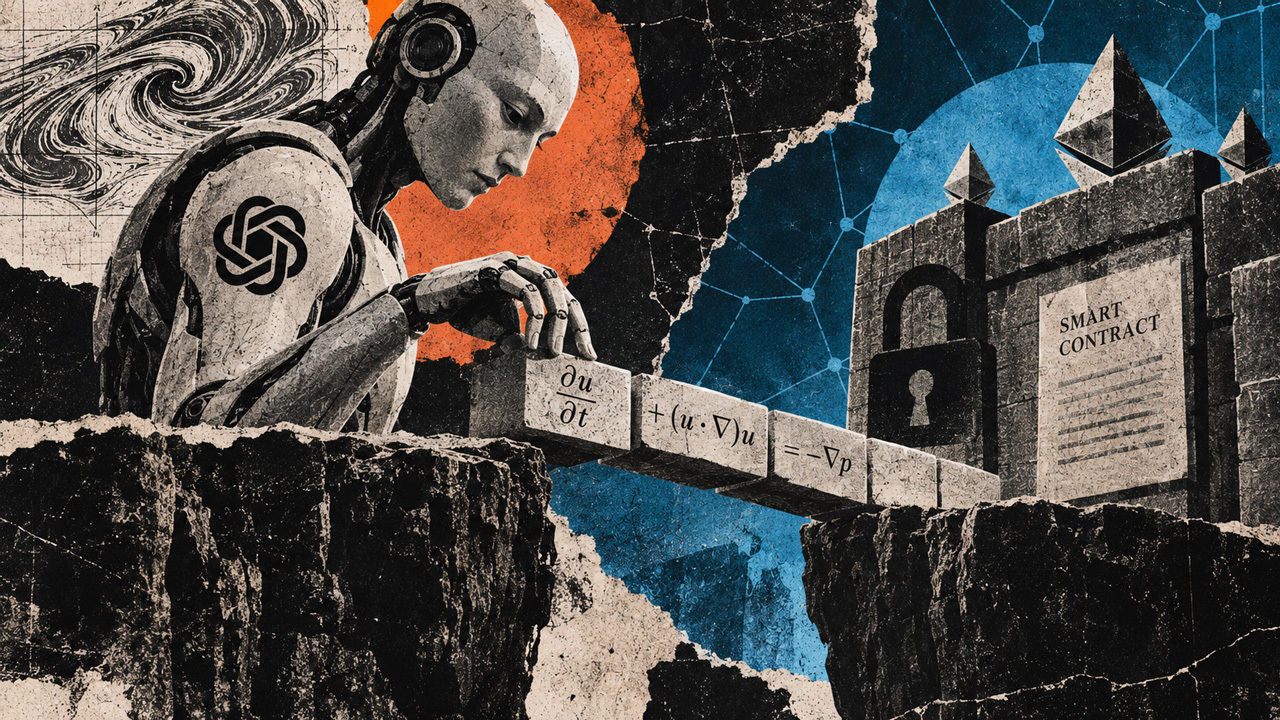
On Sept. 8, the AI company said that roughly 10,000 concurrent AI agents produced a solution addressing the Navier-Stokes fluid-motion problem after about 88 hours. Formalization and verification in Lean, a software proof assistant, required another 17 hours using GPT-6 Astra.
The system generated an analytical proof showing that an initially smooth fluid can develop a singularity in finite time while retaining finite energy, establishing cases C and D of the Millennium Prize formulation. OpenAI released both the proof and its Lean formalization for independent scrutiny.
For crypto developers, the more immediate implication lies in the process. Formal verification uses mathematical specifications and theorem proving to establish whether smart-contract code behaves as intended, an area where human guidance can make verification costly and labor-intensive.
AI could move the security bottleneck upstream
The scale of OpenAI’s experiment closely resembles a scenario mathematician Terence Tao described five days before the announcement.
Tao warned that autonomous AI systems backed by enormous computing resources could eventually generate complex Navier-Stokes solutions and formally verify them in systems such as Lean while keeping much of the iterative discovery process out of public view.
Article Intelligence
Key Entities
Sponsored
Ad
NewsLayerLearn more
NewsLayer Premium
Unlock deeper intelligence.
Ad-free reading, exclusive research, and real-time onchain insights.
Go Premium