This website uses cookies
We use cookies to personalise content and ads, to provide social media features and to analyse our traffic. We also share information about your use of our site with our social media, advertising and analytics partners who may combine it with other information that you’ve provided to them or that they’ve collected from your use of their services.
Consent Selection
Details
  • Necessary cookies help make a website usable by enabling basic functions like page navigation and access to secure areas of the website. The website cannot function properly without these cookies.
  • Preference cookies enable a website to remember information that changes the way the website behaves or looks, like your preferred language or the region that you are in.
    • We do not use cookies of this type.

  • Statistic cookies help website owners to understand how visitors interact with websites by collecting and reporting information anonymously.
    • We do not use cookies of this type.

  • Marketing cookies are used to track visitors across websites. The intention is to display ads that are relevant and engaging for the individual user and thereby more valuable for publishers and third party advertisers.
    • We do not use cookies of this type.

  • Unclassified cookies are cookies that we are in the process of classifying, together with the providers of individual cookies.
    • __emg_sidPending
      Maximum Storage Duration: 1 dayType: HTTP Cookie
      __emg_vidPending
      Maximum Storage Duration: 1 yearType: HTTP Cookie
      nl-read-countPending
      Maximum Storage Duration: PersistentType: HTML Local Storage
Cookie declaration last updated on 8/12/26 by Cookiebot
[#IABV2_TITLE#]
[#IABV2_BODY_INTRO#]
[#IABV2_BODY_LEGITIMATE_INTEREST_INTRO#]
[#IABV2_BODY_PREFERENCE_INTRO#]
[#IABV2_BODY_PURPOSES_INTRO#]
[#IABV2_BODY_PURPOSES#]
[#IABV2_BODY_FEATURES_INTRO#]
[#IABV2_BODY_FEATURES#]
[#IABV2_BODY_PARTNERS_INTRO#]
[#IABV2_BODY_PARTNERS#]
About
Cookies are small text files that can be used by websites to make a user's experience more efficient.

The law states that we can store cookies on your device if they are strictly necessary for the operation of this site. For all other types of cookies we need your permission.

This site uses different types of cookies. Some cookies are placed by third party services that appear on our pages.

You can at any time change or withdraw your consent from the Cookie Declaration on our website.

Learn more about who we are, how you can contact us and how we process personal data in our Privacy Policy.

Please state your consent ID and date when you contact us regarding your consent.
NewsLayer.com
NewsLayer PulseLIVEBTC$64,288+1.14%ETH$1,903+0.02%SOL$76.18+0.78%XRP$0.999-0.04%DOGE$0.0699-0.30%ADA$0.1733-0.80%Total Cap$2.30T+0.48%Layer Index45 Neutral
External Reporting发布于 2 天前

Public Miners Shed 21% of Bitcoin Hashrate as AI Revenue Accelerates

This article first appeared in Miner Weekly, a weekly newsletter by Blocks Bridge Consulting, curating the latest news in energy, bitcoin, and AI compute from The Energy Mag. Subscribe to receive it in your inbox once a week.

Public Miners Shed 21% of Bitcoin Hashrate as AI Revenue Accelerates
Publisher Bitcoin News 4 分钟阅读
Image via Bitcoin News
翻译中…

Market Context

Bitcoin

BTC

$64,288

+1.14% 24h

Layer Index

45

↑ 1 pts in 24h

The analysis found a notable redistribution beneath an apparently stable aggregate: Core Scientific (NASDAQ: CORZ), IREN, Cipher Digital (NASDAQ: CIFR), TeraWulf (NASDAQ: WULF) and Keel Infrastructure (NASDAQ: KEEL) were giving up bitcoin production, while Bitdeer (NASDAQ: BTDR), MARA (NASDAQ: MARA), Riot Platforms (NASDAQ: RIOT) and American Bitcoin (NASDAQ: ABTC) absorbed much of the displaced network share.

At the time, the system remained roughly balanced.

The second-quarter earnings suggest that balance is beginning to break.

The miners reducing bitcoin exposure continued to unplug machines, but fewer operators expanded enough to compensate. At the same time, colocation revenue rose sharply among the companies furthest along in their conversions.

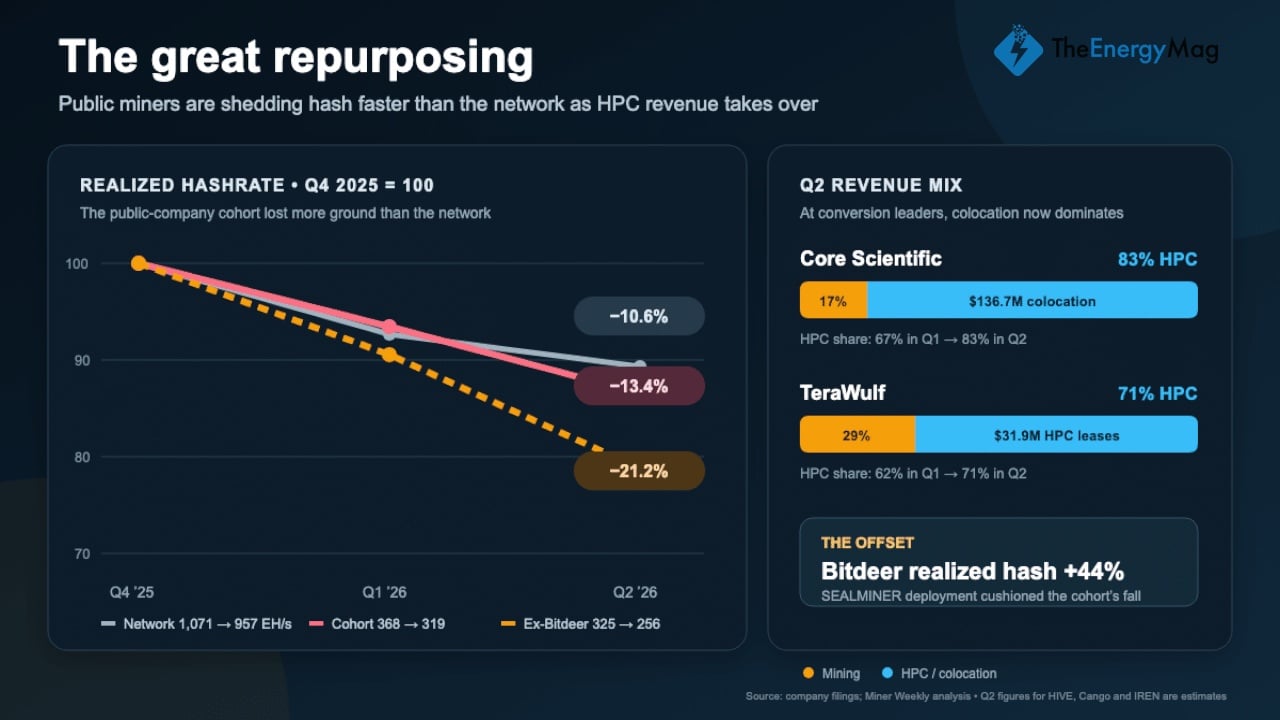
Core Scientific generated $136.7 million of colocation revenue in Q2, almost five times its $27.5 million of bitcoin mining revenue. Colocation supplied 83% of quarterly sales, up from 67% in Q1, according to the company’s second-quarter results.

TeraWulf followed the same trajectory. HPC lease revenue increased to $31.9 million, or 71% of total revenue, compared with $12.8 million from bitcoin mining. Its HPC share had already reached 62% in Q1 as contracted capacity at Lake Mariner began generating revenue.

For several miners, colocation is becoming a material contributor. At Core Scientific and TeraWulf, it has already overtaken mining.

The rest of the sector remains earlier in the conversion. Riot Platforms reported $23.2 million in data center revenue against $113.7 million from mining. Bitdeer generated $14 million from AI cloud services compared with $197.1 million from mining-related activities. Hut 8 (NASDAQ: HUT) and MARA reported smaller compute contributions, while Cipher and Keel Infrastructure had yet to recognize HPC revenue.

The offsets are no longer keeping up

Using an expanded cohort and updated network series, TheEnergyMag estimates that the public miners tracked for this analysis produced a combined realized hashrate of 368.3 EH/s in Q4 2025, 344.4 EH/s in Q1 2026 and 319.0 EH/s in Q2.

That represents a 13.4% decline in six months.

The Bitcoin network’s quarterly average fell from 1,071 EH/s to 993 EH/s and then to 957 EH/s over the same period, a 10.6% reduction. The public company cohort therefore contracted faster than the network.

In Q1, expansion by a handful of miners largely obscured the scale of the shutdowns elsewhere. By Q2, even those additions were no longer sufficient to keep the cohort stable.

Bitdeer remained the largest offset. Its realized hashrate increased 44% from Q4 to Q2, reaching 63.0 EH/s. Excluding Bitdeer, the rest of the cohort’s realized hashrate fell 21.2%, from 324.6 EH/s to 255.9 EH/s.

Bitdeer’s expansion comes from its own SEALMINER production pipeline. By June, the company reported 73 EH/s of self-mining capacity and 15.9 EH/s of co-mining capacity. It produced 990 bitcoin during the month, 388% more than a year earlier.

MARA and American Bitcoin also continued expanding, but their additions were not enough to counter reductions across Cango (NYSE: CANG), Cipher, Keel, Core Scientific, TeraWulf and IREN.

Cango provides the sharpest example of how quickly mining economics have changed.

The company entered bitcoin mining in late 2024 and reached 50 EH/s of deployed capacity during 2025, only to begin decommissioning inefficient machines, leasing out hashrate and moving capacity toward lower-cost regions.

Its realized hashrate fell from 44.8 EH/s in Q4 2025 to 31.3 EH/s in Q1. TheEnergyMag estimates its Q2 capacity would decline to 16.5 EH/s—a 63% reduction in six months.

Keel Infrastructure has taken the transition further. During Q2, it completed the decommissioning of all U.S. bitcoin mining operations in preparation for data center construction. Mining continues in Canada during the phased transition. Meanwhile, the replacement revenue has not yet arrived.

The post-China arms race unwinds

The longer-term context also looks more striking after Q2.

China’s 2021 mining ban briefly removed roughly half the Bitcoin network’s computing power. Hashrate bottomed at 57.5 EH/s in June 2021, but miners relocated and the network had almost fully recovered by December. The United States emerged as the largest mining hub.

That recovery helped trigger the institutional expansion race TheEnergyMag has tracked over the ensuing years. Public miners raised capital, acquired power sites and ordered successive generations of ASICs, eventually pushing the network beyond one zettahash per second.

Only one halving has occurred since that expansion began.

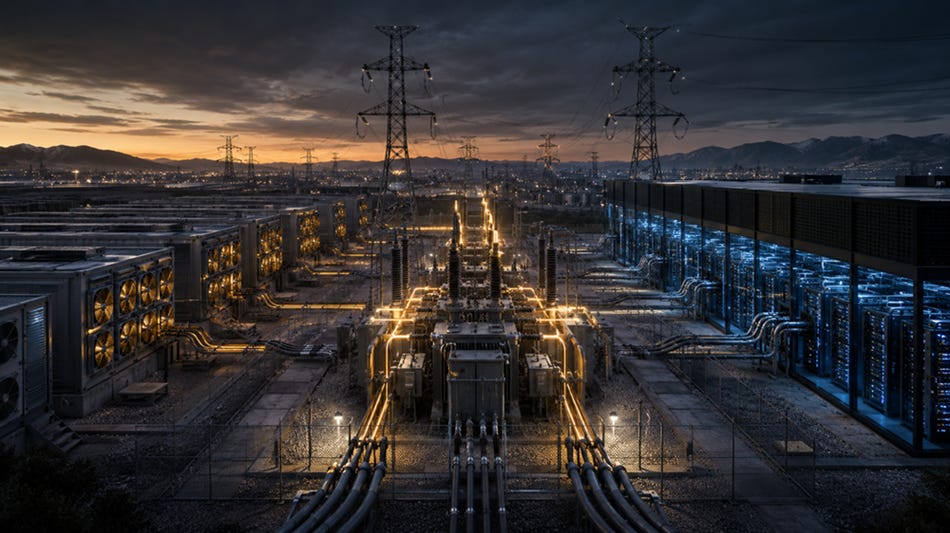
Now, machines and electrical infrastructure accumulated during the post-China race are being idled, impaired or depreciated faster so their power can be reassigned to GPUs. The industry collectively expanded at enormous cost, only for some of its most visible operators to begin dismantling that capacity after one halving cycle.

Unlike the China ban, the current contraction has no single headline trigger. It is a combination of weak mining economics and a competing use for capital and electricity.

Follow the Story

  1. Aug 16Public Miners Shed 21% of Bitcoin Hashrate as AI Revenue Accelerates
  2. Aug 18Peter Schiff Calls for Bitcoin Sell-Off at $65K as Fed Rate Hike Odds Fall
  3. Aug 18Cryptocurrencies Price Prediction: Bitcoin, PI & Chainlink – European Wrap 18 August
  4. Aug 18Fundstrat Warns Bitcoin Could Swing 30% in Either Direction as Volatility Hits Record Lows

突发新闻

Never miss a breaking story

Advertisement

House — Advertise on NewsLayer
NewsLayerAd

Sourced by

Originally reported by Bitcoin News

NewsLayer coverage based on externally reported material.

The Daily Brief

The onchain economy, before your day starts.

Curated markets, onchain insights, and key headlines — delivered every weekday morning.

Weekdays · Free · ~5 minute read

相关报道