
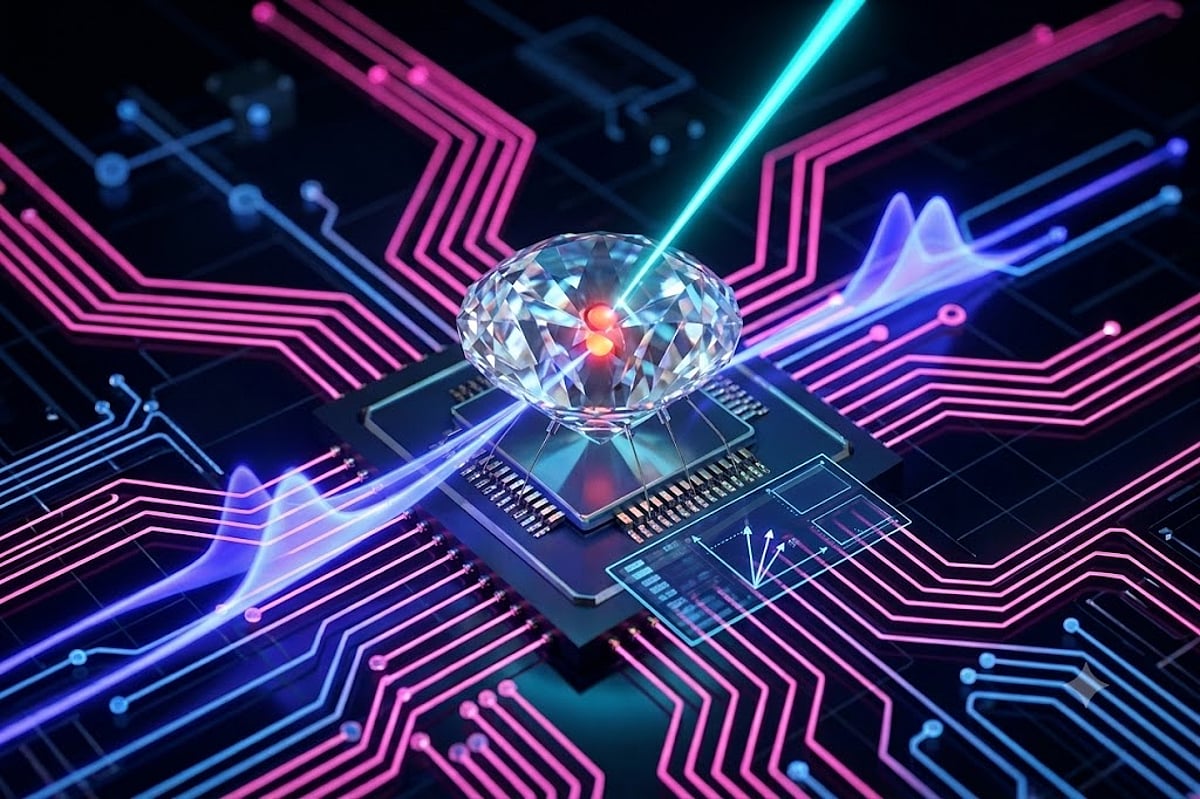
Diamonds are supposed to be flawless. But when it comes to quantum computing, a little imperfection can actually be a good thing. As Galileo once said, “the universe is a grand book open before us”. And sometimes, there is more to a beautiful crystal than meets the eye — a tiny defect can be turned into a tool for processing quantum information.
A flaw with a quantum twist
Diamonds are supposed to be flawless. But when it comes to quantum computing, a little imperfection can actually be a good thing. As Galileo once said, “the universe is a grand book open before us”. And sometimes, there is more to a…
The New Indian Express
Publisher
Sep 16, 2026 at 12:23 PM UTC · Updated il y a un jour · 3 min de lecture
Traduction…
Quantum computing uses qubits, unlike conventional computers, which use bits that are either on or off. Qubits can exist in superpositions, allowing quantum systems to process information in ways classical computers cannot.
Several physical systems are being studied for building qubits, including superconducting circuits, trapped ions, semiconductor devices and defects in diamond. One particularly interesting approach uses nitrogen-vacancy (NV) centres.
Diamond is made entirely of carbon atoms, each bonded to four neighbours in a tetrahedral structure. An NV centre is a tiny defect created when one carbon atom is replaced by nitrogen and an adjacent position is left empty. This vacancy, together with the nitrogen atom, forms the nitrogen-vacancy centre. The negatively charged NV-minus form is particularly useful for quantum technologies.
Its most important feature is its electron spin, a fundamental quantum property that can store information. Although an NV centre has several possible spin states, two can be selected to represent the two states of a qubit. Thus, the spin of a single defect in diamond can act as a quantum bit.
Article Intelligence
Topics
Related Coverage
 QuantumPost-quantum regulations converge on 2030 but split on scopeil y a une heure · 3 min read
 QuantumLGT advances post-quantum migration with banking pilotil y a 2 heures · 4 min read
 QuantumReal-time quantum jump in sound observed for first timeil y a une heure · 1 min read
Sponsored
Ad
NewsLayerLearn more
NewsLayer Premium
Unlock deeper intelligence.
Ad-free reading, exclusive research, and real-time onchain insights.
Go Premium