

Bitcoin got the inflation report it wanted — and barely flinched. July CPI landed at 2.5% core on August 12, equities sat near record highs, and BTC moved a grand total of $210. Here’s why the real problem isn’t the macro data — it’s a leverage trap hiding underneath a market that’s gone quiet.
Bitcoin's Leverage Trap: Why CPI Can't Move a Ghost Market
Bitcoin got the inflation report it wanted — and barely flinched. July CPI landed at 2.5% core on August 12, equities sat near record highs, and BTC moved a grand total of $210. Here’s why the real problem isn’t the macro data — it’s a…
Memeburn
Publisher
Aug 18, 2026 at 2:26 PM UTC · 5 分で読める

Key Signal
$131M Spot ETF daily outflows
Entities
bitcoin
Market Impact
BTC+2.10%$86,577
Last Updated
2ヶ月前
翻訳中…
The CPI That Should’ve Mattered
Through 2024 and early 2025, CPI day was Bitcoin’s Super Bowl. A 3.1% print in December 2024 moved BTC 7%. A downside surprise in March 2025 triggered an 11% rally. August 2026? Just 0.33% — the smallest CPI-day move since spot ETFs launched, and the third straight month where inflation data produced less than 1% movement. Deribit options premiums around CPI collapsed from 25% above baseline to under 5%. The market stopped expecting to react.

The more dangerous question nobody’s asking: what happens when a massively leveraged market loses its biggest catalyst?
Real Buyers Have Left
Glassnode analyst Frederik Theissen put it bluntly: demand is absent. Spot trading volume hit its lowest reading since 2019. The Seller Exhaustion Constant sits at a cycle low — one of the weakest since 2013 — meaning sellers are running dry. But buyers aren’t stepping in.
The SOPR indicator (Spent Output Profit Ratio) has tested breakeven nine times since October and failed every time. Each time BTC nears cost basis, holders sell — and nobody’s on the other side.
Market Context
Bitcoin
BTC
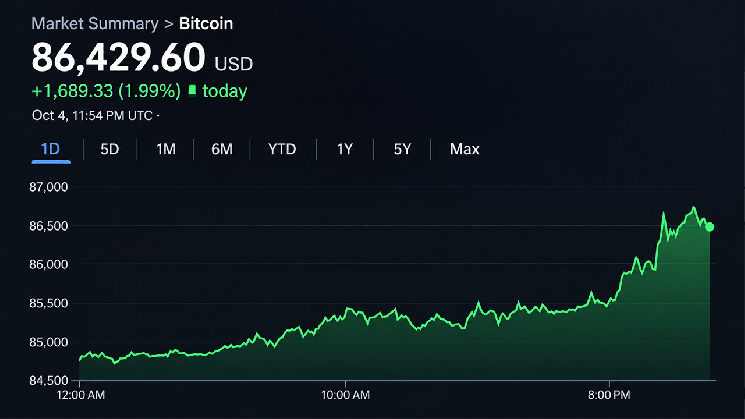
$86,490
+1.99% (24H)
Market Cap
$1.74T
24H Volume
$14.8B
24H High
$86,778
Article Intelligence
Key Entities
Related Coverage
 CryptoBitcoin Rises Toward $87,000 Amid Middle East Tensions and U.S. Stock Futures Surge1時間前 · 1 min read
 CryptoBitcoin Price Knocks on $87K as Uptober Bulls Smell $94K17分前 · 2 min read
 CryptoBitcoin and Ether hold steady as crypto market recovers from $50B dip; Zcash plunges 17%.2時間前 · 1 min read
Sponsored
Ad
NewsLayerLearn more
NewsLayer Premium
Unlock deeper intelligence.
Ad-free reading, exclusive research, and real-time onchain insights.
Go Premium